The pressure to be chosen on Valentine’s Day

Every year, Valentine’s Day functions not merely as a celebration of intimacy but as a cultural referendum on one’s relational worth. For those partnered, it becomes a public performance of adequacy. For those single, in ambiguous “situationships,” or navigating unstable romantic terrain, it can intensify feelings of lack, delay, and comparison.
These feelings are not accidental. They emerge from the intersection of capitalism, consumer culture, patriarchy, and platform design. Contemporary romantic life is shaped by systems that transform love into performance, comparison, and consumption. For example, swipe-based dating platforms operate within what scholars call an “attention economy,” where desire is engineered, uncertainty is monetised, and romantic anxiety becomes profitable.
These dynamics are visible not only on global platforms but also within every major user of dating apps in Bangalore, where young professionals navigate intimacy alongside demanding careers and urban mobility. The rapid growth of Bangalore dating sites reflects how deeply digital infrastructures now shape romantic expectations in the city.
Capitalism and the erosion of love:
Bell Hooks reminds us that lovelessness is not simply a personal failure. It is cultural. In All About Love, she argues that a society organised around domination, competition, and accumulation cannot easily nurture love because love requires care, responsibility, trust, and justice [1]. Love asks us to give. Capitalism asks us to compete.
Consumer culture depends on dissatisfaction. It survives by persuading us that something is missing, that we are incomplete, that fulfillment is always just one purchase away. Consumer culture keeps individuals in a state of “insatiable longing” [1]. This constant stimulation of desire is not limited to material goods. It extends into emotional life. Longing itself becomes normalised.
Marx described how capitalism transforms relationships into relationships between things [2]. Under late capitalism, emotional meaning is often attached to commodities. A ring stands in for devotion. A dinner reservation stands in for thoughtfulness. A public gesture stands in for commitment. The object begins to carry the weight of the feeling.
Eva Illouz expands this idea by showing how capitalism reshapes romance from within [3]. Emotional life becomes rationalised. People speak about relationships in terms of investment, return, risk, and value. Romantic choice begins to resemble market choice. Instead of asking, “Do we care for one another?” we may unconsciously ask, “Is this the best option available?”
This market logic is not abstract. It quietly structures how profiles are evaluated on a dating app in Bangalore , where individuals are filtered, compared, and ranked within seconds. Even across broader dating sites in Bangalore, romantic possibility is often framed through metrics of desirability and perceived value.
Valentine’s Day concentrates this logic into a single cultural moment. Affection becomes visible and measurable. Gifts, photos, and captions function as evidence. Those who are not visibly participating may feel as though they are failing, even if their private emotional lives are meaningful. Love becomes something that must be demonstrated publicly to count.
Research supports the psychological consequences of this shift. Individuals prioritising status and consumption report lower relationship satisfaction and higher anxiety [4]. When worth becomes externally validated, emotional security weakens. The more we depend on visible confirmation, the less stable we feel without it.Quiet care can feel less meaningful than spectacle.
Hooks insists that love cannot flourish where greed dominates [1]. Love requires presence and mutual recognition. It requires a willingness to prioritise another person’s growth alongside one’s own. A culture that rewards endless wanting makes this difficult. When desire must remain slightly unsatisfied for the system to function, contentment becomes almost subversive.
To reclaim love in this environment means resisting the idea that more is always better. It means choosing depth over display. It means understanding that intimacy is built through consistent care rather than grand gestures. Love, in Hooks’ vision, is not a product to be acquired or displayed. It is a practice to be learned.
The myth of “The One” and the pressure of romantic timing :
Alongside capitalism’s reshaping of desire, another powerful narrative quietly structures modern romantic life: the myth of “the one.” We are taught, through films, novels, wedding speeches, and even algorithms, that somewhere there exists a singular person uniquely designed for us. When we meet them, things will align. Doubt will disappear. Timing will feel perfect.
This belief feels comforting because it promises certainty in an uncertain world. Yet research suggests that believing in destiny-based love can make relationships more fragile. Ppeople who strongly endorse “destiny beliefs” are more likely to interpret conflict as evidence of incompatibility [5]. If love is meant to be effortless, then effort signals wrongness. In contrast, those who hold “growth beliefs,” the idea that love develops through work and mutual adjustment, tend to show greater resilience during conflict [5].
The myth of ‘the one’ also interacts with social timelines. Sociologists have shown that modern life course expectations still carry invisible benchmarks. There are assumed ages for partnership, marriage, and parenthood. When individuals diverge from these expectations, they often experience identity strain, even when structural factors such as education, career instability, or economic precarity explain the delay [6].
What makes Valentine’s Day particularly intense is that it compresses comparison into a single moment. Social comparison theory tells us that people evaluate themselves relative to others, especially when standards are ambiguous [7]. Romantic progress is one of the most socially visible forms of “progress” we track. Engagement posts, anniversary tributes, coordinated photographs, and declarations of ‘forever love’ function as public milestones.
Yet the average age of first marriage has steadily increased over the past several decades in many countries [8]. Economic restructuring, longer educational pathways, and changing gender norms have reshaped when and how partnerships form. These are structural shifts. However, individuals often internalise delay as personal inadequacy.When destiny narratives collide with economic and social realities, ordinary variations in life trajectories can feel like private failures.
The political economy of ambiguity:
If the myth of “the one” promises certainty, modern romantic life often delivers the opposite: ambiguity. Ambiguity is not simply confusion. It is a condition where closeness exists without clarity. People speak regularly, share intimacy, spend nights together, perhaps even meet friends, yet no shared definition is established. The relationship exists, but it is unnamed. It feels real, but it remains provisional.
For many users of a dating app in Bangalore, ambiguity is not unusual but expected. The absence of clear relational definitions mirrors the flexibility embedded into digital platform design, where optionality is preserved and closure is rarely present.
At first glance, ambiguity appears personal. It feels like miscommunication or mismatched expectations. Yet sociological research suggests that relational instability is strongly shaped by broader economic structures. Rising income inequality and economic precarity are associated with delayed marriage and declining long-term commitment among lower-income groups [9]. When financial futures feel unstable, long-term relational planning becomes more fragile.
Cherlin describes this as the “deinstitutionalisation of marriage,” a shift in which commitment norms weaken as social and economic structures change [10]. Marriage and partnership become less obligatory and more optional. While this shift has increased autonomy, it has also increased uncertainty. When there are fewer shared scripts, individuals must negotiate everything themselves.
Job instability reduces confidence in long-term planning and increases cohabitation without clear commitment trajectories [11]. When work feels unstable, relationships often mirror that instability. Emotional security becomes harder to promise when material security feels uncertain.
On a psychological level, ambiguity is not neutral. Knobloch and Solomon’s work on relational uncertainty demonstrates that unclear commitment status predicts heightened anxiety and relational distress [12]. Not knowing where one stands requires constant monitoring. Small changes in tone, response time, or behavior take on amplified meaning.
For individuals with anxious attachment tendencies, ambiguity can intensify rumination and hypervigilance [13]. The mind tries to solve what the relationship is, because the nervous system interprets uncertainty as threats. This does not mean anxious individuals are “too much.” It means the environment itself is ambiguous, and some nervous systems are more sensitive to ambiguity than others.
Ambiguity also interacts with what psychologists call maximisation. Maximisers are individuals who strive to make the optimal choice rather than a satisfactory one. Maximisation tendencies are associated with lower relationship satisfaction and greater regret [14]. In relational environments framed by abundance and possibility, people may hesitate to define relationships because doing so feels like closing other options.
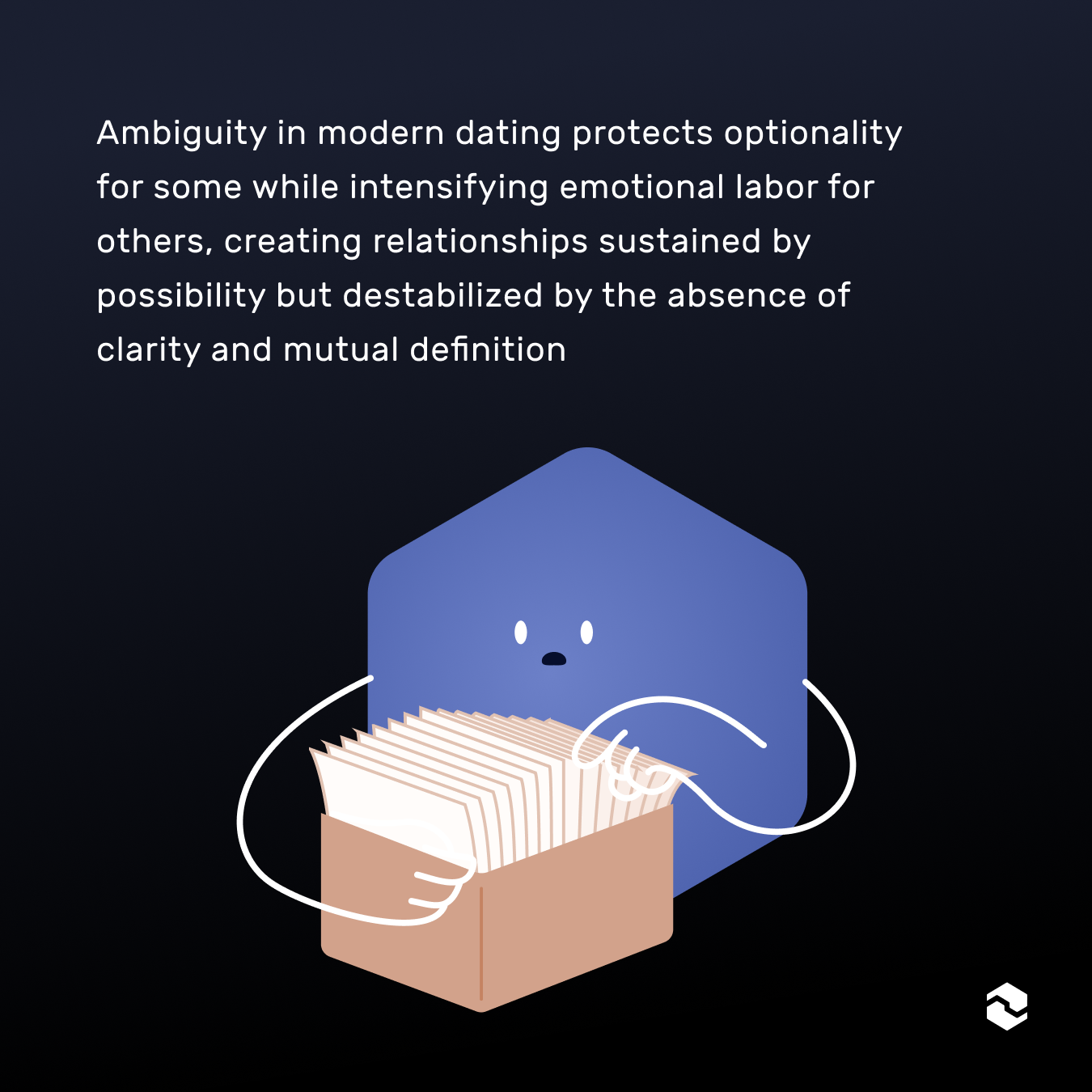
For one person, ambiguity protects optionality. For another, it intensifies emotional labor. One experiences flexibility. The other experiences instability. Ambiguity can therefore function as a rational adaptation to uncertainty. It allows intimacy without full commitment, closeness without obligation, affection without long-term guarantees. In economically and socially fluid environments, this flexibility can feel practical.
Yet emotionally, ambiguity is expensive. It requires continuous interpretation. It produces cycles of hope and doubt. It often prevents the calm security that attachment research associates with psychological well-being. Ambiguity, in this sense, is not simply a romantic trend. It is structurally reinforced and psychologically amplified.
Loneliness in the age of visibility:

We often assume loneliness comes from being alone. But loneliness is not about physical isolation. It is about perceived relational insufficiency, the painful gap between the intimacy one desires and the intimacy one experiences [15].
In a city defined by migration and professional mobility, a dating app in Bangalore often becomes a substitute for community, offering interaction without necessarily alleviating urban isolation.
In modern romantic culture, this gap can widen even in the presence of constant communication. Messages are exchanged. Photos are liked. Stories are watched. Yet depth does not necessarily follow visibility. Cacioppo’s work on loneliness demonstrates that the human brain processes social rejection in ways similar to physical pain [15]. When connection feels uncertain or partial, the nervous system does not interpret it as neutral. It interprets it as a threat. Chronic relational ambiguity or partial reciprocity can therefore produce real psychological strain.
Sherry Turkle argues that contemporary digital life often offers connection without intimacy [16]. We are visible to each other more than ever, but not necessarily known. Romantic life becomes something observed rather than lived. Valentine’s Day intensifies this dynamic. For those who feel uncertain, undefined, or unchosen, the spectacle can sharpen private doubt.
Social comparison theory indicates why this visibility is destabilising [7]. When people are exposed to curated representations of others’ relationships, they evaluate their own relational status against these images. It has been shown that high passive social media consumption predicts lower self-esteem and increased depressive symptoms [17].
The effect is subtle but cumulative. Seeing romantic milestones presented as effortless can make ordinary relational complexity feel like failure. Engagement announcements and anniversary tributes rarely show the negotiation, insecurity, or growth beneath them.
Romantic anxiety as an economic resource:
Anxiety is often framed as an individual problem. But in modern romantic systems, anxiety is not merely a side effect. It can be structurally sustained. Attention-based digital economies rely on engagement. Platforms profit when users remain active, hopeful, and searching. Resolution is stabilising. Stability reduces engagement. Uncertainty, however, keeps people checking, wondering, and returning.
Behavioral psychology demonstrates that variable reward schedules, in which rewards are unpredictable, produce higher rates of repeated behavior than consistent reinforcement [18]. When validation, responses, or reciprocation arrive inconsistently, anticipation intensifies. The brain’s dopaminergic reward systems are particularly responsive to uncertainty [19]. It is often the possibility of reward, rather than the reward itself, that generates the strongest activation.
In romantic contexts, anticipation becomes powerful. Waiting for a message. Interpreting delayed replies. Wondering about exclusivity. These states sustain emotional investment even in the absence of clarity. Research on maximisation shows that individuals who constantly seek the best possible choice experience greater regret and lower satisfaction [14]. In environments framed around abundance and comparison, commitment can feel risky. Defining a relationship may feel like foreclosing better possibilities.
Meanwhile, internalised neoliberal ideology encourages individuals to interpret romantic outcomes as personal responsibility [20]. If connection fails, one must improve. Become more attractive. More accomplished. More emotionally regulated. Structural instability becomes individualised self-critique.
The result is a quiet cycle. Hope persists. Anxiety rises. Self-evaluation intensifies. Engagement continues.This does not mean romantic technology is designed maliciously. It means that economic incentives and psychological mechanisms align in ways that privilege prolonged searching over secure attachment.
Bell Hooks reminds us that love requires commitment and responsibility [1]. Commitment calms the nervous system. Responsibility reduces ambiguity. But in systems organised around engagement metrics and endless possibility, calm attachment can feel countercultural.
Romantic anxiety, then, is not simply weakness. It is a predictable outcome of environments structured around uncertainty. The question is not whether modern systems have destroyed love. It is whether they have quietly reshaped how we experience it.
Romantic anxiety today is rarely just personal. It is structural. We are encouraged to curate, compare, optimise, and upgrade, often in the very spaces where vulnerability and patience are required. Valentine’s Day becomes a mirror in this landscape. It reflects not only who we are with, but how we measure ourselves. It amplifies absence, comparison, and the fear of falling behind. Yet it also exposes something important: beneath the noise of algorithms and markets, the human need for stable attachment, emotional safety, and mutual recognition remains unchanged.
Love has always required effort. What is different now is the environment in which that effort unfolds. If swipe culture accelerates desire but fragments attention, and consumer culture equates romance with display, then meaningful connection may require slowing down, choosing depth over dopamine, clarity over ambiguity, presence over performance.For those navigating a dating app in Bangalore, the challenge is the cultivation of clarity in an environment structured around perpetual possibility.
References:
[1] Hooks b. All about love: New visions. New York: William Morrow; 2000.
[2] Marx K. Capital: A critique of political economy. Volume I. London: Penguin Classics; 1990 (original work published 1867).
[3] Illouz E. Consuming
the romantic utopia: Love and the cultural contradictions of capitalism. Berkeley: University of
California Press; 1997.
[4] Kasser T. The
high price of materialism. Cambridge (MA): MIT
Press; 2002.
[5] Knee CR. Implicit theories of relationships: Assessment and prediction of romantic relationship initiation, coping, and longevity. J Pers Soc Psychol. 1998;74(2):360–370.
[6] Shanahan MJ. Pathways
to adulthood in changing societies: Variability and mechanisms in life course
perspective. Annu Rev Sociol. 2000;26:667–692.
[7] Festinger L. A theory of social comparison processes. Hum Relat. 1954;7(2):117–140.
[8] Pew Research Center. The decline of marriage and rise of new families. Washington (DC): Pew Research Center; 2020.
[9] Mills M, Blossfeld HP. Globalization, uncertainty and changes in early life courses. Zeitschrift für Erziehungswissenschaft. 2005;8(2):188–218.
[10] Cherlin AJ. The deinstitutionalization of American marriage. J Marriage Fam. 2004;66(4):848–861.
[11] Schneider D, Harknett K. Consequences of routine work-schedule instability for worker health and well-being. Am Sociol Rev. 2019;84(1):82–114.
[12] Knobloch LK, Solomon DH. Measuring relational uncertainty: A model of its causes and consequences. Commun Res. 1999;26(2):148–181.
[13] Mikulincer M, Shaver PR. Attachment theory and affect regulation: The dynamics, development, and cognitive consequences of attachment-related strategies. J Pers Soc Psychol. 2007;92(5):895–914.
[14] Schwartz B, Ward A, Monterosso J, Lyubomirsky S, White K, Lehman DR. Maximizing versus satisficing: Happiness is a matter of choice. J Pers Soc Psychol. 2002;83(5):1178–1197.\
[15] Cacioppo JT, Patrick W. Loneliness: Human nature and the need for social connection. New York: W.W. Norton; 2008.
[16] Turkle S. Alone together: Why we expect more from technology and less from each other. New York: Basic Books; 2011.
[17] Verduyn P, Lee DS, Park J, Shablack H, Orvell A, Bayer J, et al. Passive Facebook usage undermines affective well-being: Experimental and longitudinal evidence. J Exp Psychol Gen. 2015;144(2):480–488.
[18] Ferster CB, Skinner BF. Schedules of reinforcement. New York: Appleton-Century-Crofts; 1957.
[19] Schultz W. Dopamine reward prediction error coding. Curr Opin Neurobiol. 2016;23(2):229–238.
[20] Adams G, Estrada-Villalta S, Sullivan D, Markus HR. The
psychology of neoliberalism and the neoliberalism of psychology. J Soc
Issues. 2019;75(1):189–216.
About the author:
Sharvani is a bioinformatics graduate and neuroscience enthusiast passionate about understanding behavior, emotion, and connection. She enjoys exploring how science and technology influence modern relationships. In her free time, she loves watching films and reading. Connect with her on LinkedIn
The pressure to be chosen on Valentine’s Day
Every year, Valentine’s Day functions not merely as a celebration of intimacy but as a cultural referendum on one’s relational worth. For those partnered, it becomes a public performance of adequacy. For those single, in ambiguous “situationships,” or navigating unstable romantic terrain, it can intensify feelings of lack, delay, and comparison.
These feelings are not accidental. They emerge from the intersection of capitalism, consumer culture, patriarchy, and platform design. Contemporary romantic life is shaped by systems that transform love into performance, comparison, and consumption. For example, swipe-based dating platforms operate within what scholars call an “attention economy,” where desire is engineered, uncertainty is monetised, and romantic anxiety becomes profitable.
These dynamics are visible not only on global platforms but also within every major user of dating apps in Bangalore, where young professionals navigate intimacy alongside demanding careers and urban mobility. The rapid growth of Bangalore dating sites reflects how deeply digital infrastructures now shape romantic expectations in the city.
Capitalism and the erosion of love:
Bell Hooks reminds us that lovelessness is not simply a personal failure. It is cultural. In All About Love, she argues that a society organised around domination, competition, and accumulation cannot easily nurture love because love requires care, responsibility, trust, and justice [1]. Love asks us to give. Capitalism asks us to compete.
Consumer culture depends on dissatisfaction. It survives by persuading us that something is missing, that we are incomplete, that fulfillment is always just one purchase away. Consumer culture keeps individuals in a state of “insatiable longing” [1]. This constant stimulation of desire is not limited to material goods. It extends into emotional life. Longing itself becomes normalised.
Marx described how capitalism transforms relationships into relationships between things [2]. Under late capitalism, emotional meaning is often attached to commodities. A ring stands in for devotion. A dinner reservation stands in for thoughtfulness. A public gesture stands in for commitment. The object begins to carry the weight of the feeling.
Eva Illouz expands this idea by showing how capitalism reshapes romance from within [3]. Emotional life becomes rationalised. People speak about relationships in terms of investment, return, risk, and value. Romantic choice begins to resemble market choice. Instead of asking, “Do we care for one another?” we may unconsciously ask, “Is this the best option available?”
This market logic is not abstract. It quietly structures how profiles are evaluated on a dating app in Bangalore , where individuals are filtered, compared, and ranked within seconds. Even across broader dating sites in Bangalore, romantic possibility is often framed through metrics of desirability and perceived value.
Valentine’s Day concentrates this logic into a single cultural moment. Affection becomes visible and measurable. Gifts, photos, and captions function as evidence. Those who are not visibly participating may feel as though they are failing, even if their private emotional lives are meaningful. Love becomes something that must be demonstrated publicly to count.
Research supports the psychological consequences of this shift. Individuals prioritising status and consumption report lower relationship satisfaction and higher anxiety [4]. When worth becomes externally validated, emotional security weakens. The more we depend on visible confirmation, the less stable we feel without it.Quiet care can feel less meaningful than spectacle.
Hooks insists that love cannot flourish where greed dominates [1]. Love requires presence and mutual recognition. It requires a willingness to prioritise another person’s growth alongside one’s own. A culture that rewards endless wanting makes this difficult. When desire must remain slightly unsatisfied for the system to function, contentment becomes almost subversive.
To reclaim love in this environment means resisting the idea that more is always better. It means choosing depth over display. It means understanding that intimacy is built through consistent care rather than grand gestures. Love, in Hooks’ vision, is not a product to be acquired or displayed. It is a practice to be learned.
The myth of “The One” and the pressure of romantic timing :
Alongside capitalism’s reshaping of desire, another powerful narrative quietly structures modern romantic life: the myth of “the one.” We are taught, through films, novels, wedding speeches, and even algorithms, that somewhere there exists a singular person uniquely designed for us. When we meet them, things will align. Doubt will disappear. Timing will feel perfect.
This belief feels comforting because it promises certainty in an uncertain world. Yet research suggests that believing in destiny-based love can make relationships more fragile. Ppeople who strongly endorse “destiny beliefs” are more likely to interpret conflict as evidence of incompatibility [5]. If love is meant to be effortless, then effort signals wrongness. In contrast, those who hold “growth beliefs,” the idea that love develops through work and mutual adjustment, tend to show greater resilience during conflict [5].
The myth of ‘the one’ also interacts with social timelines. Sociologists have shown that modern life course expectations still carry invisible benchmarks. There are assumed ages for partnership, marriage, and parenthood. When individuals diverge from these expectations, they often experience identity strain, even when structural factors such as education, career instability, or economic precarity explain the delay [6].
What makes Valentine’s Day particularly intense is that it compresses comparison into a single moment. Social comparison theory tells us that people evaluate themselves relative to others, especially when standards are ambiguous [7]. Romantic progress is one of the most socially visible forms of “progress” we track. Engagement posts, anniversary tributes, coordinated photographs, and declarations of ‘forever love’ function as public milestones.
Yet the average age of first marriage has steadily increased over the past several decades in many countries [8]. Economic restructuring, longer educational pathways, and changing gender norms have reshaped when and how partnerships form. These are structural shifts. However, individuals often internalise delay as personal inadequacy.When destiny narratives collide with economic and social realities, ordinary variations in life trajectories can feel like private failures.
The political economy of ambiguity:
If the myth of “the one” promises certainty, modern romantic life often delivers the opposite: ambiguity. Ambiguity is not simply confusion. It is a condition where closeness exists without clarity. People speak regularly, share intimacy, spend nights together, perhaps even meet friends, yet no shared definition is established. The relationship exists, but it is unnamed. It feels real, but it remains provisional.
For many users of a dating app in Bangalore, ambiguity is not unusual but expected. The absence of clear relational definitions mirrors the flexibility embedded into digital platform design, where optionality is preserved and closure is rarely present.
At first glance, ambiguity appears personal. It feels like miscommunication or mismatched expectations. Yet sociological research suggests that relational instability is strongly shaped by broader economic structures. Rising income inequality and economic precarity are associated with delayed marriage and declining long-term commitment among lower-income groups [9]. When financial futures feel unstable, long-term relational planning becomes more fragile.
Cherlin describes this as the “deinstitutionalisation of marriage,” a shift in which commitment norms weaken as social and economic structures change [10]. Marriage and partnership become less obligatory and more optional. While this shift has increased autonomy, it has also increased uncertainty. When there are fewer shared scripts, individuals must negotiate everything themselves.
Job instability reduces confidence in long-term planning and increases cohabitation without clear commitment trajectories [11]. When work feels unstable, relationships often mirror that instability. Emotional security becomes harder to promise when material security feels uncertain.
On a psychological level, ambiguity is not neutral. Knobloch and Solomon’s work on relational uncertainty demonstrates that unclear commitment status predicts heightened anxiety and relational distress [12]. Not knowing where one stands requires constant monitoring. Small changes in tone, response time, or behavior take on amplified meaning.
For individuals with anxious attachment tendencies, ambiguity can intensify rumination and hypervigilance [13]. The mind tries to solve what the relationship is, because the nervous system interprets uncertainty as threats. This does not mean anxious individuals are “too much.” It means the environment itself is ambiguous, and some nervous systems are more sensitive to ambiguity than others.
Ambiguity also interacts with what psychologists call maximisation. Maximisers are individuals who strive to make the optimal choice rather than a satisfactory one. Maximisation tendencies are associated with lower relationship satisfaction and greater regret [14]. In relational environments framed by abundance and possibility, people may hesitate to define relationships because doing so feels like closing other options.
For one person, ambiguity protects optionality. For another, it intensifies emotional labor. One experiences flexibility. The other experiences instability. Ambiguity can therefore function as a rational adaptation to uncertainty. It allows intimacy without full commitment, closeness without obligation, affection without long-term guarantees. In economically and socially fluid environments, this flexibility can feel practical.
Yet emotionally, ambiguity is expensive. It requires continuous interpretation. It produces cycles of hope and doubt. It often prevents the calm security that attachment research associates with psychological well-being. Ambiguity, in this sense, is not simply a romantic trend. It is structurally reinforced and psychologically amplified.
Loneliness in the age of visibility:
We often assume loneliness comes from being alone. But loneliness is not about physical isolation. It is about perceived relational insufficiency, the painful gap between the intimacy one desires and the intimacy one experiences [15].
In a city defined by migration and professional mobility, a dating app in Bangalore often becomes a substitute for community, offering interaction without necessarily alleviating urban isolation.
In modern romantic culture, this gap can widen even in the presence of constant communication. Messages are exchanged. Photos are liked. Stories are watched. Yet depth does not necessarily follow visibility. Cacioppo’s work on loneliness demonstrates that the human brain processes social rejection in ways similar to physical pain [15]. When connection feels uncertain or partial, the nervous system does not interpret it as neutral. It interprets it as a threat. Chronic relational ambiguity or partial reciprocity can therefore produce real psychological strain.
Sherry Turkle argues that contemporary digital life often offers connection without intimacy [16]. We are visible to each other more than ever, but not necessarily known. Romantic life becomes something observed rather than lived. Valentine’s Day intensifies this dynamic. For those who feel uncertain, undefined, or unchosen, the spectacle can sharpen private doubt.
Social comparison theory indicates why this visibility is destabilising [7]. When people are exposed to curated representations of others’ relationships, they evaluate their own relational status against these images. It has been shown that high passive social media consumption predicts lower self-esteem and increased depressive symptoms [17].
The effect is subtle but cumulative. Seeing romantic milestones presented as effortless can make ordinary relational complexity feel like failure. Engagement announcements and anniversary tributes rarely show the negotiation, insecurity, or growth beneath them.
Romantic anxiety as an economic resource:
Anxiety is often framed as an individual problem. But in modern romantic systems, anxiety is not merely a side effect. It can be structurally sustained. Attention-based digital economies rely on engagement. Platforms profit when users remain active, hopeful, and searching. Resolution is stabilising. Stability reduces engagement. Uncertainty, however, keeps people checking, wondering, and returning.
Behavioral psychology demonstrates that variable reward schedules, in which rewards are unpredictable, produce higher rates of repeated behavior than consistent reinforcement [18]. When validation, responses, or reciprocation arrive inconsistently, anticipation intensifies. The brain’s dopaminergic reward systems are particularly responsive to uncertainty [19]. It is often the possibility of reward, rather than the reward itself, that generates the strongest activation.
In romantic contexts, anticipation becomes powerful. Waiting for a message. Interpreting delayed replies. Wondering about exclusivity. These states sustain emotional investment even in the absence of clarity. Research on maximisation shows that individuals who constantly seek the best possible choice experience greater regret and lower satisfaction [14]. In environments framed around abundance and comparison, commitment can feel risky. Defining a relationship may feel like foreclosing better possibilities.
Meanwhile, internalised neoliberal ideology encourages individuals to interpret romantic outcomes as personal responsibility [20]. If connection fails, one must improve. Become more attractive. More accomplished. More emotionally regulated. Structural instability becomes individualised self-critique.
The result is a quiet cycle. Hope persists. Anxiety rises. Self-evaluation intensifies. Engagement continues.This does not mean romantic technology is designed maliciously. It means that economic incentives and psychological mechanisms align in ways that privilege prolonged searching over secure attachment.
Bell Hooks reminds us that love requires commitment and responsibility [1]. Commitment calms the nervous system. Responsibility reduces ambiguity. But in systems organised around engagement metrics and endless possibility, calm attachment can feel countercultural.
Romantic anxiety, then, is not simply weakness. It is a predictable outcome of environments structured around uncertainty. The question is not whether modern systems have destroyed love. It is whether they have quietly reshaped how we experience it.
Romantic anxiety today is rarely just personal. It is structural. We are encouraged to curate, compare, optimise, and upgrade, often in the very spaces where vulnerability and patience are required. Valentine’s Day becomes a mirror in this landscape. It reflects not only who we are with, but how we measure ourselves. It amplifies absence, comparison, and the fear of falling behind. Yet it also exposes something important: beneath the noise of algorithms and markets, the human need for stable attachment, emotional safety, and mutual recognition remains unchanged.
Love has always required effort. What is different now is the environment in which that effort unfolds. If swipe culture accelerates desire but fragments attention, and consumer culture equates romance with display, then meaningful connection may require slowing down, choosing depth over dopamine, clarity over ambiguity, presence over performance.For those navigating a dating app in Bangalore, the challenge is the cultivation of clarity in an environment structured around perpetual possibility.
References:
[1] Hooks b. All about love: New visions. New York: William Morrow; 2000.
[2] Marx K. Capital: A critique of political economy. Volume I. London: Penguin Classics; 1990 (original work published 1867).
[3] Illouz E. Consuming
the romantic utopia: Love and the cultural contradictions of capitalism. Berkeley: University of
California Press; 1997.
[4] Kasser T. The
high price of materialism. Cambridge (MA): MIT
Press; 2002.
[5] Knee CR. Implicit theories of relationships: Assessment and prediction of romantic relationship initiation, coping, and longevity. J Pers Soc Psychol. 1998;74(2):360–370.
[6] Shanahan MJ. Pathways
to adulthood in changing societies: Variability and mechanisms in life course
perspective. Annu Rev Sociol. 2000;26:667–692.
[7] Festinger L. A theory of social comparison processes. Hum Relat. 1954;7(2):117–140.
[8] Pew Research Center. The decline of marriage and rise of new families. Washington (DC): Pew Research Center; 2020.
[9] Mills M, Blossfeld HP. Globalization, uncertainty and changes in early life courses. Zeitschrift für Erziehungswissenschaft. 2005;8(2):188–218.
[10] Cherlin AJ. The deinstitutionalization of American marriage. J Marriage Fam. 2004;66(4):848–861.
[11] Schneider D, Harknett K. Consequences of routine work-schedule instability for worker health and well-being. Am Sociol Rev. 2019;84(1):82–114.
[12] Knobloch LK, Solomon DH. Measuring relational uncertainty: A model of its causes and consequences. Commun Res. 1999;26(2):148–181.
[13] Mikulincer M, Shaver PR. Attachment theory and affect regulation: The dynamics, development, and cognitive consequences of attachment-related strategies. J Pers Soc Psychol. 2007;92(5):895–914.
[14] Schwartz B, Ward A, Monterosso J, Lyubomirsky S, White K, Lehman DR. Maximizing versus satisficing: Happiness is a matter of choice. J Pers Soc Psychol. 2002;83(5):1178–1197.\
[15] Cacioppo JT, Patrick W. Loneliness: Human nature and the need for social connection. New York: W.W. Norton; 2008.
[16] Turkle S. Alone together: Why we expect more from technology and less from each other. New York: Basic Books; 2011.
[17] Verduyn P, Lee DS, Park J, Shablack H, Orvell A, Bayer J, et al. Passive Facebook usage undermines affective well-being: Experimental and longitudinal evidence. J Exp Psychol Gen. 2015;144(2):480–488.
[18] Ferster CB, Skinner BF. Schedules of reinforcement. New York: Appleton-Century-Crofts; 1957.
[19] Schultz W. Dopamine reward prediction error coding. Curr Opin Neurobiol. 2016;23(2):229–238.
[20] Adams G, Estrada-Villalta S, Sullivan D, Markus HR. The
psychology of neoliberalism and the neoliberalism of psychology. J Soc
Issues. 2019;75(1):189–216.
About the author:
Sharvani is a bioinformatics graduate and neuroscience enthusiast passionate about understanding behavior, emotion, and connection. She enjoys exploring how science and technology influence modern relationships. In her free time, she loves watching films and reading. Connect with her on LinkedIn

Your privacy matters most.
- We will never share your data with any third parties. Vlncy will always be an ad-free platform.
- We will use your anonymised data only to improve the platform, in our efforts to serve you better.
- We do not store/ own any of your content on our servers.
- Upon account deletion, we will purge all your personal data.
- We will never reveal your identity on the platform. Only you decide when, how and with whom your information is shared.


