Neuroscience based habits and resolutions for better relationships that actually work
Romantic relationships are neurobiologically complex endeavors. Your brain doesn't simply fall in love, it undergoes a cascade of neurochemical changes, structural reorganisation, and dynamic recalibration of neural circuits. Intimate bonds are instantiated in predictable patterns of brain activity that shape how closeness, threat, and commitment are perceived. The question is not whether science can improve your relationships, but whether you understand which habits, rituals, and behavioral changes your brain actually responds to. This becomes especially relevant when navigating a dating app in Bangalore, where abundance of choice can amplify emotional fatigue rather than clarity.
How does your brain form and maintain relationship habits?

The popular wisdom that habits require willpower is neuroscientifically incomplete. The brain uses two distinct dopamine-based learning processes to form habits: one for evaluating outcomes (reward prediction error or RPE) and another for reinforcing repeated actions over time. When you first decide to communicate more openly with your partner, valuation and outcome-monitoring systems, including the ventromedial prefrontal cortex (vmPFC) and broader reward-related networks, determine how positive that interaction feels. However, after weeks of consistent practice, habitual learning increasingly relies on striatal circuits involved in action reinforcement and stimulus; this constitutes response learning, making the behavior more automatic and less dependent on conscious effort [1,2].
This distinction is crucial: early relationship change requires motivation and conscious attention, but sustained change happens through repetition that stabilises behavioral patterns over time. Once a positive relationship behavior becomes well-practiced, your brain initiates it with less cognitive load, freeing resources for deeper emotional presence and responsiveness. The implication for dating app users and those seeking secure partnerships is clear: small, consistent daily practices compound into lasting change more reliably than occasional grand gestures.These patterns become especially visible when using a dating app in Bangalore, where repeated micro-interactions shape emotional habits more than rare intense conversations.
The oxytocin–vasopressin pathway: building biological bonding:
Your brain’s capacity to form deep pair bonds relies on the oxytocin (OT)–vasopressin (VP) pathway. Oxytocin, often called the “bonding hormone,” is elevated during the early stages of romantic attachment and is associated with affiliative behaviors such as social focus, positive affect, affectionate touch, and dyadic synchrony, meaning synchrony between two individuals [3]. While oxytocin is linked to bonding-related behaviors, long-term relationship stability reflects the interaction of biological, psychological, and social factors.
Crucially, both oxytocin and vasopressin contribute to pair-bonding processes. Oxytocin supports experiences of social closeness, perceived safety, and emotional regulation, while vasopressin is associated with partner-oriented behaviors linked to bond maintenance. Together with dopaminergic reward systems, these pathways support the motivational and affiliative dimensions of romantic attachment [4,5]. When partners engage in affectionate touch or sustained eye contact, oxytocin-linked processes are engaged, reinforcing associations between partner cues and reward-related neural activity over time, consistent with the formation of secure attachment representations [3,4,5].
Attachment, stress regulation, and predictive learning:
Romantic bonding is structured by the attachment system, which forms internal working models: cognitive affective representations of self and others that guide expectations of availability, responsiveness, and safety in close relationships [6]. Neuroimaging studies indicate that these models correspond to stable patterns of neural activation across circuits involving the amygdala, hippocampus, medial prefrontal cortex, and anterior cingulate cortex, integrating emotional memory, threat detection, and social evaluation [7].
Close relationships play a central role in regulating stress physiology. Partner presence and even mental representations of trusted partners are associated with reduced hypothalamic–pituitary–adrenal (HPA) axis activation and attenuated amygdala threat responses during challenging times [8]. Over time, repeated experiences of effective co-regulation are associated with lower baseline stress reactivity and greater attachment security, reflecting experience-dependent tuning of stress regulation systems [9].
These processes can be framed within predictive processing models, which propose that the brain continuously updates expectations about social outcomes based on experience, including expectations about the emotional consequences of closeness [10]. Consistent responsiveness and repair are associated with more stable expectations of emotional safety, whereas inconsistency is associated with greater uncertainty and vigilance in close relationships [9].
Crucially, these neural systems remain plastic across adulthood. Relational experiences are associated with changes in attachment representations, emotional regulation capacity, and stress sensitivity beyond early development [11,12]. This plasticity provides the neuroscientific basis for habits and resolutions aimed at improving romantic relationships. Rather than relying on willpower alone, effective relational change operates by repeatedly shaping the neural circuits that govern bonding, safety, and expectation.
From neural mechanisms to daily habits and resolutions:
Habit formation in close relationships relies on reinforcement learning mechanisms that gradually shift behaviors from effortful, goal-directed actions to automatic, context-triggered responses [13]. Early attempts at relational change depend on outcome evaluation and conscious monitoring, whereas repetition stabilises these behaviors within cortico-striatal circuits that support habit expression [13,14]. This transition explains why consistency, rather than intensity, determines whether relationship practices endure. Crucially, reward sensitivity within romantic contexts is shaped by dopaminergic signaling in mesolimbic pathways, which assigns motivational value to partner-related cues and interactions [15]. However, these same reward circuits are sensitive to unpredictability and intermittent reinforcement, which can amplify craving and emotional volatility in unstable relational dynamics [16]. This asymmetry explains why inconsistent partners can feel disproportionately compelling despite lower long-term relational safety.
Learning in close relationships also depends on prediction error, mismatches between expected and actual relational outcomes, which drives updating of social expectations [17]. When bids for connection are reliably met with responsiveness, prediction error decreases and expectations of safety stabilise. When bids are inconsistently met, heightened prediction error maintains vigilance and emotional reactivity, reinforcing insecure patterns of interaction [18].
These learning and reward processes operate within a brain that remains experience-dependent across adulthood. Repeated relational experiences modify functional connectivity within networks supporting emotion regulation, valuation, and social cognition, indicating that sustained habit change can recalibrate the neural substrates of intimacy rather than merely override them through willpower [19]. This indicates neuroscientific justification for relationship “resolutions” framed as small, repeatable behaviors.
The practical implication is straightforward: durable relational change does not come from insight alone, but from structuring environments and routines that reliably cue desired behaviors.This is particularly relevant for people navigating a dating app in Bangalore, where design choices can either reinforce healthy habits or amplify emotional volatility. This pattern is increasingly visible across Bangalore dating sites, where speed often replaces depth. Habits that align with reward learning, prediction updating, and stress co-regulation are more likely to become automatic and self-maintaining. The section that follows translates these mechanisms into concrete habits and resolutions that target communication, emotional regulation, and bonding behaviors in everyday relational life.
Core relationship habits and resolutions (Neuroscience-grounded):
- Establish a daily micro-connection ritual: Whether
you are meeting someone organically or through a dating app in
Bangalore, these habits train the brain for stability rather than stimulation.
Make one small, predictable moment of connection non-negotiable each day (a 5-minute check-in, a
good-morning message, or a short walk together). The brain’s habit systems encode behaviors that
are repeated in stable contexts. When connection becomes a daily cue-triggered routine, it shifts from
effortful intention to automatic behavior. This directly supports attachment security by reducing
uncertainty and lowering relational prediction error.
- Repair quickly after conflict: Conflict is not what destabilises bonds, unrepaired conflict is. When you return to a disagreement with calm acknowledgement (“That came out harsh, I’m sorry”), you update your partner’s threat predictions and your own. Neural threat responses (especially amygdala-driven reactivity) decrease when repair follows conflict reliably. Identify one or two common conflict patterns and pre-agree on how repair will happen (“If we escalate, we take 20 minutes and come back with one thing we appreciate and one clear need”). Over repeated cycles, the brain learns that closeness does not lead to abandonment or escalation, which stabilises stress responses and prevents small conflicts from becoming encoded as long-term relational threats.

- Anchor difficult conversations to positive effect: Pair emotionally challenging discussions with warmth cues, soft tone, eye contact,
physical presence, or appreciation before critique. The brain learns contextually: when difficult
content is repeatedly delivered alongside affiliative signals, reward and safety networks co-activate
with threat-monitoring systems. This habit gradually retrains prediction systems to associate honesty
with safety rather than danger.
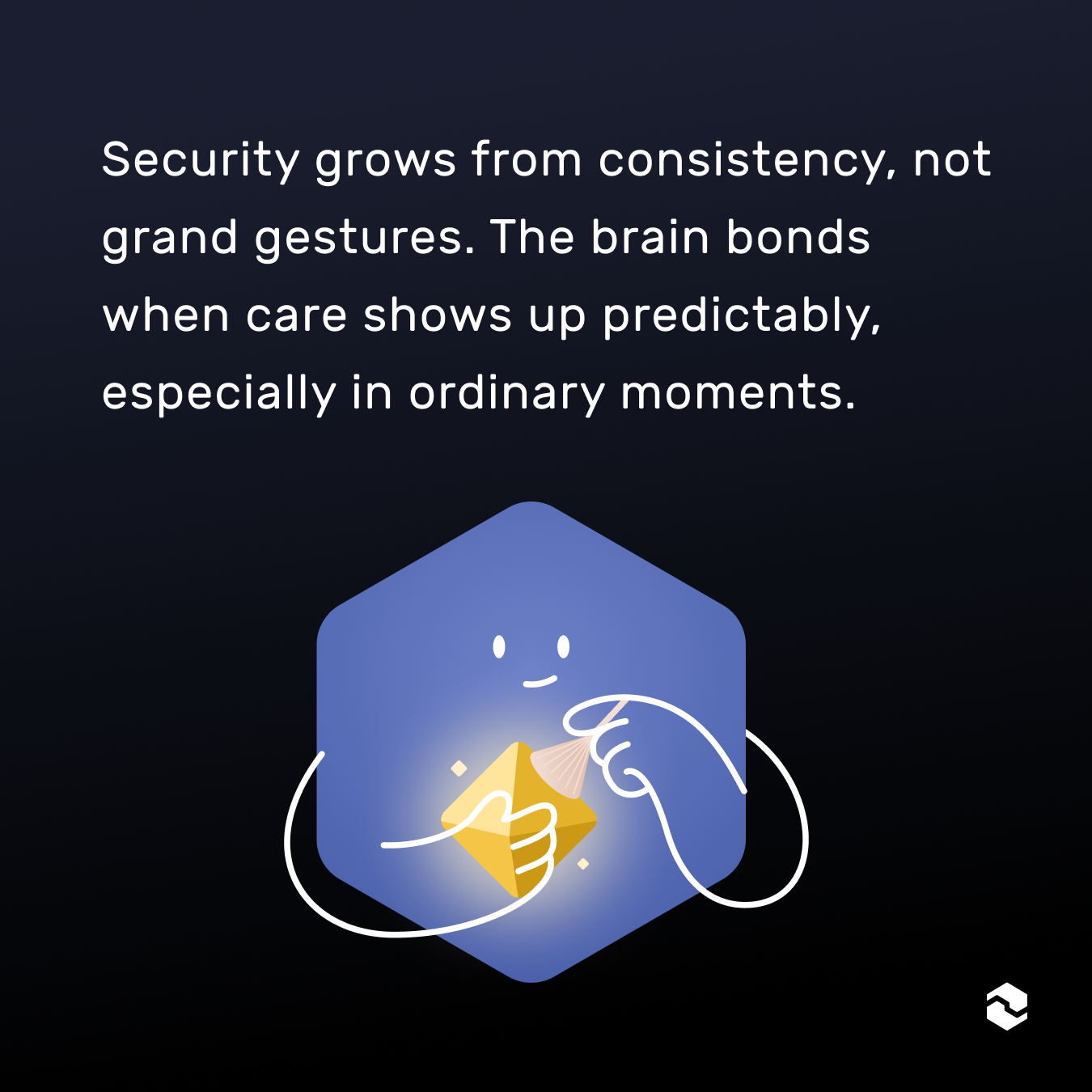
- Practice consistency over intensity: Avoid relying on occasional grand gestures to “reset” relational closeness. The brain’s learning systems privilege frequency and predictability over magnitude. Small, repeated acts of care (checking in, following through, showing up on time) more reliably shape habitual expectations of reliability than rare dramatic displays of affection. Emotional availability that is reliable (not perfect, but consistent) stabilises attachment predictions.
- Build physiological co-regulation habits: During
stress, regulate your body first before attempting to regulate the relationship. Simple practices, such
as slowing your breath before responding, pausing before sending reactive messages, or grounding
physically, reduce autonomic arousal. When partners repeatedly experience each other as sources of
physiological calming, the brain encodes the relationship as a safety signal.
- Limit high-arousal communication channels during
conflict: Avoid resolving emotionally charged issues over text or late at
night when fatigue heightens threat sensitivity. The brain’s emotion regulation capacity drops
under sleep deprivation and cognitive overload, increasing misinterpretation and escalation. Structuring
when and how difficult conversations happen is a habit-level intervention that protects learning systems
from encoding conflict as danger. Over time, this preserves the association between intimacy and safety
rather than intimacy and stress.
- Reinforce desired behaviors immediately: such as when
your partner does something you want more of, listens well, follows through, shows care or acknowledges
it in the moment. Immediate positive feedback strengthens reinforcement learning far more effectively
than delayed appreciation. The brain updates behavior based on proximal outcomes; when warmth follows
desired actions quickly, those actions become more likely to repeat. This shifts the relationship change
away from criticism-driven correction toward reward-based learning.
- Treat habit formation as relational training, not moral effort: Stop framing relationship change as “trying harder” and start framing it as training neural circuits. Habits form through repetition in stable contexts, not through motivation spikes. Designing your environment (shared routines, agreed check-in times, protected conversation windows) makes desired behaviors easier to execute consistently. This approach leverages plasticity mechanisms rather than relying on willpower, which is unreliable under emotional load.
References:
[1]. "Two Learning Systems in the Brain Reveal How Habits Are Formed."
[2] Psychology Today. (2025). "The Neurobiology of Habits.”
[3] Schneiderman, I., et al. (2012). "Oxytocin during the initial stages of romantic attachment." Hormones and Behavior.
[4] Carter, C. S. (2017). The Oxytocin–Vasopressin pathway in the context of love and fear. Frontiers in Endocrinology, 8, 356.
[5] Babková, J., & Repiská, G. (2025). The molecular basis of love. International Journal of Molecular Sciences, 26(4), 1533.
[6] Bowlby J. A secure base: Parent-child attachment and healthy human development. New York: Basic Books; 1988.
[7] Menon V. Large-scale brain networks and psychopathology. Neuron. 2011;72(1):23–38.
[8] Coan JA, Schaefer HS, Davidson RJ. Lending a hand: Social regulation of the neural response to threat. Psychol Sci. 2006;17(12):1032–1039.
[9] Mikulincer M, Shaver PR. Attachment in adulthood: Structure, dynamics, and change. New York: Guilford Press; 2007.
[10] Friston K. The free-energy principle: A unified brain theory? Nat Rev Neurosci. 2010;11(2):127–138.
[11] Kim P, Strathearn L, Swain JE. The maternal brain and its plasticity in humans. Horm Behav. 2016;77:113–123.
[12] Rilling JK, Young LJ. The biology of mammalian parenting and its effect on offspring social development. Science. 2014;345(6198):771–776.
[13] Yin HH, Knowlton BJ. The role of the basal ganglia in habit formation. Nat Rev Neurosci. 2006;7(6):464–476.
[14] Dolan RJ, Dayan P. Goals and habits in the brain. Neuron. 2013;80(2):312–325.
[15] Aron A, Fisher H, Mashek DJ, Strong G, Li H, Brown LL. Reward, motivation, and emotion systems associated with early-stage intense romantic love. J Neurophysiol. 2005;94(1):327–337.
[16] Schultz W. Dopamine reward prediction error coding. Dialogues Clin Neurosci. 2016;18(1):23–32.
[17] O’Doherty JP, Dayan P, Friston K, Critchley H, Dolan RJ. Temporal difference models and reward-related learning in the human brain. Neuron. 2003;38(2):329–337.
[18] Mikulincer M, Shaver PR. Attachment orientations and emotion regulation. J Pers Soc Psychol. 2007;92(2):282–301.
[19] Pessoa L. A network model of the emotional brain. Trends Cogn Sci. 2017;21(5):357–371.
About the author:
Sharvani is a bioinformatics graduate and neuroscience enthusiast passionate about understanding behavior, emotion, and connection. She enjoys exploring how science and technology influence modern relationships. In her free time, she loves watching films and reading. Connect with her on LinkedIn
Neuroscience based habits and resolutions for better relationships that actually work
Romantic relationships are neurobiologically complex endeavors. Your brain doesn't simply fall in love, it undergoes a cascade of neurochemical changes, structural reorganisation, and dynamic recalibration of neural circuits. Intimate bonds are instantiated in predictable patterns of brain activity that shape how closeness, threat, and commitment are perceived. The question is not whether science can improve your relationships, but whether you understand which habits, rituals, and behavioral changes your brain actually responds to. This becomes especially relevant when navigating a dating app in Bangalore, where abundance of choice can amplify emotional fatigue rather than clarity.
How does your brain form and maintain relationship habits?
The popular wisdom that habits require willpower is neuroscientifically incomplete. The brain uses two distinct dopamine-based learning processes to form habits: one for evaluating outcomes (reward prediction error or RPE) and another for reinforcing repeated actions over time. When you first decide to communicate more openly with your partner, valuation and outcome-monitoring systems, including the ventromedial prefrontal cortex (vmPFC) and broader reward-related networks, determine how positive that interaction feels. However, after weeks of consistent practice, habitual learning increasingly relies on striatal circuits involved in action reinforcement and stimulus; this constitutes response learning, making the behavior more automatic and less dependent on conscious effort [1,2].
This distinction is crucial: early relationship change requires motivation and conscious attention, but sustained change happens through repetition that stabilises behavioral patterns over time. Once a positive relationship behavior becomes well-practiced, your brain initiates it with less cognitive load, freeing resources for deeper emotional presence and responsiveness. The implication for dating app users and those seeking secure partnerships is clear: small, consistent daily practices compound into lasting change more reliably than occasional grand gestures.These patterns become especially visible when using a dating app in Bangalore, where repeated micro-interactions shape emotional habits more than rare intense conversations.
The oxytocin–vasopressin pathway: building biological bonding:
Your brain’s capacity to form deep pair bonds relies on the oxytocin (OT)–vasopressin (VP) pathway. Oxytocin, often called the “bonding hormone,” is elevated during the early stages of romantic attachment and is associated with affiliative behaviors such as social focus, positive affect, affectionate touch, and dyadic synchrony, meaning synchrony between two individuals [3]. While oxytocin is linked to bonding-related behaviors, long-term relationship stability reflects the interaction of biological, psychological, and social factors.
Crucially, both oxytocin and vasopressin contribute to pair-bonding processes. Oxytocin supports experiences of social closeness, perceived safety, and emotional regulation, while vasopressin is associated with partner-oriented behaviors linked to bond maintenance. Together with dopaminergic reward systems, these pathways support the motivational and affiliative dimensions of romantic attachment [4,5]. When partners engage in affectionate touch or sustained eye contact, oxytocin-linked processes are engaged, reinforcing associations between partner cues and reward-related neural activity over time, consistent with the formation of secure attachment representations [3,4,5].
Attachment, stress regulation, and predictive learning:
Romantic bonding is structured by the attachment system, which forms internal working models: cognitive affective representations of self and others that guide expectations of availability, responsiveness, and safety in close relationships [6]. Neuroimaging studies indicate that these models correspond to stable patterns of neural activation across circuits involving the amygdala, hippocampus, medial prefrontal cortex, and anterior cingulate cortex, integrating emotional memory, threat detection, and social evaluation [7].
Close relationships play a central role in regulating stress physiology. Partner presence and even mental representations of trusted partners are associated with reduced hypothalamic–pituitary–adrenal (HPA) axis activation and attenuated amygdala threat responses during challenging times [8]. Over time, repeated experiences of effective co-regulation are associated with lower baseline stress reactivity and greater attachment security, reflecting experience-dependent tuning of stress regulation systems [9].
These processes can be framed within predictive processing models, which propose that the brain continuously updates expectations about social outcomes based on experience, including expectations about the emotional consequences of closeness [10]. Consistent responsiveness and repair are associated with more stable expectations of emotional safety, whereas inconsistency is associated with greater uncertainty and vigilance in close relationships [9].
Crucially, these neural systems remain plastic across adulthood. Relational experiences are associated with changes in attachment representations, emotional regulation capacity, and stress sensitivity beyond early development [11,12]. This plasticity provides the neuroscientific basis for habits and resolutions aimed at improving romantic relationships. Rather than relying on willpower alone, effective relational change operates by repeatedly shaping the neural circuits that govern bonding, safety, and expectation.
From neural mechanisms to daily habits and resolutions:
Habit formation in close relationships relies on reinforcement learning mechanisms that gradually shift behaviors from effortful, goal-directed actions to automatic, context-triggered responses [13]. Early attempts at relational change depend on outcome evaluation and conscious monitoring, whereas repetition stabilises these behaviors within cortico-striatal circuits that support habit expression [13,14]. This transition explains why consistency, rather than intensity, determines whether relationship practices endure. Crucially, reward sensitivity within romantic contexts is shaped by dopaminergic signaling in mesolimbic pathways, which assigns motivational value to partner-related cues and interactions [15]. However, these same reward circuits are sensitive to unpredictability and intermittent reinforcement, which can amplify craving and emotional volatility in unstable relational dynamics [16]. This asymmetry explains why inconsistent partners can feel disproportionately compelling despite lower long-term relational safety.
Learning in close relationships also depends on prediction error, mismatches between expected and actual relational outcomes, which drives updating of social expectations [17]. When bids for connection are reliably met with responsiveness, prediction error decreases and expectations of safety stabilise. When bids are inconsistently met, heightened prediction error maintains vigilance and emotional reactivity, reinforcing insecure patterns of interaction [18].
These learning and reward processes operate within a brain that remains experience-dependent across adulthood. Repeated relational experiences modify functional connectivity within networks supporting emotion regulation, valuation, and social cognition, indicating that sustained habit change can recalibrate the neural substrates of intimacy rather than merely override them through willpower [19]. This indicates neuroscientific justification for relationship “resolutions” framed as small, repeatable behaviors.
The practical implication is straightforward: durable relational change does not come from insight alone, but from structuring environments and routines that reliably cue desired behaviors.This is particularly relevant for people navigating a dating app in Bangalore, where design choices can either reinforce healthy habits or amplify emotional volatility. This pattern is increasingly visible across Bangalore dating sites, where speed often replaces depth. Habits that align with reward learning, prediction updating, and stress co-regulation are more likely to become automatic and self-maintaining. The section that follows translates these mechanisms into concrete habits and resolutions that target communication, emotional regulation, and bonding behaviors in everyday relational life.
Core relationship habits and resolutions (Neuroscience-grounded):
- Establish a daily micro-connection ritual: Whether
you are meeting someone organically or through a dating app in
Bangalore, these habits train the brain for stability rather than stimulation.
Make one small, predictable moment of connection non-negotiable each day (a 5-minute check-in, a
good-morning message, or a short walk together). The brain’s habit systems encode behaviors that
are repeated in stable contexts. When connection becomes a daily cue-triggered routine, it shifts from
effortful intention to automatic behavior. This directly supports attachment security by reducing
uncertainty and lowering relational prediction error.
- Repair quickly after conflict: Conflict is not what destabilises bonds, unrepaired conflict is. When you return to a disagreement with calm acknowledgement (“That came out harsh, I’m sorry”), you update your partner’s threat predictions and your own. Neural threat responses (especially amygdala-driven reactivity) decrease when repair follows conflict reliably. Identify one or two common conflict patterns and pre-agree on how repair will happen (“If we escalate, we take 20 minutes and come back with one thing we appreciate and one clear need”). Over repeated cycles, the brain learns that closeness does not lead to abandonment or escalation, which stabilises stress responses and prevents small conflicts from becoming encoded as long-term relational threats.
- Anchor difficult conversations to positive effect: Pair emotionally challenging discussions with warmth cues, soft tone, eye contact,
physical presence, or appreciation before critique. The brain learns contextually: when difficult
content is repeatedly delivered alongside affiliative signals, reward and safety networks co-activate
with threat-monitoring systems. This habit gradually retrains prediction systems to associate honesty
with safety rather than danger.
- Practice consistency over intensity: Avoid relying on occasional grand gestures to “reset” relational closeness. The brain’s learning systems privilege frequency and predictability over magnitude. Small, repeated acts of care (checking in, following through, showing up on time) more reliably shape habitual expectations of reliability than rare dramatic displays of affection. Emotional availability that is reliable (not perfect, but consistent) stabilises attachment predictions.
- Build physiological co-regulation habits: During
stress, regulate your body first before attempting to regulate the relationship. Simple practices, such
as slowing your breath before responding, pausing before sending reactive messages, or grounding
physically, reduce autonomic arousal. When partners repeatedly experience each other as sources of
physiological calming, the brain encodes the relationship as a safety signal.
- Limit high-arousal communication channels during
conflict: Avoid resolving emotionally charged issues over text or late at
night when fatigue heightens threat sensitivity. The brain’s emotion regulation capacity drops
under sleep deprivation and cognitive overload, increasing misinterpretation and escalation. Structuring
when and how difficult conversations happen is a habit-level intervention that protects learning systems
from encoding conflict as danger. Over time, this preserves the association between intimacy and safety
rather than intimacy and stress.
- Reinforce desired behaviors immediately: such as when
your partner does something you want more of, listens well, follows through, shows care or acknowledges
it in the moment. Immediate positive feedback strengthens reinforcement learning far more effectively
than delayed appreciation. The brain updates behavior based on proximal outcomes; when warmth follows
desired actions quickly, those actions become more likely to repeat. This shifts the relationship change
away from criticism-driven correction toward reward-based learning.
- Treat habit formation as relational training, not moral effort: Stop framing relationship change as “trying harder” and start framing it as training neural circuits. Habits form through repetition in stable contexts, not through motivation spikes. Designing your environment (shared routines, agreed check-in times, protected conversation windows) makes desired behaviors easier to execute consistently. This approach leverages plasticity mechanisms rather than relying on willpower, which is unreliable under emotional load.
References:
[1]. "Two Learning Systems in the Brain Reveal How Habits Are Formed."
[2] Psychology Today. (2025). "The Neurobiology of Habits.”
[3] Schneiderman, I., et al. (2012). "Oxytocin during the initial stages of romantic attachment." Hormones and Behavior.
[4] Carter, C. S. (2017). The Oxytocin–Vasopressin pathway in the context of love and fear. Frontiers in Endocrinology, 8, 356.
[5] Babková, J., & Repiská, G. (2025). The molecular basis of love. International Journal of Molecular Sciences, 26(4), 1533.
[6] Bowlby J. A secure base: Parent-child attachment and healthy human development. New York: Basic Books; 1988.
[7] Menon V. Large-scale brain networks and psychopathology. Neuron. 2011;72(1):23–38.
[8] Coan JA, Schaefer HS, Davidson RJ. Lending a hand: Social regulation of the neural response to threat. Psychol Sci. 2006;17(12):1032–1039.
[9] Mikulincer M, Shaver PR. Attachment in adulthood: Structure, dynamics, and change. New York: Guilford Press; 2007.
[10] Friston K. The free-energy principle: A unified brain theory? Nat Rev Neurosci. 2010;11(2):127–138.
[11] Kim P, Strathearn L, Swain JE. The maternal brain and its plasticity in humans. Horm Behav. 2016;77:113–123.
[12] Rilling JK, Young LJ. The biology of mammalian parenting and its effect on offspring social development. Science. 2014;345(6198):771–776.
[13] Yin HH, Knowlton BJ. The role of the basal ganglia in habit formation. Nat Rev Neurosci. 2006;7(6):464–476.
[14] Dolan RJ, Dayan P. Goals and habits in the brain. Neuron. 2013;80(2):312–325.
[15] Aron A, Fisher H, Mashek DJ, Strong G, Li H, Brown LL. Reward, motivation, and emotion systems associated with early-stage intense romantic love. J Neurophysiol. 2005;94(1):327–337.
[16] Schultz W. Dopamine reward prediction error coding. Dialogues Clin Neurosci. 2016;18(1):23–32.
[17] O’Doherty JP, Dayan P, Friston K, Critchley H, Dolan RJ. Temporal difference models and reward-related learning in the human brain. Neuron. 2003;38(2):329–337.
[18] Mikulincer M, Shaver PR. Attachment orientations and emotion regulation. J Pers Soc Psychol. 2007;92(2):282–301.
[19] Pessoa L. A network model of the emotional brain. Trends Cogn Sci. 2017;21(5):357–371.
About the author:
Sharvani is a bioinformatics graduate and neuroscience enthusiast passionate about understanding behavior, emotion, and connection. She enjoys exploring how science and technology influence modern relationships. In her free time, she loves watching films and reading. Connect with her on LinkedIn

Your privacy matters most.
- We will never share your data with any third parties. Vlncy will always be an ad-free platform.
- We will use your anonymised data only to improve the platform, in our efforts to serve you better.
- We do not store/ own any of your content on our servers.
- Upon account deletion, we will purge all your personal data.
- We will never reveal your identity on the platform. Only you decide when, how and with whom your information is shared.


