How VLNCY rethought compatibility: A five-phase research evolution

In the early days of digital matchmaking, compatibility was treated as a checklist. Do you like sushi? Do you enjoy trekking? Are you a dog person? The assumption was simple: shared preferences equal shared happiness. But as online dating evolved, Vlncy the dating app recognised that surface similarities rarely predict long-term compatibility.
At VLNCY, the journey toward building a more meaningful curated matching system did not begin with complex neuroscience. It began with something far more ordinary: manual matching based on likes and dislikes. What followed was a gradual shift from surface-level similarities to psychological models, finally incorporating the Fisher Temperament Inventory (FTI). Each of these phases was not only theorised but tested in real-world curated mixers, where insights from live interactions shaped and refined the evolving compatibility model before VLNCY was formally built. VLNCY is designed to address the limitations of engagement-driven swipe-based dating apps and self-declared compatibility systems. This is the story of how Vlncy the dating app evolved its approach to compatibility. that evolution.
Phase 1: Preference Matching: Matched people based on shared
interests, hobbies, and lifestyle choices.
Phase 2: Self-Declared Virtues: Introduced
questionnaires asking users to describe their values, personality
traits, and relationship expectations.
Phase 3: MBTI + Self-Declared
Virtues: Structured personality typology added to reduce ambiguity in
self-perception and classify cognitive styles.
Phase 4: MBTI + ASMR: Cognitive personality typing combined with
sensory response patterns to explore physiological emotional resonance.
Phase 5: FTI +
ASMR: Compatibility modeling shifted toward biologically grounded
temperament systems paired with nervous-system responses.
Phase 1: The illusion of compatibility (Activity and interest-based questionnaire matching)
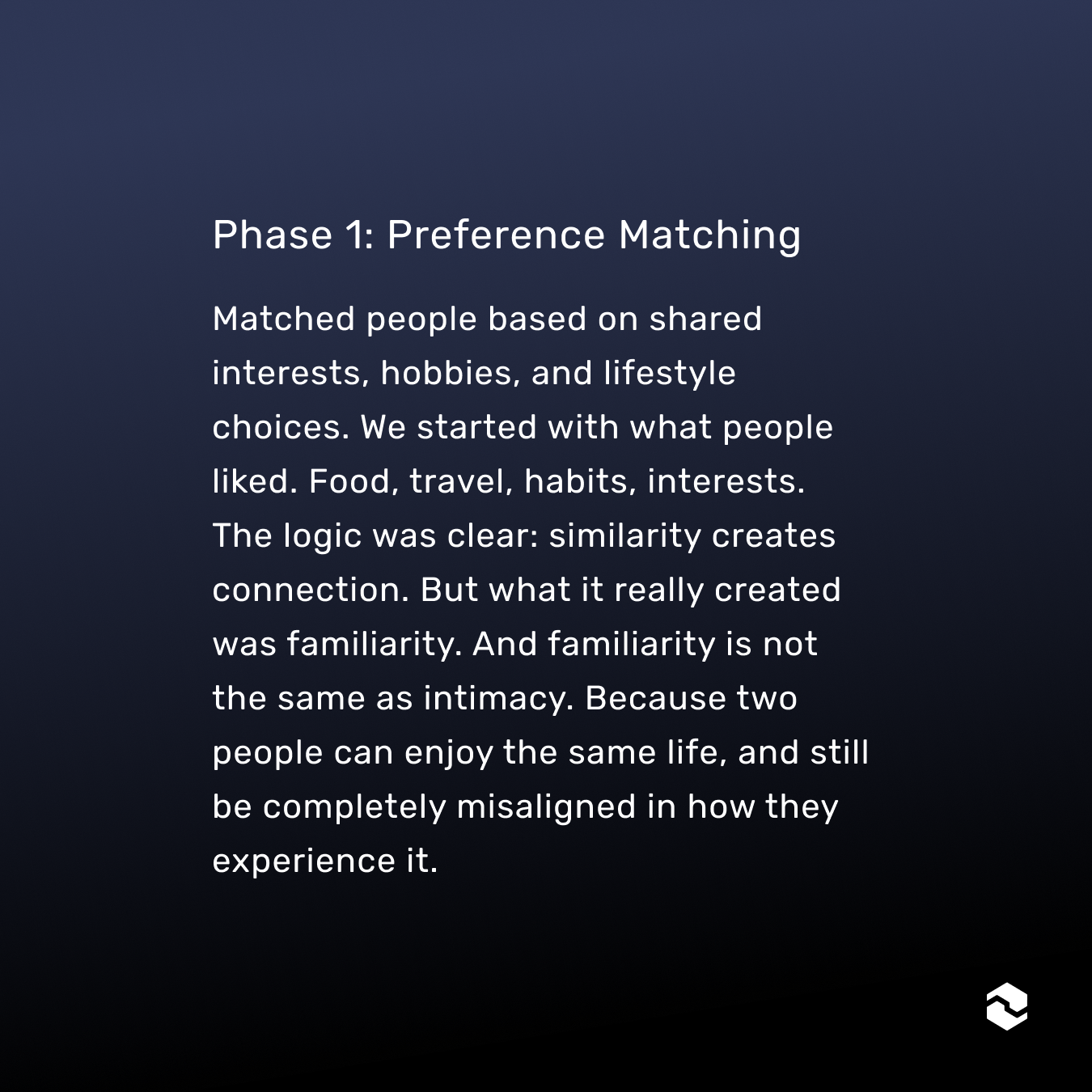
In the earliest stage, matching was built on visible alignment. People were paired based on what they liked, what they disliked, the food they preferred and the hobbies they enjoyed. It was a system rooted in overlap: if two individuals both enjoyed travel, fitness, and similar cultural experiences, the assumption was that their connection would unfold naturally.
This felt logical because similarity is cognitively comfortable. But similarity of preference does not necessarily imply compatibility. Two people may both enjoy the same activities yet differ profoundly in how they respond to stress, rejection, ambiguity, or intimacy. What became evident was that preference-based matching generates familiarity, not necessarily intimacy. It helps people begin conversations; it does not reliably predict how those conversations evolve when vulnerability enters the equation.
There is also a structural limitation: it depends entirely on conscious self-reporting. Individuals select what they believe represents them. Yet most relational conflicts do not arise from declared interests. They arise from unexamined patterns, attachment triggers, regulation styles, and stress thresholds. These patterns are rarely captured in a question about favorite cuisine or travel frequency. The question shifted from "What do they like?" to something far more consequential: "How do they function?" That said, these questions are not entirely discarded. As part of the onboarding process, VLNCY still captures surface-level preferences through prompts such as what users do in their free time, their hobbies and passions, and how often they engage in physical fitness activities. These inputs are not treated as indicators of compatibility, but rather as contextual signals that help initiate interaction while deeper behavioral and temperament-based factors guide the matching process.
Part 2: When self-perception became the data (Self-declared virtues + Activities & interests questionnaire matching)
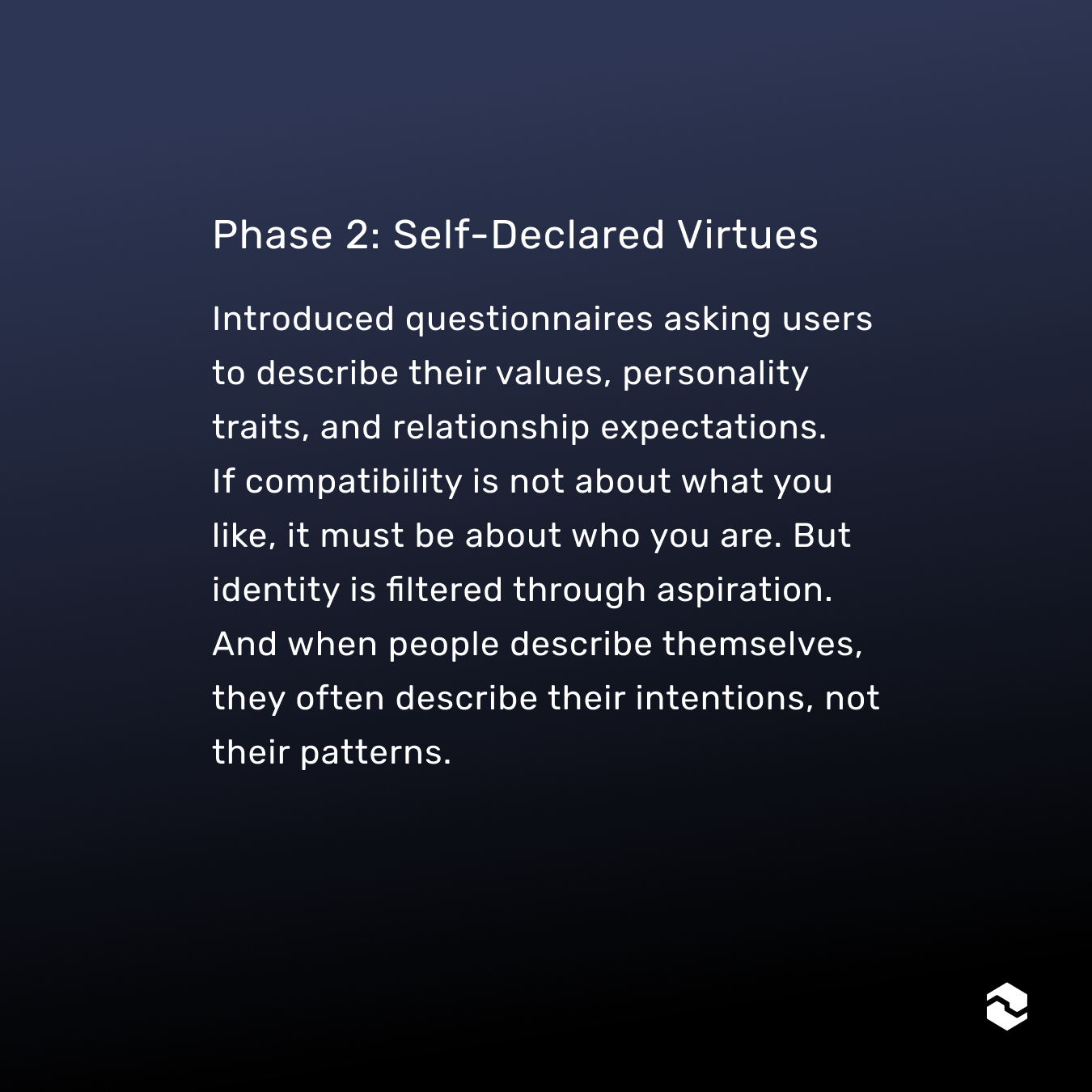
If matching based on preferences was too shallow, Vlncy the dating app’s next step was to move inward. We began asking who they believed they were. This marked an important philosophical shift: compatibility was no longer defined by shared activities but by shared values, moral priorities, and perceived personality traits. Users were invited to describe their virtues and vices through structured templates, and optional objective-style questions replaced open-ended ambiguity. The goal was clarity, and we moved from lifestyle similarity to psychological self-description, acknowledging that values shape relationships more deeply than hobbies.
A new limitation emerged, however. Self-description is filtered through aspiration. When asked about virtues, most individuals select the traits they admire rather than those they consistently embody. We began to detect a pattern: differentiation collapsed when everyone chose socially desirable qualities. More importantly, even sincere responses reflected self-perception rather than behavioral consistency. Templates reduce complexity to selectable categories, they create clean data, but human psychology is not clean. Attachment responses fluctuate depending on context, history, and perceived threat. This raised a sharper internal question, if preferences are too superficial and self-declarations too aspirational, where does more reliable relational data come from?
Phase 3: Turning toward typology: Introducing the MBTI test + self declared virtues
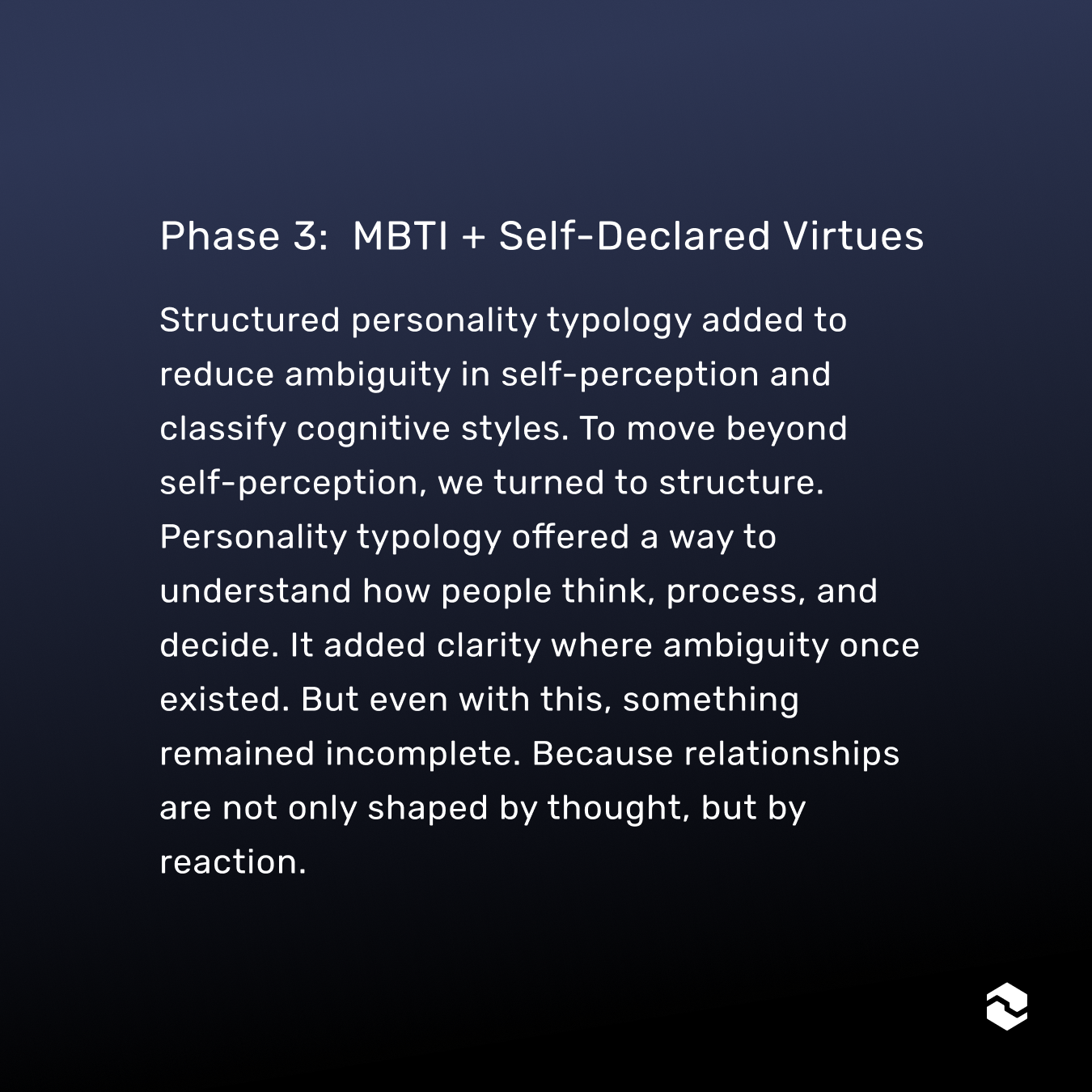
When preference lists proved too shallow and self-declared virtues too aspirational, Vlncy the dating app’s next step was to introduce a structured psychological model. Instead of relying solely on how users described themselves, we turned to established personality frameworks designed to categorize cognitive tendencies systematically.
This is where the Myers–Briggs Type Indicator (MBTI) entered [1]. Integrated into the existing questionnaire, it added a typology-based assessment that categorized individuals according to cognitive preferences. The goal was to move beyond vague self-perception and introduce clearer differentiation in how people process information and make decisions.
The combined system now looked like this: A values and behavior-based questionnaire capturing self-perception + An MBTI assessment capturing cognitive style. Together, they created a more layered compatibility profile.
The MBTI classifies individuals into sixteen personality types based on dimensions such as energy orientation, information processing, decision making, and interaction with the external world [1]. Rather than matching individuals solely based on shared interests or declared values, typology-based matching attempted to align cognitive styles. The assumption was that similarity or complementarity in cognitive processing could reduce relational friction. Personality research has long suggested that certain trait similarities and complementarities influence relationship satisfaction [2].
However, empirical concerns soon emerged. The MBTI relies on categorical dichotomies, yet most personality traits exist along continuous spectrums rather than fixed binaries [3]. Converting dimensional traits into rigid categories can reduce nuance and create artificial boundaries. Questions have also been raised about the MBTI’s reliability. Studies show that many individuals receive different type classifications when retested after a period of time [4]. This instability makes typology difficult to use as a stable predictor of long-term relational behavior.
More importantly, the MBTI primarily describes cognitive preferences. Relationships, however, are shaped not only by how individuals think but also by how they emotionally and physiologically respond to interaction. This limitation prompted the search for a complementary layer that could capture embodied responses rather than cognitive style alone.
Phase 4: MBTI + ASMR (Sensory Resonance, self report of virtues removed):
The MBTI helped explain how people think. It highlighted cognitive alignment, whether someone is intuitive or practical, feeling-oriented or analytical. But it did not explain how people physiologically respond to emotional experiences. It described mental patterns, not embodied reactions [6]. To address this gap, the next step was to explore something more physical: sensory response. This is where Autonomous Sensory Meridian Response (ASMR) entered the model. ASMR refers to a calming, tingling sensation that some people experience when they hear soft sounds like whispering, tapping, or slow, gentle speech. For many, it creates a feeling of relaxation and emotional comfort [7].
Research suggests that ASMR sensitivity is linked to certain personality traits, particularly high Openness and sometimes higher emotional sensitivity [8]. Studies have also shown that ASMR can activate the parasympathetic nervous system, the part of the body responsible for calming and slowing the heart rate. In controlled experiments, participants experienced a measurable reduction in heart rate during ASMR exposure, suggesting a genuine physiological calming effect [8,9].
We now had two components:The Myers–Briggs Type Indicator continued to capture cognitive style, how individuals process information, make decisions, and structure their environment + ASMR-based inputs attempt to capture sensory-emotional response patterns, reflecting how an individual’s nervous system reacts to calming or intimate stimuli.
The hypothesis was that compatibility is not only about shared values or similar thinking styles, but also about how two nervous systems respond to emotional environments. If two individuals experience similar calming responses to sensory cues, it may suggest a form of physiological resonance that supports emotional comfort.
Phase 5: FTI + ASMR: Temperament meets physiology
Because of the limitations of the MBTI, we gradually shifted toward the Fisher Temperament Inventory (FTI), developed by biological anthropologist Helen Fisher [10]. Unlike the MBTI, the FTI is grounded in neuroscience and attempts to map personality traits to underlying brain chemistry. The framework proposes four broad temperament systems associated with different neurochemical pathways: Explorers linked to dopamine and novelty seeking, Builders associated with serotonin and stability, Directors connected with testosterone-driven analytical tendencies, and Negotiators associated with estrogen and oxytocin systems involved in empathy and social bonding [10]. [Read previous article for further reading]
This shift, as reflected in a Vlncy’s dating app review of research on FTI and ASMR, was significant because it moved compatibility modeling closer to biological temperament rather than learned cognitive preferences. Cognitive styles can evolve through experience and environment, but temperament traits linked to neurochemical systems tend to remain relatively stable across time. Research on these temperament dimensions has shown meaningful correlations with established personality models and behavioral patterns, suggesting that biologically grounded traits may provide a more reliable baseline for understanding attraction and compatibility [10].
Combining the FTI with ASMR created a framework that linked temperament with physiological response. Temperament profiles could explain baseline behavioral tendencies, while ASMR responses offered insight into how individuals’ nervous systems reacted to soothing sensory stimuli. Researchers have also suggested that physiological signals related to emotional regulation, such as vagal tone and heart rate variability, can play a role in how individuals experience social bonding and co-regulation during interaction [9]. When two individuals regulate stress and emotional signals in similar ways, emotional synchrony may occur more easily during conversation or shared experiences.

At the same time, neuroscience research on long-term romantic attachment suggests that attraction and bonding involve complex interactions between reward systems, emotional regulation, and social cognition in the brain [12]. These findings support the idea that compatibility cannot be explained by cognitive preferences alone, and that temperament and physiological processes play a critical role in relational dynamics. The integration of the FTI and ASMR shifted compatibility modeling toward a framework that incorporated temperament and nervous system response. The progression of Vlncy the dating app from preference matching to temperament-based modeling reflects an ongoing attempt to better understand compatibility. Each phase addressed limitations of the previous one, gradually moving from self-perception to cognitive style and biological temperament, a progression captured in a Vlncy’s dating app review of FTI-based temperament research. The Fisher Temperament Inventory, combined with physiological insights, currently provides the most robust framework available to us.
References:
[1] Myers, I. B., McCaulley, M. H., Quenk, N. L., & Hammer, A. L. (1998). MBTI manual: A guide to the development and use of the Myers-Briggs Type Indicator (3rd ed.). Consulting Psychologists Press.
[2] Keirsey, D. (1998). Please understand me II: Temperament, character, intelligence. Prometheus Nemesis Book Company.
[3] McCrae, R. R., & Costa, P. T. (1989). Reinterpreting the Myers-Briggs Type Indicator from the perspective of the Five-Factor Model of personality. Journal of Personality, 57(1), 17–40.
[4] Pittenger, D. J. (2005). Cautionary comments regarding the Myers-Briggs Type Indicator. Consulting Psychology Journal: Practice and Research, 57(3), 89–96.
[5] Furnham, A., & Crump, J. (1996). The big five versus the big four: The relationship between the Myers-Briggs Type Indicator (MBTI) and NEO-PI five factor model of personality. Personality and Individual Differences, 21(2), 303–307.
[6] Clayton, M. (2023). The Psychology of ASMR. Psychology Today.
[7] Poerio, G. L., Blakey, E., Hostler, T. J., & Veltri, T. (2018). More than a feeling: Autonomous sensory meridian response (ASMR) is characterized by reliable changes in affect and physiology. PLOS ONE, 13(6).
[8] Fredborg, B. K., Clark, J. M., & Smith, S. D. (2017). An examination of personality traits associated with ASMR. Frontiers in Psychology, 8, 247.
[9] Grossman, P., & Taylor, E. W. (2007). Toward understanding respiratory sinus arrhythmia: Relations to cardiac vagal tone, evolution and biobehavioral functions. Biological Psychology, 74(2), 263–285.
[10] Fisher, H. E., Island, H. D., Richart-Hayes, A., et al. (2017). Four broad temperament dimensions: Description, convergent validation correlations, and comparison with the Big Five. Frontiers in Psychology.
[11] Richard C. The brain science and benefits of ASMR . TED; 2018
[12] Acevedo, B. P., Aron, A., Fisher, H. E., & Brown, L. L. (2012). Neural correlates of long-term intense romantic love. Social Cognitive and Affective Neuroscience, 7(2), 145–159.
About the author:
Sharvani is a bioinformatics graduate and neuroscience enthusiast passionate about understanding behavior, emotion, and connection. She enjoys exploring how science and technology influence modern relationships. In her free time, she loves watching films and reading. Connect with her on LinkedIn
How VLNCY rethought compatibility: A five-phase research evolution
In the early days of digital matchmaking, compatibility was treated as a checklist. Do you like sushi? Do you enjoy trekking? Are you a dog person? The assumption was simple: shared preferences equal shared happiness. But as online dating evolved, Vlncy the dating app recognised that surface similarities rarely predict long-term compatibility.
At VLNCY, the journey toward building a more meaningful curated matching system did not begin with complex neuroscience. It began with something far more ordinary: manual matching based on likes and dislikes. What followed was a gradual shift from surface-level similarities to psychological models, finally incorporating the Fisher Temperament Inventory (FTI). Each of these phases was not only theorised but tested in real-world curated mixers, where insights from live interactions shaped and refined the evolving compatibility model before VLNCY was formally built. VLNCY is designed to address the limitations of engagement-driven swipe-based dating apps and self-declared compatibility systems. This is the story of how Vlncy the dating app evolved its approach to compatibility. that evolution.
Phase 1: Preference Matching: Matched people based on shared
interests, hobbies, and lifestyle choices.
Phase 2: Self-Declared Virtues: Introduced
questionnaires asking users to describe their values, personality
traits, and relationship expectations.
Phase 3: MBTI + Self-Declared
Virtues: Structured personality typology added to reduce ambiguity in
self-perception and classify cognitive styles.
Phase 4: MBTI + ASMR: Cognitive personality typing combined with
sensory response patterns to explore physiological emotional resonance.
Phase 5: FTI +
ASMR: Compatibility modeling shifted toward biologically grounded
temperament systems paired with nervous-system responses.
Phase 1: The illusion of compatibility (Activity and interest-based questionnaire matching)
In the earliest stage, matching was built on visible alignment. People were paired based on what they liked, what they disliked, the food they preferred and the hobbies they enjoyed. It was a system rooted in overlap: if two individuals both enjoyed travel, fitness, and similar cultural experiences, the assumption was that their connection would unfold naturally.
This felt logical because similarity is cognitively comfortable. But similarity of preference does not necessarily imply compatibility. Two people may both enjoy the same activities yet differ profoundly in how they respond to stress, rejection, ambiguity, or intimacy. What became evident was that preference-based matching generates familiarity, not necessarily intimacy. It helps people begin conversations; it does not reliably predict how those conversations evolve when vulnerability enters the equation.
There is also a structural limitation: it depends entirely on conscious self-reporting. Individuals select what they believe represents them. Yet most relational conflicts do not arise from declared interests. They arise from unexamined patterns, attachment triggers, regulation styles, and stress thresholds. These patterns are rarely captured in a question about favorite cuisine or travel frequency. The question shifted from "What do they like?" to something far more consequential: "How do they function?" That said, these questions are not entirely discarded. As part of the onboarding process, VLNCY still captures surface-level preferences through prompts such as what users do in their free time, their hobbies and passions, and how often they engage in physical fitness activities. These inputs are not treated as indicators of compatibility, but rather as contextual signals that help initiate interaction while deeper behavioral and temperament-based factors guide the matching process.
Part 2: When self-perception became the data (Self-declared virtues + Activities & interests questionnaire matching)
If matching based on preferences was too shallow, Vlncy the dating app’s next step was to move inward. We began asking who they believed they were. This marked an important philosophical shift: compatibility was no longer defined by shared activities but by shared values, moral priorities, and perceived personality traits. Users were invited to describe their virtues and vices through structured templates, and optional objective-style questions replaced open-ended ambiguity. The goal was clarity, and we moved from lifestyle similarity to psychological self-description, acknowledging that values shape relationships more deeply than hobbies.
A new limitation emerged, however. Self-description is filtered through aspiration. When asked about virtues, most individuals select the traits they admire rather than those they consistently embody. We began to detect a pattern: differentiation collapsed when everyone chose socially desirable qualities. More importantly, even sincere responses reflected self-perception rather than behavioral consistency. Templates reduce complexity to selectable categories, they create clean data, but human psychology is not clean. Attachment responses fluctuate depending on context, history, and perceived threat. This raised a sharper internal question, if preferences are too superficial and self-declarations too aspirational, where does more reliable relational data come from?
Phase 3: Turning toward typology: Introducing the MBTI test + self declared virtues
When preference lists proved too shallow and self-declared virtues too aspirational, Vlncy the dating app’s next step was to introduce a structured psychological model. Instead of relying solely on how users described themselves, we turned to established personality frameworks designed to categorize cognitive tendencies systematically.
This is where the Myers–Briggs Type Indicator (MBTI) entered [1]. Integrated into the existing questionnaire, it added a typology-based assessment that categorized individuals according to cognitive preferences. The goal was to move beyond vague self-perception and introduce clearer differentiation in how people process information and make decisions.
The combined system now looked like this: A values and behavior-based questionnaire capturing self-perception + An MBTI assessment capturing cognitive style. Together, they created a more layered compatibility profile.
The MBTI classifies individuals into sixteen personality types based on dimensions such as energy orientation, information processing, decision making, and interaction with the external world [1]. Rather than matching individuals solely based on shared interests or declared values, typology-based matching attempted to align cognitive styles. The assumption was that similarity or complementarity in cognitive processing could reduce relational friction. Personality research has long suggested that certain trait similarities and complementarities influence relationship satisfaction [2].
However, empirical concerns soon emerged. The MBTI relies on categorical dichotomies, yet most personality traits exist along continuous spectrums rather than fixed binaries [3]. Converting dimensional traits into rigid categories can reduce nuance and create artificial boundaries. Questions have also been raised about the MBTI’s reliability. Studies show that many individuals receive different type classifications when retested after a period of time [4]. This instability makes typology difficult to use as a stable predictor of long-term relational behavior.
More importantly, the MBTI primarily describes cognitive preferences. Relationships, however, are shaped not only by how individuals think but also by how they emotionally and physiologically respond to interaction. This limitation prompted the search for a complementary layer that could capture embodied responses rather than cognitive style alone.
Phase 4: MBTI + ASMR (Sensory Resonance, self report of virtues removed):
The MBTI helped explain how people think. It highlighted cognitive alignment, whether someone is intuitive or practical, feeling-oriented or analytical. But it did not explain how people physiologically respond to emotional experiences. It described mental patterns, not embodied reactions [6]. To address this gap, the next step was to explore something more physical: sensory response. This is where Autonomous Sensory Meridian Response (ASMR) entered the model. ASMR refers to a calming, tingling sensation that some people experience when they hear soft sounds like whispering, tapping, or slow, gentle speech. For many, it creates a feeling of relaxation and emotional comfort [7].
Research suggests that ASMR sensitivity is linked to certain personality traits, particularly high Openness and sometimes higher emotional sensitivity [8]. Studies have also shown that ASMR can activate the parasympathetic nervous system, the part of the body responsible for calming and slowing the heart rate. In controlled experiments, participants experienced a measurable reduction in heart rate during ASMR exposure, suggesting a genuine physiological calming effect [8,9].
We now had two components:The Myers–Briggs Type Indicator continued to capture cognitive style, how individuals process information, make decisions, and structure their environment + ASMR-based inputs attempt to capture sensory-emotional response patterns, reflecting how an individual’s nervous system reacts to calming or intimate stimuli.
The hypothesis was that compatibility is not only about shared values or similar thinking styles, but also about how two nervous systems respond to emotional environments. If two individuals experience similar calming responses to sensory cues, it may suggest a form of physiological resonance that supports emotional comfort.
Phase 5: FTI + ASMR: Temperament meets physiology
Because of the limitations of the MBTI, we gradually shifted toward the Fisher Temperament Inventory (FTI), developed by biological anthropologist Helen Fisher [10]. Unlike the MBTI, the FTI is grounded in neuroscience and attempts to map personality traits to underlying brain chemistry. The framework proposes four broad temperament systems associated with different neurochemical pathways: Explorers linked to dopamine and novelty seeking, Builders associated with serotonin and stability, Directors connected with testosterone-driven analytical tendencies, and Negotiators associated with estrogen and oxytocin systems involved in empathy and social bonding [10]. [Read previous article for further reading]
This shift, as reflected in a Vlncy’s dating app review of research on FTI and ASMR, was significant because it moved compatibility modeling closer to biological temperament rather than learned cognitive preferences. Cognitive styles can evolve through experience and environment, but temperament traits linked to neurochemical systems tend to remain relatively stable across time. Research on these temperament dimensions has shown meaningful correlations with established personality models and behavioral patterns, suggesting that biologically grounded traits may provide a more reliable baseline for understanding attraction and compatibility [10].
Combining the FTI with ASMR created a framework that linked temperament with physiological response. Temperament profiles could explain baseline behavioral tendencies, while ASMR responses offered insight into how individuals’ nervous systems reacted to soothing sensory stimuli. Researchers have also suggested that physiological signals related to emotional regulation, such as vagal tone and heart rate variability, can play a role in how individuals experience social bonding and co-regulation during interaction [9]. When two individuals regulate stress and emotional signals in similar ways, emotional synchrony may occur more easily during conversation or shared experiences.
At the same time, neuroscience research on long-term romantic attachment suggests that attraction and bonding involve complex interactions between reward systems, emotional regulation, and social cognition in the brain [12]. These findings support the idea that compatibility cannot be explained by cognitive preferences alone, and that temperament and physiological processes play a critical role in relational dynamics. The integration of the FTI and ASMR shifted compatibility modeling toward a framework that incorporated temperament and nervous system response. The progression of Vlncy the dating app from preference matching to temperament-based modeling reflects an ongoing attempt to better understand compatibility. Each phase addressed limitations of the previous one, gradually moving from self-perception to cognitive style and biological temperament, a progression captured in a Vlncy’s dating app review of FTI-based temperament research. The Fisher Temperament Inventory, combined with physiological insights, currently provides the most robust framework available to us.
References:
[1] Myers, I. B., McCaulley, M. H., Quenk, N. L., & Hammer, A. L. (1998). MBTI manual: A guide to the development and use of the Myers-Briggs Type Indicator (3rd ed.). Consulting Psychologists Press.
[2] Keirsey, D. (1998). Please understand me II: Temperament, character, intelligence. Prometheus Nemesis Book Company.
[3] McCrae, R. R., & Costa, P. T. (1989). Reinterpreting the Myers-Briggs Type Indicator from the perspective of the Five-Factor Model of personality. Journal of Personality, 57(1), 17–40.
[4] Pittenger, D. J. (2005). Cautionary comments regarding the Myers-Briggs Type Indicator. Consulting Psychology Journal: Practice and Research, 57(3), 89–96.
[5] Furnham, A., & Crump, J. (1996). The big five versus the big four: The relationship between the Myers-Briggs Type Indicator (MBTI) and NEO-PI five factor model of personality. Personality and Individual Differences, 21(2), 303–307.
[6] Clayton, M. (2023). The Psychology of ASMR. Psychology Today.
[7] Poerio, G. L., Blakey, E., Hostler, T. J., & Veltri, T. (2018). More than a feeling: Autonomous sensory meridian response (ASMR) is characterized by reliable changes in affect and physiology. PLOS ONE, 13(6).
[8] Fredborg, B. K., Clark, J. M., & Smith, S. D. (2017). An examination of personality traits associated with ASMR. Frontiers in Psychology, 8, 247.
[9] Grossman, P., & Taylor, E. W. (2007). Toward understanding respiratory sinus arrhythmia: Relations to cardiac vagal tone, evolution and biobehavioral functions. Biological Psychology, 74(2), 263–285.
[10] Fisher, H. E., Island, H. D., Richart-Hayes, A., et al. (2017). Four broad temperament dimensions: Description, convergent validation correlations, and comparison with the Big Five. Frontiers in Psychology.
[11] Richard C. The brain science and benefits of ASMR . TED; 2018
[12] Acevedo, B. P., Aron, A., Fisher, H. E., & Brown, L. L. (2012). Neural correlates of long-term intense romantic love. Social Cognitive and Affective Neuroscience, 7(2), 145–159.
About the author:
Sharvani is a bioinformatics graduate and neuroscience enthusiast passionate about understanding behavior, emotion, and connection. She enjoys exploring how science and technology influence modern relationships. In her free time, she loves watching films and reading. Connect with her on LinkedIn

Your privacy matters most.
- We will never share your data with any third parties. Vlncy will always be an ad-free platform.
- We will use your anonymised data only to improve the platform, in our efforts to serve you better.
- We do not store/ own any of your content on our servers.
- Upon account deletion, we will purge all your personal data.
- We will never reveal your identity on the platform. Only you decide when, how and with whom your information is shared.


