Vlncy: Designing digital dating systems that respect the human brain for meaningful connections

The system was never meant to help you find meaningful relationships, only to keep you looking. Digital dating was supposed to make connection easier; instead, it has turned intimacy into an interface [1]. We now live in an environment of infinite profiles and constant novelty, yet many people report more anxiety, loneliness and burnout than before [27]. The problem is not just whom we meet online, but how the systems themselves interact with the brain: every swipe, notification and delay in response subtly trains our nervous system to seek stimulation over steadiness [2,3,27]. This challenge is increasingly visible for anyone searching for a more intentional dating app in Bangalore.
Most dating apps are engineered around one principle: engagement. They are built to hold attention, not space. VLNCY emerged from a different question: What if dating design could work with our biology instead of against it?What if the future of dating wasn’t faster, but slower, less about stimulation? What if design could restore trust and attention in a system built to exploit our impulsivity? [5]
This is the ecosystem VLNCY seeks to change, not by rejecting technology, but by redesigning it from the inside out [4].
The problem: When design hijacks the brain
The swipe loop is not an accident. It’s an engineered behavioral trap [2]. Modern dating apps exploit the same neurochemical mechanisms as slot machines. Dating apps don’t reward users consistently. Instead, they operate on what behavioral psychologists call a variable ratio reinforcement schedule. You don’t know when a reward will come or what it will look like. One swipe leads to a match, another leads to nothing, and occasionally there’s a highly salient reward: attention, validation or perceived romantic potential.
This unpredictability is crucial. When rewards are uncertain, the brain releases more dopamine, not when the reward arrives, but in anticipation of it. These dopamine signals originate in the ventral tegmental area (VTA) and project to regions involved in motivation and habit formation, particularly the nucleus accumbens and prefrontal cortex.
Over time, the brain begins to associate the act of swiping itself with potential reward. This strengthens compulsive checking behaviors, reduces sensitivity to stable rewards and reinforces habitual engagement, even when the experience is emotionally unsatisfying. The system trains users to seek stimulation and novelty rather than connection or emotional regulation [5,6,7,8]
This constant stimulation floods the striatum (the brain’s “craving center”) while exhausting the prefrontal cortex, which governs empathy, patience and long-term reasoning. The result? Connection feels like consumption [9,10]
VLNCY begins by acknowledging this biological mismatch: we are using hunter-gatherer brains inside engagement-driven ecosystems. Its approach is not to moralise this, but to redesign the system that exploits it [11,12].
Dating is simple:
VLNCY’s structure is radically simple: users receive only five curated matches at a time.
This small number is not an aesthetic choice; it’s a cognitive intervention. Psychologists like Barry Schwartz (2004) and Iyengar & Lepper (2000) [13,14] have shown that too many choices increase anxiety, reduce satisfaction and cause decision fatigue. VLNCY applies this insight neurologically. By limiting choice, it preserves the prefrontal cortex’s attentional bandwidth, allowing users to think, feel and decide with clarity [15,16].

The role of Relationship Managers:
Technology cannot replace human intuition. VLNCY’s innovation lies in blending technological precision with human assessment. Each user is paired with a Relationship Manager, a real person who ensures that profiles are genuine, intentions are transparent and emotional alignment is preserved.
These Relationship Managers act as custodians of emotional integrity. They verify profiles through multi-step authentication, not merely through ID checks, but through conversational calibration and behavioral cues. This reduces fake profiles, manipulative behavior and performative self-presentation that plague most dating ecosystems.
Scientific matching: The Fisher Temperament Inventory
VLNCY’s matching logic draws from Dr. Helen Fisher’s Temperament Inventory (FTI), a neuroscience-based model linking attraction patterns to dominant neurochemical systems revolving around dopamine, serotonin, testosterone and estrogen. Rather than viewing compatibility as a single trait or preference, this model recognises that attraction emerges from stable neurobiological tendencies that shape how individuals think, feel, communicate and bond in relationships [17,18]
- Explorers (dopamine-dominant): Individuals with a dopamine-leaning profile tend to be energised by novelty, curiosity and reward-seeking.
- Builders (serotonin-dominant): Serotonin is strongly linked to emotional regulation, social stability and long-term planning.
- Directors (testosterone-dominant): Testosterone is associated with analytical thinking, decisiveness and goal-oriented behavior.
- Negotiators (estrogen-dominant): Estrogen is linked to empathy, emotional awareness and social sensitivity. [26]
By integrating this temperament-based framework, VLNCY’s matching logic aims to move beyond surface-level preferences and toward deeper psychological and neurobiological compatibility, helping individuals understand not only who they are attracted to, but why certain relational dynamics feel more natural and sustainable over time [17,18]
Rather than reducing attraction to aesthetics or hobbies, VLNCY matches individuals based on temperament compatibility, how their neurochemical patterns interact in communication, empathy and stress response.The human brain evolved for social bonding in small groups, not for processing thousands of potential partners [12]. Working memory is the limited-capacity system that allows us to reason, evaluate and choose. Traditional dating apps violate this cognitive principle by flooding users with endless options, triggering stress, decision fatigue and reduced satisfaction [15,19].
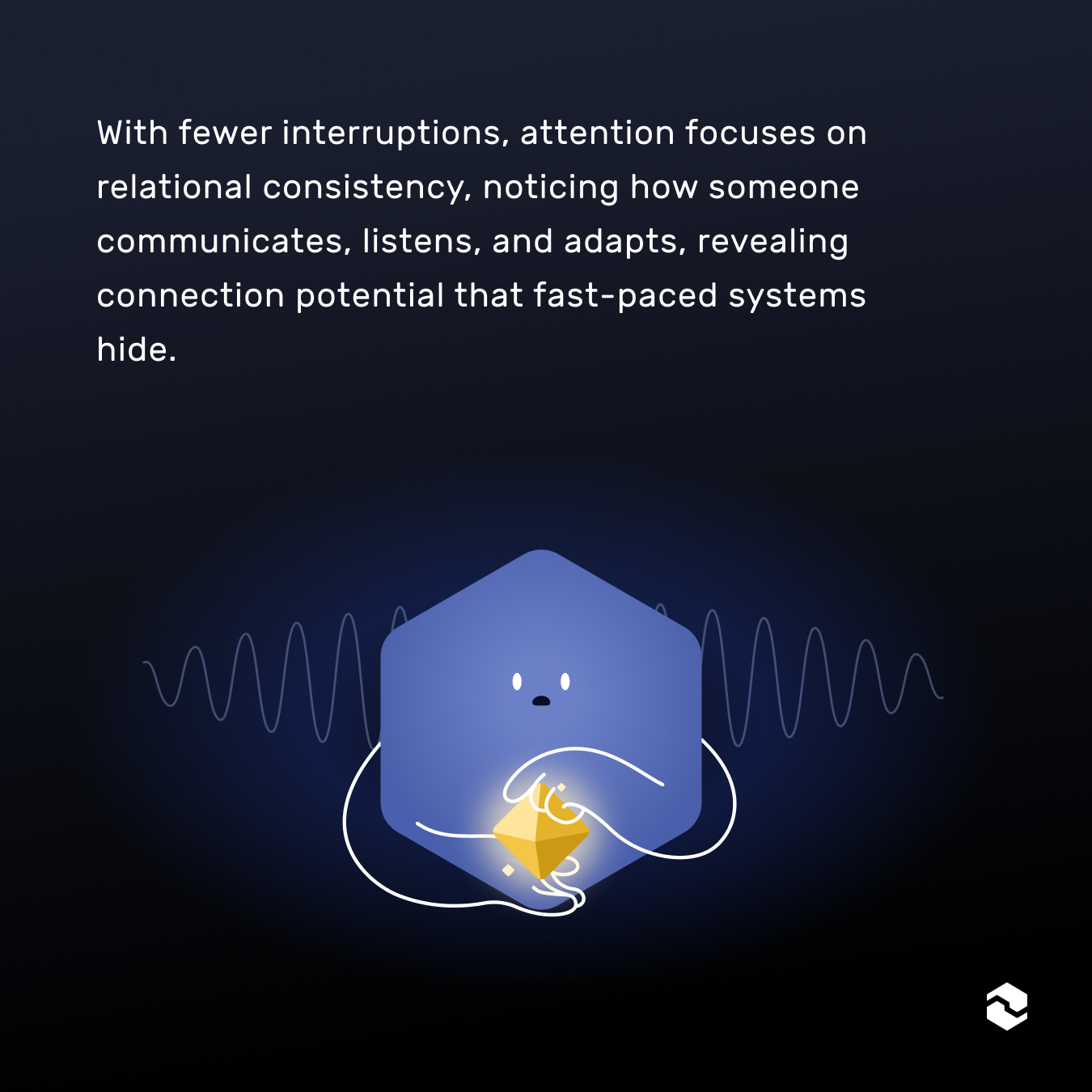
The importance of predictive clarity in human courtship:
Humans rely heavily on predictive processing to navigate social environments [22]. The brain constantly generates models of how others will behave, updating these models based on new information. When predictions are accurate, individuals experience psychological safety; when predictions consistently fail, anxiety increases [22,23,4]
Swipe culture undermines predictive clarity. Profiles offer minimal behavioral data, intentions change rapidly and communication patterns are inconsistent. This unpredictability forces the brain into a state of continual prediction error, a state linked to stress, rumination and emotional fatigue [23,24]
Curated matching helps restore predictive clarity. When individuals are matched based on stable traits, temperament, communication style and relational orientation, the likelihood of unexpected behavior decreases. This allows the brain's prediction models to stabilise, fostering a sense of consistency that supports emotional openness.[25]
This clarity is not merely "nice to have." It is essential for attachment. Humans bond when they can predict how another person will make them feel tomorrow, next week and next month. Curated matching increases the probability of such stability by reducing noise and aligning partners whose temperaments produce coherent emotional environments [21]
Cognitive load theory suggests that human working memory is limited and easily overwhelmed by extraneous information. Dating apps often violate this principle by exposing users to overwhelming choice and rapid-fire decision demands, activating stress and diminishing satisfaction [13,15].
Beyond Engagement: rejecting surveillance logic
Most dating platforms operate on surveillance capitalism’s logic: more engagement means more data; more data means more profit. The result is that feelings get treated as metrics. VLNCY redefines this relationship. It is designed to enhance emotional autonomy, not manipulate it. This is not “gamification” but guided introspection . Shifting the emphasis from behavioural nudging to self-understanding and deliberate choice. Traditional dating tech commodifies emotion; VLNCY explicitly resists this by limiting choice, adding human oversight and avoiding endless-scroll reward loops, so users don’t lose themselves in algorithms [15,20]
Human attachment is temporal, not instantaneous. The brain forms bonds through repeated cycles of anticipation and fulfillment, not through constant stimulation, with attachment research showing that predictability and repeated emotionally coherent interactions are foundational for secure bonds. When digital design compresses this rhythm, through instant feedback, read receipts and real-time visibility, this system is hampered, encouraging hypervigilance rather than secure expectation [21]
VLNCY challenges the dominant paradigm of dating technology by reducing emotional burnout among users and reducing compulsive user behaviour; where conventional apps compete for attention, VLNCY steps back to create mental space. Where algorithms predict, VLNCY listens, foregrounding human Relationship Managers and temperament over pure engagement metrics. Where platforms extract, VLNCY invests in long-term connections. In doing so, it reframes what technology should do in the context of relationships: not amplify our impulsivity but protect our capacity for depth. Such an approach may redefine what a thoughtful dating app in Bangalore can offer urban users.
VLNCY’s core insight is that technology doesn’t have to hijack emotion; it can foster REAL ones.
References:
[1] https://thedecisionlab.com/reference-guide/economics/the-paradox-of-choice
[2] Lerner TN. Interfacing behavioral and neural circuit models for habit formation. Journal of Neuroscience Research. 2020 Jan 8;98(6):1031–45.
[3] Bogacz R. Dopamine role in learning and action inference. eLife. 2020 Jul 7;9.
[4] Lee KM et al. Predictive processing models and affective neuroscience. Neuroscience & Biobehavioral Reviews. 2021 Sep 10;131:211–28.
[5] Shao R et al. Shifts in reinforcement signalling while playing slot-machines as a function of prior experience and impulsivity. Translational Psychiatry. 2013 Jan 15;3(1):e213.
[6] Schultz W. Dopamine reward prediction error coding. Dialogues in Clinical Neuroscience. 2016 Mar 31;18(1):23–32.
[7] Winstanley CA et al. Dopamine modulates reward expectancy during performance of a slot machine task in rats: evidence for a ‘Near-miss’ effect. Neuropsychopharmacology. 2011 Jan 5;36(5):913–25.
[8] The role of reinforcement schedules in behavioral interventions
[9] Kober H et al. Prefrontal–striatal pathway underlies cognitive regulation of craving. Proceedings of the National Academy of Sciences. 2010 Aug 2;107(33):14811–6.
[10] Tabibnia G et al. Common prefrontal regions activate during Self-Control of craving, emotion, and motor impulses in smokers.Clinical Psychological Science. 2014 Mar 18;2(5):611–9.
[11] Hoogland M, Ploeger A. Two different mismatches: integrating the developmental and the Evolutionary-Mismatch hypothesis. Perspectives on Psychological Science. 2022 Jul 14;17(6):1737–45.
[12] Goetz CD, Pillsworth EG, Buss DM, Conroy-Beam D. Evolutionary mismatch in mating. Frontiers in Psychology. 2019 Dec 4;10:2709.
[13] Iyengar SS, Lepper MR. When choice is demotivating: Can one desire too much of a good thing? >Journal of Personality and Social Psychology. 2000 Dec 1;79(6):995–1006.
[14] Schwartz B. The paradox of choice: why more is less.
[15] Clark, C. & Kimmons,Cognitive Load Theory R.EdTech Books.
[16] Arnsten A, Mazure CM, Sinha R. This is your brain in meltdown. Scientific American. 2012 Mar 23;30(2s):48.
[17] Brown LL, Acevedo B, Fisher HE. Neural correlates of four broad temperament dimensions: testing predictions for a novel construct of personality. PLoS ONE [Internet]. 2013 Nov 13;8(11):e78734.
[18] Fisher HE et al. Four broad temperament dimensions: description, convergent validation correlations, and comparison with the Big Five. Frontiers in Psychology [Internet]. 2015 Aug 3;6:1098.
[19] Cowan N. Working memory underpins cognitive development, learning, and education . Educational Psychology Review [Internet]. 2013 Dec 2;26(2):197–223.
[20] Laidler J, Laidler J. High tech is watching you [Internet]. Harvard Gazette. 2023.
[21] Hoehl S, Striano T. Interactional synchrony: signals, mechanisms and benefits. Soc Cogn Affect Neurosci. 2021;16(1-2):5-16.
[22] Friston K. The free-energy principle: a unified brain theory? Nature Reviews Neuroscience [Internet]. 2010 Jan 13;11(2):127–38.
[23] McGovern HT et al. Learned uncertainty: The free energy principle in anxiety. Frontiers in Psychology . 2022 Sep 6;13:943785.
[24] Griffin JD, Fletcher PC. Predictive processing, source monitoring, and psychosis. Annual Review of Clinical Psychology [Internet]. 2017 Apr 4;13(1):265–89.
[25] Wright CJ, Clark GI, Rock AJ, Coventry WL. Intolerance of uncertainty mediates the relationship between adult attachment and worry. Personality and Individual Differences. 2017;112:97–102.
[26] Personality – Helen Fisher, PhD .
[27] Sharabi LL, Von Feldt PA, Ha T. Burnt out and still single: Susceptibility to dating app burnout over time . New Media & Society [Internet]. 2024 Oct 19.
About the author:
Sharvani is a bioinformatics graduate and neuroscience enthusiast passionate about understanding behavior, emotion, and connection. She enjoys exploring how science and technology influence modern relationships. In her free time, she loves watching films and reading. Connect with her on LinkedIn
Vlncy: Designing digital dating systems that respect the human brain for meaningful connections
The system was never meant to help you find meaningful relationships, only to keep you looking. Digital dating was supposed to make connection easier; instead, it has turned intimacy into an interface [1]. We now live in an environment of infinite profiles and constant novelty, yet many people report more anxiety, loneliness and burnout than before [27]. The problem is not just whom we meet online, but how the systems themselves interact with the brain: every swipe, notification and delay in response subtly trains our nervous system to seek stimulation over steadiness [2,3,27]. This challenge is increasingly visible for anyone searching for a more intentional dating app in Bangalore.
Most dating apps are engineered around one principle: engagement. They are built to hold attention, not space. VLNCY emerged from a different question: What if dating design could work with our biology instead of against it?What if the future of dating wasn’t faster, but slower, less about stimulation? What if design could restore trust and attention in a system built to exploit our impulsivity? [5]
This is the ecosystem VLNCY seeks to change, not by rejecting technology, but by redesigning it from the inside out [4].
The problem: When design hijacks the brain
The swipe loop is not an accident. It’s an engineered behavioral trap [2]. Modern dating apps exploit the same neurochemical mechanisms as slot machines. Dating apps don’t reward users consistently. Instead, they operate on what behavioral psychologists call a variable ratio reinforcement schedule. You don’t know when a reward will come or what it will look like. One swipe leads to a match, another leads to nothing, and occasionally there’s a highly salient reward: attention, validation or perceived romantic potential.
This unpredictability is crucial. When rewards are uncertain, the brain releases more dopamine, not when the reward arrives, but in anticipation of it. These dopamine signals originate in the ventral tegmental area (VTA) and project to regions involved in motivation and habit formation, particularly the nucleus accumbens and prefrontal cortex.
Over time, the brain begins to associate the act of swiping itself with potential reward. This strengthens compulsive checking behaviors, reduces sensitivity to stable rewards and reinforces habitual engagement, even when the experience is emotionally unsatisfying. The system trains users to seek stimulation and novelty rather than connection or emotional regulation [5,6,7,8]
This constant stimulation floods the striatum (the brain’s “craving center”) while exhausting the prefrontal cortex, which governs empathy, patience and long-term reasoning. The result? Connection feels like consumption [9,10]
VLNCY begins by acknowledging this biological mismatch: we are using hunter-gatherer brains inside engagement-driven ecosystems. Its approach is not to moralise this, but to redesign the system that exploits it [11,12].
Dating is simple:
VLNCY’s structure is radically simple: users receive only five curated matches at a time.
This small number is not an aesthetic choice; it’s a cognitive intervention. Psychologists like Barry Schwartz (2004) and Iyengar & Lepper (2000) [13,14] have shown that too many choices increase anxiety, reduce satisfaction and cause decision fatigue. VLNCY applies this insight neurologically. By limiting choice, it preserves the prefrontal cortex’s attentional bandwidth, allowing users to think, feel and decide with clarity [15,16].
The role of Relationship Managers:
Technology cannot replace human intuition. VLNCY’s innovation lies in blending technological precision with human assessment. Each user is paired with a Relationship Manager, a real person who ensures that profiles are genuine, intentions are transparent and emotional alignment is preserved.
These Relationship Managers act as custodians of emotional integrity. They verify profiles through multi-step authentication, not merely through ID checks, but through conversational calibration and behavioral cues. This reduces fake profiles, manipulative behavior and performative self-presentation that plague most dating ecosystems.
Scientific matching: The Fisher Temperament Inventory
VLNCY’s matching logic draws from Dr. Helen Fisher’s Temperament Inventory (FTI), a neuroscience-based model linking attraction patterns to dominant neurochemical systems revolving around dopamine, serotonin, testosterone and estrogen. Rather than viewing compatibility as a single trait or preference, this model recognises that attraction emerges from stable neurobiological tendencies that shape how individuals think, feel, communicate and bond in relationships [17,18]
- Explorers (dopamine-dominant): Individuals with a dopamine-leaning profile tend to be energised by novelty, curiosity and reward-seeking.
- Builders (serotonin-dominant): Serotonin is strongly linked to emotional regulation, social stability and long-term planning.
- Directors (testosterone-dominant): Testosterone is associated with analytical thinking, decisiveness and goal-oriented behavior.
- Negotiators (estrogen-dominant): Estrogen is linked to empathy, emotional awareness and social sensitivity. [26]
By integrating this temperament-based framework, VLNCY’s matching logic aims to move beyond surface-level preferences and toward deeper psychological and neurobiological compatibility, helping individuals understand not only who they are attracted to, but why certain relational dynamics feel more natural and sustainable over time [17,18]
Rather than reducing attraction to aesthetics or hobbies, VLNCY matches individuals based on temperament compatibility, how their neurochemical patterns interact in communication, empathy and stress response.The human brain evolved for social bonding in small groups, not for processing thousands of potential partners [12]. Working memory is the limited-capacity system that allows us to reason, evaluate and choose. Traditional dating apps violate this cognitive principle by flooding users with endless options, triggering stress, decision fatigue and reduced satisfaction [15,19].
The importance of predictive clarity in human courtship:
Humans rely heavily on predictive processing to navigate social environments [22]. The brain constantly generates models of how others will behave, updating these models based on new information. When predictions are accurate, individuals experience psychological safety; when predictions consistently fail, anxiety increases [22,23,4]
Swipe culture undermines predictive clarity. Profiles offer minimal behavioral data, intentions change rapidly and communication patterns are inconsistent. This unpredictability forces the brain into a state of continual prediction error, a state linked to stress, rumination and emotional fatigue [23,24]
Curated matching helps restore predictive clarity. When individuals are matched based on stable traits, temperament, communication style and relational orientation, the likelihood of unexpected behavior decreases. This allows the brain's prediction models to stabilise, fostering a sense of consistency that supports emotional openness.[25]
This clarity is not merely "nice to have." It is essential for attachment. Humans bond when they can predict how another person will make them feel tomorrow, next week and next month. Curated matching increases the probability of such stability by reducing noise and aligning partners whose temperaments produce coherent emotional environments [21]
Cognitive load theory suggests that human working memory is limited and easily overwhelmed by extraneous information. Dating apps often violate this principle by exposing users to overwhelming choice and rapid-fire decision demands, activating stress and diminishing satisfaction [13,15].
Beyond Engagement: rejecting surveillance logic
Most dating platforms operate on surveillance capitalism’s logic: more engagement means more data; more data means more profit. The result is that feelings get treated as metrics. VLNCY redefines this relationship. It is designed to enhance emotional autonomy, not manipulate it. This is not “gamification” but guided introspection . Shifting the emphasis from behavioural nudging to self-understanding and deliberate choice. Traditional dating tech commodifies emotion; VLNCY explicitly resists this by limiting choice, adding human oversight and avoiding endless-scroll reward loops, so users don’t lose themselves in algorithms [15,20]
Human attachment is temporal, not instantaneous. The brain forms bonds through repeated cycles of anticipation and fulfillment, not through constant stimulation, with attachment research showing that predictability and repeated emotionally coherent interactions are foundational for secure bonds. When digital design compresses this rhythm, through instant feedback, read receipts and real-time visibility, this system is hampered, encouraging hypervigilance rather than secure expectation [21]
VLNCY challenges the dominant paradigm of dating technology by reducing emotional burnout among users and reducing compulsive user behaviour; where conventional apps compete for attention, VLNCY steps back to create mental space. Where algorithms predict, VLNCY listens, foregrounding human Relationship Managers and temperament over pure engagement metrics. Where platforms extract, VLNCY invests in long-term connections. In doing so, it reframes what technology should do in the context of relationships: not amplify our impulsivity but protect our capacity for depth. Such an approach may redefine what a thoughtful dating app in Bangalore can offer urban users.
VLNCY’s core insight is that technology doesn’t have to hijack emotion; it can foster REAL ones.
References:
[1] https://thedecisionlab.com/reference-guide/economics/the-paradox-of-choice
[2] Lerner TN. Interfacing behavioral and neural circuit models for habit formation. Journal of Neuroscience Research. 2020 Jan 8;98(6):1031–45.
[3] Bogacz R. Dopamine role in learning and action inference. eLife. 2020 Jul 7;9.
[4] Lee KM et al. Predictive processing models and affective neuroscience. Neuroscience & Biobehavioral Reviews. 2021 Sep 10;131:211–28.
[5] Shao R et al. Shifts in reinforcement signalling while playing slot-machines as a function of prior experience and impulsivity. Translational Psychiatry. 2013 Jan 15;3(1):e213.
[6] Schultz W. Dopamine reward prediction error coding. Dialogues in Clinical Neuroscience. 2016 Mar 31;18(1):23–32.
[7] Winstanley CA et al. Dopamine modulates reward expectancy during performance of a slot machine task in rats: evidence for a ‘Near-miss’ effect. Neuropsychopharmacology. 2011 Jan 5;36(5):913–25.
[8] The role of reinforcement schedules in behavioral interventions
[9] Kober H et al. Prefrontal–striatal pathway underlies cognitive regulation of craving. Proceedings of the National Academy of Sciences. 2010 Aug 2;107(33):14811–6.
[10] Tabibnia G et al. Common prefrontal regions activate during Self-Control of craving, emotion, and motor impulses in smokers.Clinical Psychological Science. 2014 Mar 18;2(5):611–9.
[11] Hoogland M, Ploeger A. Two different mismatches: integrating the developmental and the Evolutionary-Mismatch hypothesis. Perspectives on Psychological Science. 2022 Jul 14;17(6):1737–45.
[12] Goetz CD, Pillsworth EG, Buss DM, Conroy-Beam D. Evolutionary mismatch in mating. Frontiers in Psychology. 2019 Dec 4;10:2709.
[13] Iyengar SS, Lepper MR. When choice is demotivating: Can one desire too much of a good thing? >Journal of Personality and Social Psychology. 2000 Dec 1;79(6):995–1006.
[14] Schwartz B. The paradox of choice: why more is less.
[15] Clark, C. & Kimmons,Cognitive Load Theory R.EdTech Books.
[16] Arnsten A, Mazure CM, Sinha R. This is your brain in meltdown. Scientific American. 2012 Mar 23;30(2s):48.
[17] Brown LL, Acevedo B, Fisher HE. Neural correlates of four broad temperament dimensions: testing predictions for a novel construct of personality. PLoS ONE [Internet]. 2013 Nov 13;8(11):e78734.
[18] Fisher HE et al. Four broad temperament dimensions: description, convergent validation correlations, and comparison with the Big Five. Frontiers in Psychology [Internet]. 2015 Aug 3;6:1098.
[19] Cowan N. Working memory underpins cognitive development, learning, and education . Educational Psychology Review [Internet]. 2013 Dec 2;26(2):197–223.
[20] Laidler J, Laidler J. High tech is watching you [Internet]. Harvard Gazette. 2023.
[21] Hoehl S, Striano T. Interactional synchrony: signals, mechanisms and benefits. Soc Cogn Affect Neurosci. 2021;16(1-2):5-16.
[22] Friston K. The free-energy principle: a unified brain theory? Nature Reviews Neuroscience [Internet]. 2010 Jan 13;11(2):127–38.
[23] McGovern HT et al. Learned uncertainty: The free energy principle in anxiety. Frontiers in Psychology . 2022 Sep 6;13:943785.
[24] Griffin JD, Fletcher PC. Predictive processing, source monitoring, and psychosis. Annual Review of Clinical Psychology [Internet]. 2017 Apr 4;13(1):265–89.
[25] Wright CJ, Clark GI, Rock AJ, Coventry WL. Intolerance of uncertainty mediates the relationship between adult attachment and worry. Personality and Individual Differences. 2017;112:97–102.
[26] Personality – Helen Fisher, PhD .
[27] Sharabi LL, Von Feldt PA, Ha T. Burnt out and still single: Susceptibility to dating app burnout over time . New Media & Society [Internet]. 2024 Oct 19.
About the author:
Sharvani is a bioinformatics graduate and neuroscience enthusiast passionate about understanding behavior, emotion, and connection. She enjoys exploring how science and technology influence modern relationships. In her free time, she loves watching films and reading. Connect with her on LinkedIn

Your privacy matters most.
- We will never share your data with any third parties. Vlncy will always be an ad-free platform.
- We will use your anonymised data only to improve the platform, in our efforts to serve you better.
- We do not store/ own any of your content on our servers.
- Upon account deletion, we will purge all your personal data.
- We will never reveal your identity on the platform. Only you decide when, how and with whom your information is shared.


