You learned the language but skipped the work
At some point in the last decade, a particular kind of fluency became socially mandatory. You need to know your attachment style. You need to be able to name what your body does in moments of stress. You need, above all, to be working on yourself and to have the vocabulary to prove it. This is not therapy. It is something that looks similar, uses the same words, and wears the same earnest affection. It spread through podcasts and Instagram and the specific kind of friendship that involves sending each other articles at midnight. And it spread much, much faster than any of the things that actual change requires.
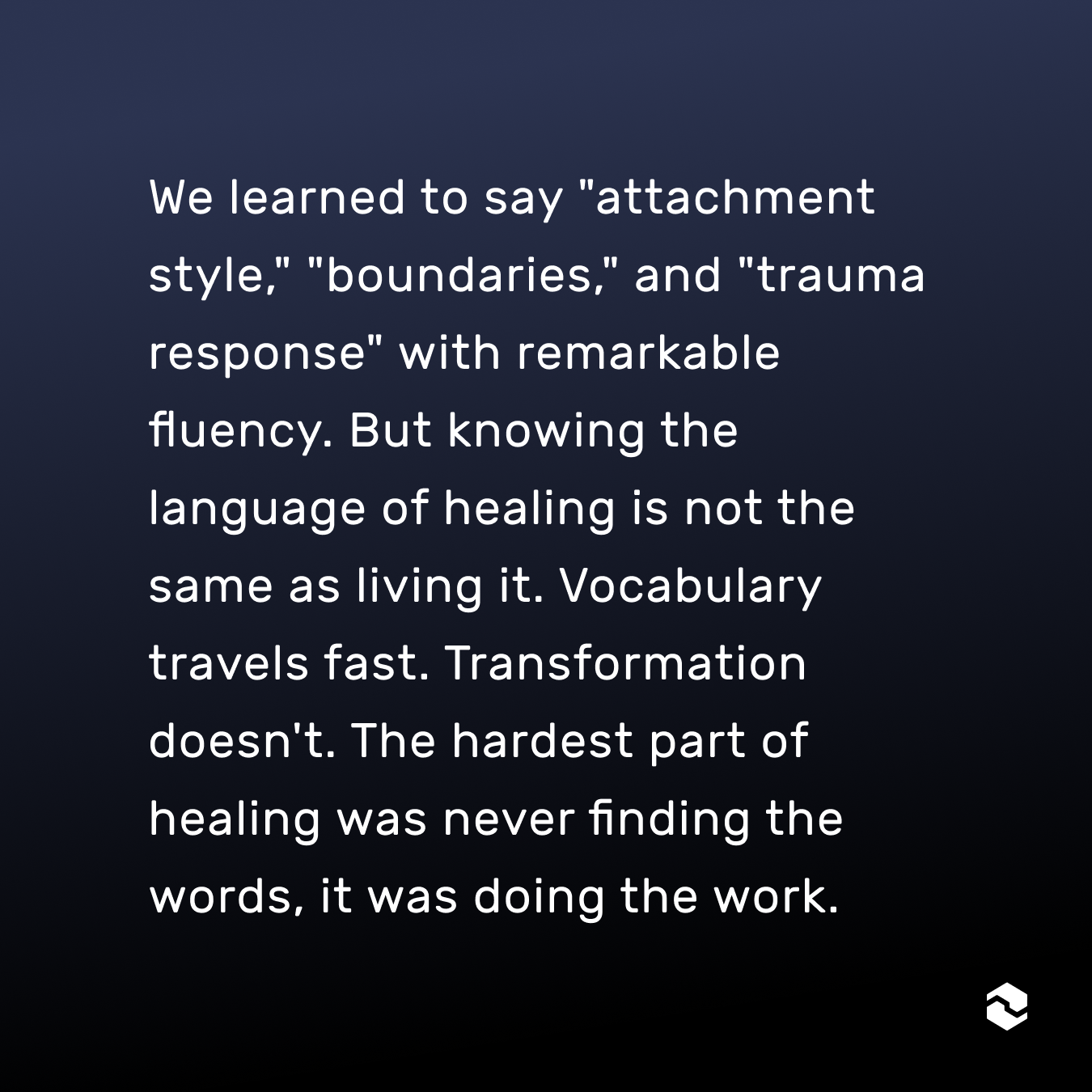
This is the peculiar condition of the 2020s: therapy culture has gone fully mainstream without the infrastructure to support it.This is the paradox at the heart of Instagram therapy culture: millions of people have access to the language of healing, but far fewer have access to the relationships and systems that make healing possible. The vocabulary arrived first. Words like "attachment style," "trauma response," "emotional dysregulation," and "nervous system" now appear in Instagram captions and first-date conversation. They migrated out of clinical rooms and into everyday speech quickly, carried by podcasts, TikTok therapists and a generation that had collectively decided that self-knowledge was both urgent and admirable.
But vocabulary is not a treatment. Naming a wound does not close it. And the infrastructure that actual therapeutic work requires, i.e., trained clinicians, accessible and affordable sessions, long-term relational containers in which growth can happen slowly, has not scaled at the same pace.The gap between the cultural aspiration and the structural reality is not incidental. It is the story.
Therapy culture is the set of ideas, language and aesthetic sensibilities that migrated out of clinical psychology and into everyday life. It is the reason people talk about their attachment styles on first dates, post about their nervous systems on Instagram, describe difficult colleagues as "triggering," and frame the act of cutting off a family member as "protecting their peace." It is not therapy. It is a cultural residue of therapy, the vocabulary and the frameworks, decoupled from the clinical relationship in which they were meant to be used. Instagram therapy culture rewards fluency with psychological language, but rarely creates the conditions that allow this language to become lasting behavioural change.
What the brain actually needs to change:
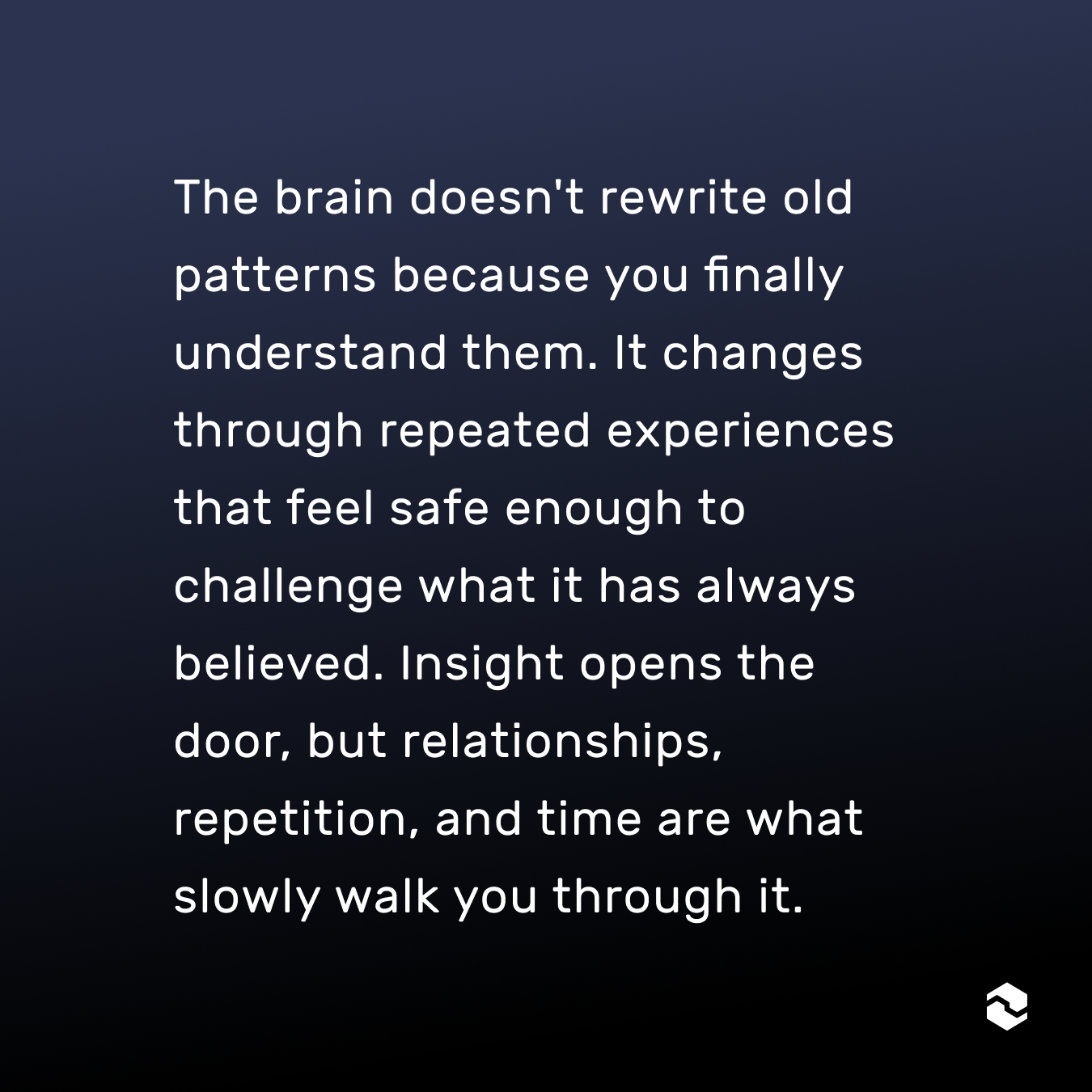
Here’s what therapy culture does not tell you: the brain does not update simply because you have learned new words for your patterns. Language is not the mechanism. It is, at best, a way in. What actually produces change in the brain is something slower and considerably less photogenic. Neuroscientists call it the default mode network, the system implicated in the kind of self-referential processing that underlies sense-making about one’s own life [2]. Not scrolling, not captioning. Making sense. Holding two contradictory feelings about the same person at the same time. Sitting with something you would rather not look at and looking at it anyway. The second thing therapy culture gets wrong is the assumption that this is a solo project. It is not. Developmental neuroscience has shown that the brain’s capacity for emotional integration is built through attuned relationships, and that it is revised the same way, through new relational experience over time [3]. The patterns that bring most people into therapy, the ones that now get named and posted and hashtagged were formed in early relational experience. They do not dissolve in isolation. They shift when a sustained, regulated relationship provides the conditions for a different experience to accumulate, slowly, over time.
This is what effective therapy actually produces: changes in how the brain's emotional alarm system and its reasoning centres talk to each other [4]. But it takes repetition. It takes weeks and months of the same relationship, the same room, the same person, which is consistent with what the psychotherapy research literature identifies as the common factors that drive durable change across treatment approaches [8].
The vocabulary without the container:
Instagram therapy culture encourages emotional disclosure in public spaces, yet disclosure alone is not the same as emotional processing. In 2020, psychologists had already spent more than a decade documenting the health consequences of loneliness before social media became the primary venue for communicating about emotional life [6]. What the pandemic accelerated was the decoupling of emotional language from emotional context: people began describing their internal states in public, to audiences, in real time, without the relational container, the sustained, boundaried, confidential relationship in which that description could be received and worked with.
This matters because the act of naming an emotional pattern is not the same as processing it. Writing about emotional experience produces benefits, but those benefits are moderated by the extent to which the writing involves constructing a coherent narrative not simply venting, not simply labelling [7]. What produces change is the effort of integration: placing the experience in time, seeing its causes, acknowledging its contradictions. A caption cannot not do this. A Story cannot not do this. A thread about your attachment style is not narrative integration; it is performance of familiarity with a framework.
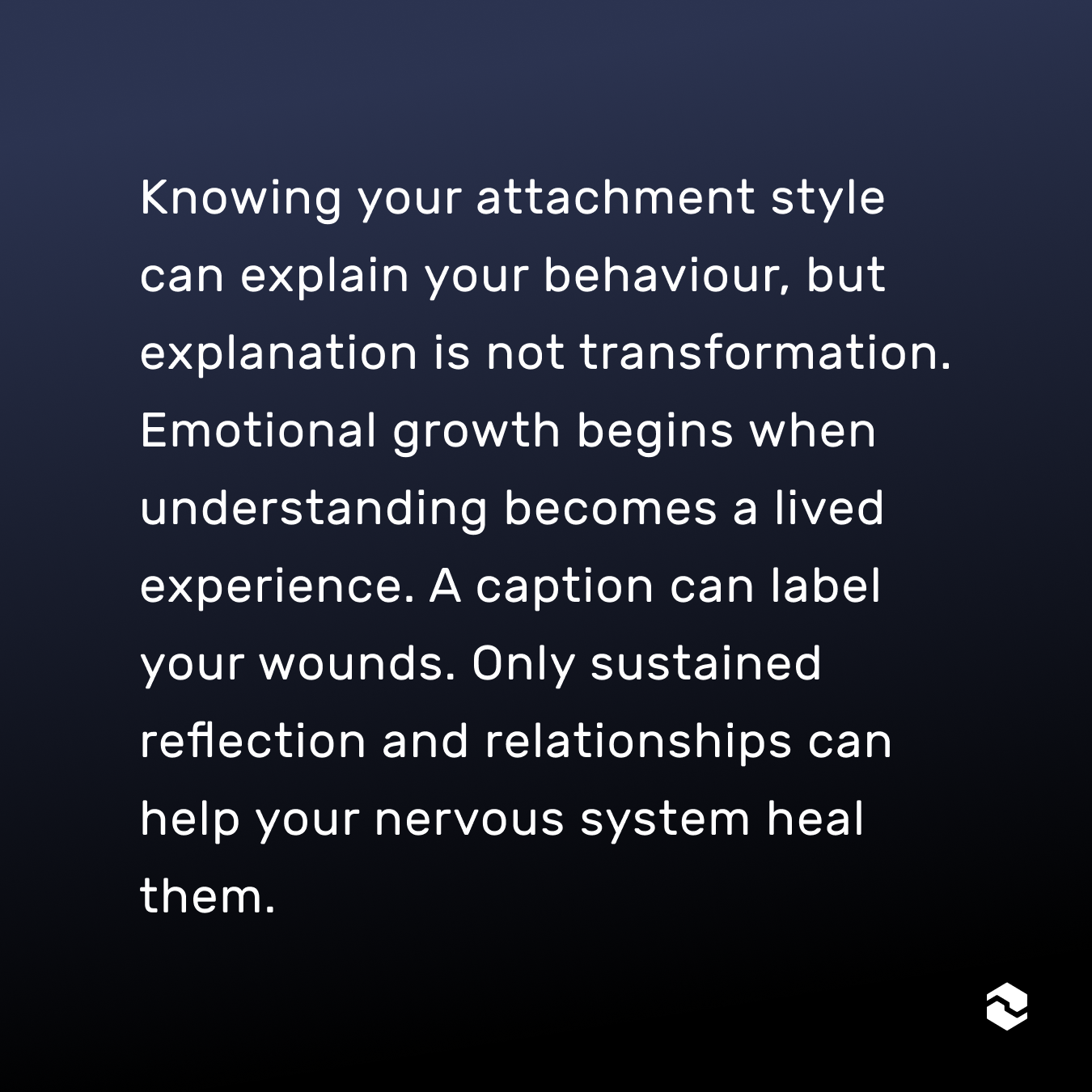
Research on intellectual vs emotional insight psychology offers a far more nuanced picture than popular therapy discourse suggests. Research consistently distinguishes between intellectual insight knowing, in an abstract way, that one has a particular pattern and emotional insight, which involves feeling the truth of that knowledge in a way that shifts behaviour [8]. Therapy culture has become extraordinarily good at producing the former. Someone can accurately identify themselves as anxiously attached, describe the developmental origins of that pattern with clinical precision, and then act it out in full in the following week.This distinction sits at the heart of intellectual vs emotional insight psychology: understanding a pattern cognitively is fundamentally different from experiencing it deeply enough to change behaviour.The literature on this gap suggests exactly why: identifying a pattern intellectually does not reliably produce the emotional insight that drives behavioural change.
The sociological texture of this is important. In urban professional contexts particularly among millennials and Gen Z in cities like London, New York, or Bangalore self-awareness has become a form of social currency. Research on self-presentation in networked social environments has shown that disclosure online is shaped by an imagined, often heterogeneous audience, and that people manage that disclosure strategically, in ways that resemble personal branding more than private reflection [9]. People are not posting about their healing to heal. They are posting about their healing to signal membership in a particular kind of educated, introspective, emotionally literate community. The audience rewards the announcement, not the quiet and largely invisible work.
The Individualism problem: accountability is relational
Something that therapy culture completely misses as it has been absorbed into mainstream culture is that self-knowledge is something you can pursue alone. The journal. The meditation app. The podcast, listened to on a commute. The weekend retreat. All of these are framed as individual projects: you, going inward, doing the work, emerging, changed. The language of “the work” is itself revealing, in the way it casts inner change as a private labour performed on the self, for the self, by the self alone, an emphasis on self-reliant striving that has deep roots in American cultural individualism [12].
This framing collides directly with what social neuroscience has established about how humans regulate their emotions. James Gross’s process model of emotion regulation, one of the most cited frameworks in affective neuroscience, identifies a range of strategies people use to manage their internal states [10]. But the capacity to manage one’s own emotional states is scaffolded, in infancy and throughout life, by the presence of another regulated nervous system: experimental work using fMRI has shown that simply holding the hand of a trusted partner attenuates neural threat responses, and that the effect strengthens with relationship quality [11]. We learn, neurologically, to calm down in the presence of someone who is calm. We learn to tolerate distress in the presence of someone who can tolerate it with us.
This makes accountability, the process of genuinely reckoning with one's patterns and their effects on others, irreducibly relational. You cannot do it in your journal. You can prepare for it there. You can notice things there. But the reckoning itself requires another: someone who has experienced your pattern, who is present enough to name what they see, and who will not collude with your preferred self-narrative. Therapy provides a structured version of this. So do certain friendships. So do some communities. What it cannot be is a solo project.
The performance of self-awareness:
Perhaps nowhere is Instagram therapy culture more visible than in the performance of self-awareness on social media. Social media did not invent the performance of self-knowledge, but it has industrialised it. The confessional impulse, and the idea that narrating one’s inner life is morally and spiritually valuable, has deep roots in Western culture, and the emotional labour of managing and performing one’s feelings for others has long been a feature of public and commercial life, not a new one [15].
The neuroscience of social reward is relevant here. Self-disclosure activates reward-related neural circuitry, the same dopaminergic system involved more broadly in processing reward [13]. The mesolimbic pathways implicated in this kind of reward signalling are well characterised in the broader neuroscience of reward and decision-making [5]. People find talking about themselves intrinsically rewarding, independent of whether the talking produces any insight. When that self-disclosure is made public and receives positive social feedback, the loop tightens: the brain encodes the disclosure as successful not because it was honest or generative but because it was affirmed. This creates a condition in which the feeling of doing therapeutic work, posting, disclosing, naming, is neurologically reinforced in much the same way that actually doing therapeutic work might be, without any of the change.
The cultural dimensions of this performance vary significantly across contexts. In South Asian urban professional communities in cities like Bangalore or Mumbai, where a globalised educated class has absorbed therapy discourse alongside Western media, the performance of self-awareness goes through additional layers of complexity. There are family structures in which the very act of naming an emotion publicly is transgressive. There are communal obligations that make individual therapeutic language feel not just unfamiliar but actively alienating. The vocabulary arrived via Instagram and podcasts, but the contexts in which it might be applied: the family dinner table, the arranged marriage negotiation, the intergenerational home are not the contexts the vocabulary was built for.
The system that produced this gap:

Therapy culture did not go mainstream by accident. It was carried there by specific structural forces, and understanding those forces is necessary for understanding why the gap between language and access looks the way it does.
The commodification of wellness is central to this. Since the early 2000s, the wellness industry has expanded to encompass mental health, with meditation apps, journaling products, therapy-adjacent coaching, and content creators all positioned as alternatives to or supplements for clinical care. The wellness economy in 2019 estimated global revenues at over four trillion dollars, with mental wellness as one of the fastest-growing segments [14]. This is not incidental to the problem. The market has a strong interest in selling the language and aesthetics of therapeutic work without requiring the conditions that actual work demands. A journal costs around 200 rupees. Whereas a session with a qualified therapist costs thousands and is often inaccessible, and is frequently not covered by insurance or public health systems.
The research on narrative integration suggests that writing about emotional experience produces genuine benefit when it involves making sense of experience over time, not simply labelling it [7]. Journaling that asks "what happened" and "what does this mean about me" is different from journaling that asks "how did this feel in the moment." The former builds coherent self-narrative. The latter builds emotional fluency without integration.
The social neuroscience on co-regulation suggests that seeking embodied, sustained presence with regulated others is not optional for emotional change; it is the mechanism [10, 11]. This means actual relationships, not parasocial ones. A therapist, yes, but also a friendship in which genuine accountability is possible, in which the other person is not required to affirm your preferred narrative of yourself.

The mainstreaming of therapy culture is not cynical. It emerged from genuine need, from a generation that was, by almost every measure, experiencing more anxiety, more depression, and more relational instability than the ones before it; cross-temporal analyses of clinical symptom measures across decades of young Americans bear this out directly, showing a substantial generational rise in reported psychopathology even before accounting for any single cultural trigger [16]. The language landed because it named real things. That is not nothing.
Neuroscience says the brain changes slowly, relationally, through repeated experience in sustained conditions. Ultimately, intellectual vs emotional insight psychology reminds us that lasting change depends less on what we know about ourselves than on what we repeatedly experience in safe, supportive relationships. Social neuroscience says the nervous system is a social organ, not a solo project. Sociology says the structural forces that shape whether any of this is actually accessible cost, time, trained clinicians, relational communities are not being addressed by the proliferation of content about it.
Knowing your attachment style is not the same as changing your relationships.If Instagram therapy culture has taught us anything, it is that language can begin healing, but it cannot replace the slow, relational work that healing actually requires. And maybe the more honest question, the one that the healing-era caption cannot hold, is this: who is actually in the room with you, and are you willing to let them see what you see in yourself?
References
[1] Busch AB, Barry CL. Mental health disorders: the United States faces shortages. Health Affairs. 2008;27(3):667-678.
[2] Buckner RL, Andrews-Hanna JR, Schacter DL. The brain’s default network: anatomy, function, and relevance to disease. Ann N Y Acad Sci. 2008;1124:1-38.
[3] Siegel DJ. Toward an interpersonal neurobiology of the developing mind: attachment relationships, “mindsight,” and neural integration. Infant Ment Health J. 2001;22(1):67-94.
[4] Dichter GS, Felder JN, Smoski MJ. The effects of Brief Behavioral Activation Therapy for Depression on cognitive control in affective contexts: an fMRI investigation. J Affect Disord. 2010;126(1-2):236-244.
[5] Schultz W. Neuronal reward and decision signals: from theories to data. Physiol Rev. 2015;95(3):853-951.
[6] Cacioppo JT, Hawkley LC. Perceived social isolation and cognition. Trends Cogn Sci. 2009;13(10):447-454.
[7] Pennebaker JW, Smyth JM. Opening Up by Writing It Down: How Expressive Writing Improves Health and Eases Emotional Pain. 3rd ed. New York: Guilford Press; 2016.
[8] Wampold BE. How important are the common factors in psychotherapy? An update. World Psychiatry. 2015;14(3):270-277.
[9] Marwick AE, Boyd D. I tweet honestly, I tweet passionately: Twitter users, context collapse, and the imagined audience. New Media Soc. 2011;13(1):114-133.
[10] Gross JJ. Emotion regulation: Current status and future prospects. Psychol Inq. 2015;26(1):1-26.
[11] Coan JA, Schaefer HS, Davidson RJ. Lending a hand: social regulation of the neural response to threat. Psychol Sci. 2006;17(12):1032-1039.
[12] Bellah RN, Madsen R, Sullivan WM, Swidler A, Tipton SM. Habits of the Heart: Individualism and Commitment in American Life. Berkeley: University of California Press; 1985.
[13] Tamir DI, Mitchell JP. Disclosing information about the self is intrinsically rewarding. Proc Natl Acad Sci USA. 2012;109(21):8038-8043.
[14] Global Wellness Institute. Global Wellness Economy Monitor. 2019.
[15] Hochschild AR. The Managed Heart: Commercialization of Human Feeling. Berkeley: University of California Press; 1983.
[16] Twenge JM, Gentile B, DeWall CN, Ma D, Lacefield K, Schurtz DR. Birth cohort increases in psychopathology among young Americans, 1938-2007: a cross-temporal meta-analysis of the MMPI. Clin Psychol Rev. 2010;30(2):145-154.
About the author:
Sharvani is a bioinformatics graduate and neuroscience enthusiast passionate about understanding behavior, emotion, and connection. She enjoys exploring how science and technology influence modern relationships. In her free time, she loves watching films and reading. Connect with her on LinkedIn
You learned the language but skipped the work
At some point in the last decade, a particular kind of fluency became socially mandatory. You need to know your attachment style. You need to be able to name what your body does in moments of stress. You need, above all, to be working on yourself and to have the vocabulary to prove it. This is not therapy. It is something that looks similar, uses the same words, and wears the same earnest affection. It spread through podcasts and Instagram and the specific kind of friendship that involves sending each other articles at midnight. And it spread much, much faster than any of the things that actual change requires.
This is the peculiar condition of the 2020s: therapy culture has gone fully mainstream without the infrastructure to support it.This is the paradox at the heart of Instagram therapy culture: millions of people have access to the language of healing, but far fewer have access to the relationships and systems that make healing possible. The vocabulary arrived first. Words like "attachment style," "trauma response," "emotional dysregulation," and "nervous system" now appear in Instagram captions and first-date conversation. They migrated out of clinical rooms and into everyday speech quickly, carried by podcasts, TikTok therapists and a generation that had collectively decided that self-knowledge was both urgent and admirable.
But vocabulary is not a treatment. Naming a wound does not close it. And the infrastructure that actual therapeutic work requires, i.e., trained clinicians, accessible and affordable sessions, long-term relational containers in which growth can happen slowly, has not scaled at the same pace.The gap between the cultural aspiration and the structural reality is not incidental. It is the story.
Therapy culture is the set of ideas, language and aesthetic sensibilities that migrated out of clinical psychology and into everyday life. It is the reason people talk about their attachment styles on first dates, post about their nervous systems on Instagram, describe difficult colleagues as "triggering," and frame the act of cutting off a family member as "protecting their peace." It is not therapy. It is a cultural residue of therapy, the vocabulary and the frameworks, decoupled from the clinical relationship in which they were meant to be used. Instagram therapy culture rewards fluency with psychological language, but rarely creates the conditions that allow this language to become lasting behavioural change.
What the brain actually needs to change:
Here’s what therapy culture does not tell you: the brain does not update simply because you have learned new words for your patterns. Language is not the mechanism. It is, at best, a way in. What actually produces change in the brain is something slower and considerably less photogenic. Neuroscientists call it the default mode network, the system implicated in the kind of self-referential processing that underlies sense-making about one’s own life [2]. Not scrolling, not captioning. Making sense. Holding two contradictory feelings about the same person at the same time. Sitting with something you would rather not look at and looking at it anyway. The second thing therapy culture gets wrong is the assumption that this is a solo project. It is not. Developmental neuroscience has shown that the brain’s capacity for emotional integration is built through attuned relationships, and that it is revised the same way, through new relational experience over time [3]. The patterns that bring most people into therapy, the ones that now get named and posted and hashtagged were formed in early relational experience. They do not dissolve in isolation. They shift when a sustained, regulated relationship provides the conditions for a different experience to accumulate, slowly, over time.
This is what effective therapy actually produces: changes in how the brain's emotional alarm system and its reasoning centres talk to each other [4]. But it takes repetition. It takes weeks and months of the same relationship, the same room, the same person, which is consistent with what the psychotherapy research literature identifies as the common factors that drive durable change across treatment approaches [8].
The vocabulary without the container:
Instagram therapy culture encourages emotional disclosure in public spaces, yet disclosure alone is not the same as emotional processing. In 2020, psychologists had already spent more than a decade documenting the health consequences of loneliness before social media became the primary venue for communicating about emotional life [6]. What the pandemic accelerated was the decoupling of emotional language from emotional context: people began describing their internal states in public, to audiences, in real time, without the relational container, the sustained, boundaried, confidential relationship in which that description could be received and worked with.
This matters because the act of naming an emotional pattern is not the same as processing it. Writing about emotional experience produces benefits, but those benefits are moderated by the extent to which the writing involves constructing a coherent narrative not simply venting, not simply labelling [7]. What produces change is the effort of integration: placing the experience in time, seeing its causes, acknowledging its contradictions. A caption cannot not do this. A Story cannot not do this. A thread about your attachment style is not narrative integration; it is performance of familiarity with a framework.
Research on intellectual vs emotional insight psychology offers a far more nuanced picture than popular therapy discourse suggests. Research consistently distinguishes between intellectual insight knowing, in an abstract way, that one has a particular pattern and emotional insight, which involves feeling the truth of that knowledge in a way that shifts behaviour [8]. Therapy culture has become extraordinarily good at producing the former. Someone can accurately identify themselves as anxiously attached, describe the developmental origins of that pattern with clinical precision, and then act it out in full in the following week.This distinction sits at the heart of intellectual vs emotional insight psychology: understanding a pattern cognitively is fundamentally different from experiencing it deeply enough to change behaviour.The literature on this gap suggests exactly why: identifying a pattern intellectually does not reliably produce the emotional insight that drives behavioural change.
The sociological texture of this is important. In urban professional contexts particularly among millennials and Gen Z in cities like London, New York, or Bangalore self-awareness has become a form of social currency. Research on self-presentation in networked social environments has shown that disclosure online is shaped by an imagined, often heterogeneous audience, and that people manage that disclosure strategically, in ways that resemble personal branding more than private reflection [9]. People are not posting about their healing to heal. They are posting about their healing to signal membership in a particular kind of educated, introspective, emotionally literate community. The audience rewards the announcement, not the quiet and largely invisible work.
The Individualism problem: accountability is relational
Something that therapy culture completely misses as it has been absorbed into mainstream culture is that self-knowledge is something you can pursue alone. The journal. The meditation app. The podcast, listened to on a commute. The weekend retreat. All of these are framed as individual projects: you, going inward, doing the work, emerging, changed. The language of “the work” is itself revealing, in the way it casts inner change as a private labour performed on the self, for the self, by the self alone, an emphasis on self-reliant striving that has deep roots in American cultural individualism [12].
This framing collides directly with what social neuroscience has established about how humans regulate their emotions. James Gross’s process model of emotion regulation, one of the most cited frameworks in affective neuroscience, identifies a range of strategies people use to manage their internal states [10]. But the capacity to manage one’s own emotional states is scaffolded, in infancy and throughout life, by the presence of another regulated nervous system: experimental work using fMRI has shown that simply holding the hand of a trusted partner attenuates neural threat responses, and that the effect strengthens with relationship quality [11]. We learn, neurologically, to calm down in the presence of someone who is calm. We learn to tolerate distress in the presence of someone who can tolerate it with us.
This makes accountability, the process of genuinely reckoning with one's patterns and their effects on others, irreducibly relational. You cannot do it in your journal. You can prepare for it there. You can notice things there. But the reckoning itself requires another: someone who has experienced your pattern, who is present enough to name what they see, and who will not collude with your preferred self-narrative. Therapy provides a structured version of this. So do certain friendships. So do some communities. What it cannot be is a solo project.
The performance of self-awareness:
Perhaps nowhere is Instagram therapy culture more visible than in the performance of self-awareness on social media. Social media did not invent the performance of self-knowledge, but it has industrialised it. The confessional impulse, and the idea that narrating one’s inner life is morally and spiritually valuable, has deep roots in Western culture, and the emotional labour of managing and performing one’s feelings for others has long been a feature of public and commercial life, not a new one [15].
The neuroscience of social reward is relevant here. Self-disclosure activates reward-related neural circuitry, the same dopaminergic system involved more broadly in processing reward [13]. The mesolimbic pathways implicated in this kind of reward signalling are well characterised in the broader neuroscience of reward and decision-making [5]. People find talking about themselves intrinsically rewarding, independent of whether the talking produces any insight. When that self-disclosure is made public and receives positive social feedback, the loop tightens: the brain encodes the disclosure as successful not because it was honest or generative but because it was affirmed. This creates a condition in which the feeling of doing therapeutic work, posting, disclosing, naming, is neurologically reinforced in much the same way that actually doing therapeutic work might be, without any of the change.
The cultural dimensions of this performance vary significantly across contexts. In South Asian urban professional communities in cities like Bangalore or Mumbai, where a globalised educated class has absorbed therapy discourse alongside Western media, the performance of self-awareness goes through additional layers of complexity. There are family structures in which the very act of naming an emotion publicly is transgressive. There are communal obligations that make individual therapeutic language feel not just unfamiliar but actively alienating. The vocabulary arrived via Instagram and podcasts, but the contexts in which it might be applied: the family dinner table, the arranged marriage negotiation, the intergenerational home are not the contexts the vocabulary was built for.
The system that produced this gap:
Therapy culture did not go mainstream by accident. It was carried there by specific structural forces, and understanding those forces is necessary for understanding why the gap between language and access looks the way it does.
The commodification of wellness is central to this. Since the early 2000s, the wellness industry has expanded to encompass mental health, with meditation apps, journaling products, therapy-adjacent coaching, and content creators all positioned as alternatives to or supplements for clinical care. The wellness economy in 2019 estimated global revenues at over four trillion dollars, with mental wellness as one of the fastest-growing segments [14]. This is not incidental to the problem. The market has a strong interest in selling the language and aesthetics of therapeutic work without requiring the conditions that actual work demands. A journal costs around 200 rupees. Whereas a session with a qualified therapist costs thousands and is often inaccessible, and is frequently not covered by insurance or public health systems.
The research on narrative integration suggests that writing about emotional experience produces genuine benefit when it involves making sense of experience over time, not simply labelling it [7]. Journaling that asks "what happened" and "what does this mean about me" is different from journaling that asks "how did this feel in the moment." The former builds coherent self-narrative. The latter builds emotional fluency without integration.
The social neuroscience on co-regulation suggests that seeking embodied, sustained presence with regulated others is not optional for emotional change; it is the mechanism [10, 11]. This means actual relationships, not parasocial ones. A therapist, yes, but also a friendship in which genuine accountability is possible, in which the other person is not required to affirm your preferred narrative of yourself.
The mainstreaming of therapy culture is not cynical. It emerged from genuine need, from a generation that was, by almost every measure, experiencing more anxiety, more depression, and more relational instability than the ones before it; cross-temporal analyses of clinical symptom measures across decades of young Americans bear this out directly, showing a substantial generational rise in reported psychopathology even before accounting for any single cultural trigger [16]. The language landed because it named real things. That is not nothing.
Neuroscience says the brain changes slowly, relationally, through repeated experience in sustained conditions. Ultimately, intellectual vs emotional insight psychology reminds us that lasting change depends less on what we know about ourselves than on what we repeatedly experience in safe, supportive relationships. Social neuroscience says the nervous system is a social organ, not a solo project. Sociology says the structural forces that shape whether any of this is actually accessible cost, time, trained clinicians, relational communities are not being addressed by the proliferation of content about it.
Knowing your attachment style is not the same as changing your relationships.If Instagram therapy culture has taught us anything, it is that language can begin healing, but it cannot replace the slow, relational work that healing actually requires. And maybe the more honest question, the one that the healing-era caption cannot hold, is this: who is actually in the room with you, and are you willing to let them see what you see in yourself?
References
[1] Busch AB, Barry CL. Mental health disorders: the United States faces shortages. Health Affairs. 2008;27(3):667-678.
[2] Buckner RL, Andrews-Hanna JR, Schacter DL. The brain’s default network: anatomy, function, and relevance to disease. Ann N Y Acad Sci. 2008;1124:1-38.
[3] Siegel DJ. Toward an interpersonal neurobiology of the developing mind: attachment relationships, “mindsight,” and neural integration. Infant Ment Health J. 2001;22(1):67-94.
[4] Dichter GS, Felder JN, Smoski MJ. The effects of Brief Behavioral Activation Therapy for Depression on cognitive control in affective contexts: an fMRI investigation. J Affect Disord. 2010;126(1-2):236-244.
[5] Schultz W. Neuronal reward and decision signals: from theories to data. Physiol Rev. 2015;95(3):853-951.
[6] Cacioppo JT, Hawkley LC. Perceived social isolation and cognition. Trends Cogn Sci. 2009;13(10):447-454.
[7] Pennebaker JW, Smyth JM. Opening Up by Writing It Down: How Expressive Writing Improves Health and Eases Emotional Pain. 3rd ed. New York: Guilford Press; 2016.
[8] Wampold BE. How important are the common factors in psychotherapy? An update. World Psychiatry. 2015;14(3):270-277.
[9] Marwick AE, Boyd D. I tweet honestly, I tweet passionately: Twitter users, context collapse, and the imagined audience. New Media Soc. 2011;13(1):114-133.
[10] Gross JJ. Emotion regulation: Current status and future prospects. Psychol Inq. 2015;26(1):1-26.
[11] Coan JA, Schaefer HS, Davidson RJ. Lending a hand: social regulation of the neural response to threat. Psychol Sci. 2006;17(12):1032-1039.
[12] Bellah RN, Madsen R, Sullivan WM, Swidler A, Tipton SM. Habits of the Heart: Individualism and Commitment in American Life. Berkeley: University of California Press; 1985.
[13] Tamir DI, Mitchell JP. Disclosing information about the self is intrinsically rewarding. Proc Natl Acad Sci USA. 2012;109(21):8038-8043.
[14] Global Wellness Institute. Global Wellness Economy Monitor. 2019.
[15] Hochschild AR. The Managed Heart: Commercialization of Human Feeling. Berkeley: University of California Press; 1983.
[16] Twenge JM, Gentile B, DeWall CN, Ma D, Lacefield K, Schurtz DR. Birth cohort increases in psychopathology among young Americans, 1938-2007: a cross-temporal meta-analysis of the MMPI. Clin Psychol Rev. 2010;30(2):145-154.
About the author:
Sharvani is a bioinformatics graduate and neuroscience enthusiast passionate about understanding behavior, emotion, and connection. She enjoys exploring how science and technology influence modern relationships. In her free time, she loves watching films and reading. Connect with her on LinkedIn

Your privacy matters most.
- We will never share your data with any third parties. Vlncy will always be an ad-free platform.
- We will use your anonymised data only to improve the platform, in our efforts to serve you better.
- We do not store/ own any of your content on our servers.
- Upon account deletion, we will purge all your personal data.
- We will never reveal your identity on the platform. Only you decide when, how and with whom your information is shared.


