The disappearance of courtship
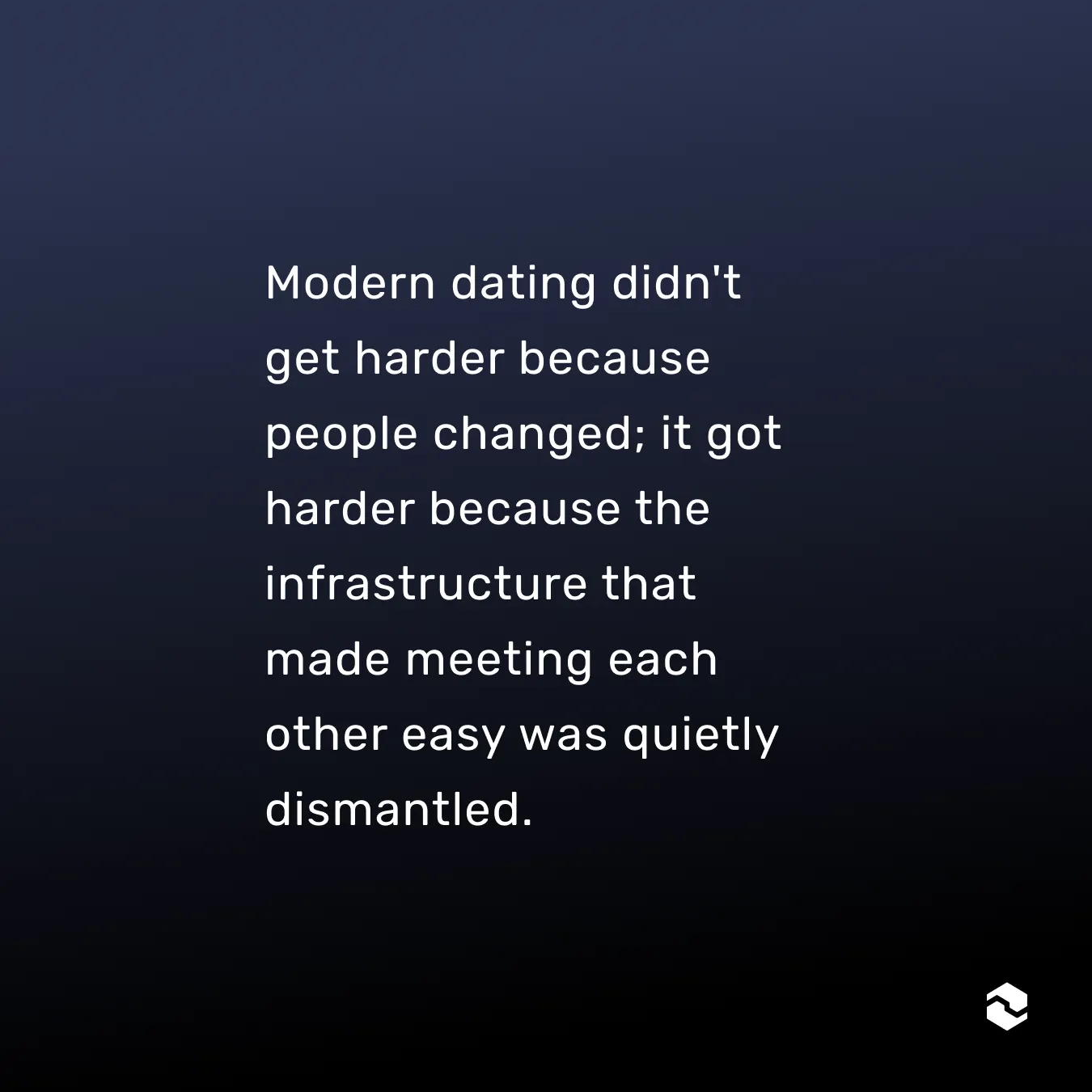
Something has gone wrong with modern dating, and most people feel it even if they can't say exactly what it is. It is not the ordinary pain of a breakup, or the sting of being rejected by someone you liked. It is something quieter than that and more confusing. It is the feeling that the whole process has broken down, that the rules changed when nobody was looking and that you are now playing a game whose logic you cannot quite follow. Not heartbreak in the traditional sense, but grief for a way of being pursued, and of pursuing, that the current dating landscape seems structurally unable to provide.
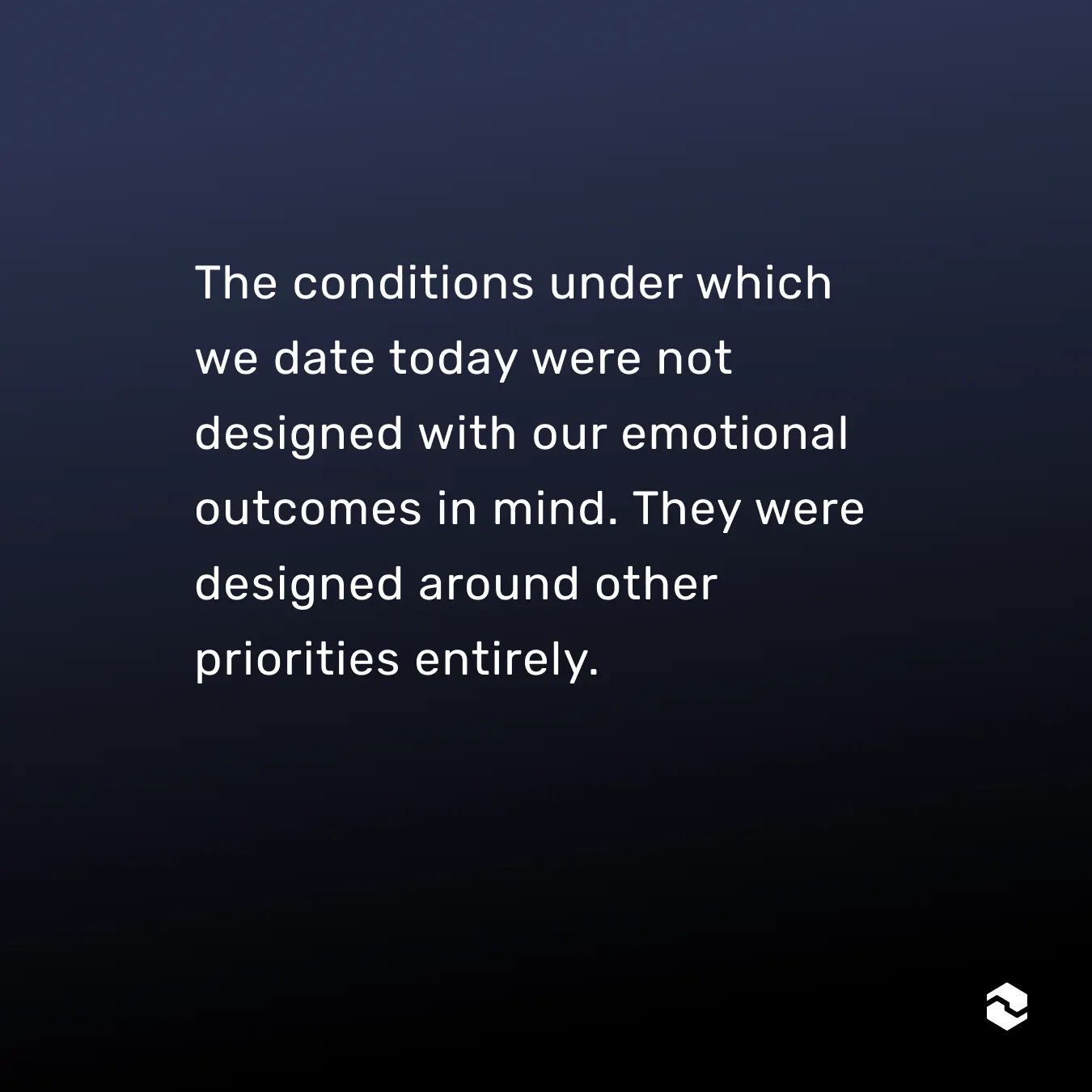
The sociologist Eva Illouz, who has spent decades studying the relationship between modern capitalism and romantic life, argues that this grief is not irrational and it is not a personal failing. In her book Why Love Hurts, she makes a case that might feel uncomfortable at first: that romantic suffering in the modern era is not something that happens to unlucky or emotionally broken people. It is something the system reliably produces [1]. The conditions under which we date today were not designed with our emotional outcomes in mind. They were designed around other priorities entirely. The pain many people feel is the accurate perception of a real structural problem, not evidence that they are doing something wrong.
What courtship actually was
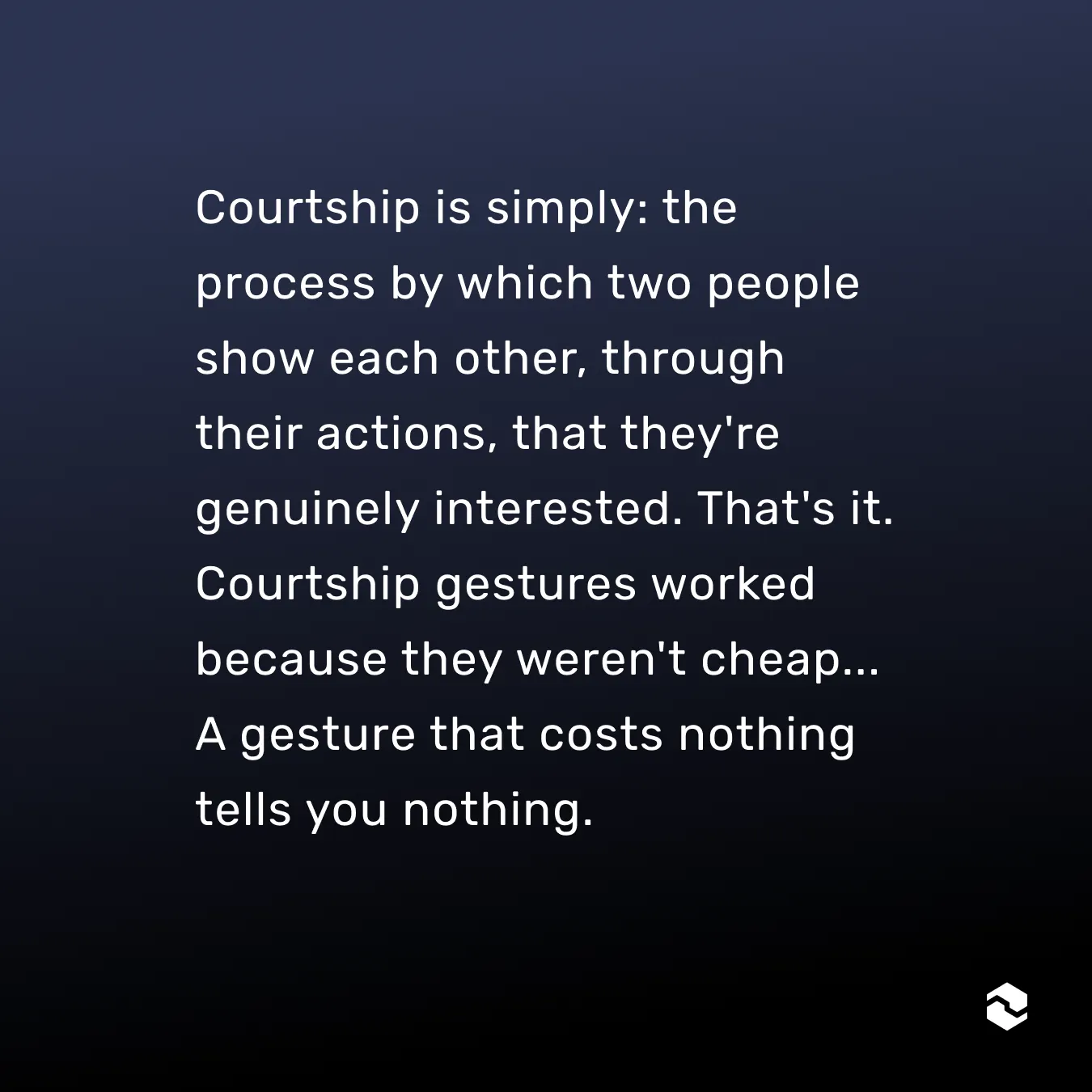
Courtship doesn't mean what most people think it means. It’s not men paying for everything or some set of old-fashioned rules we should want back. Strip all of that away and courtship is simply the process by which two people show each other, through their actions, that they're genuinely interested. That's it. But that simple thing turns out to matter enormously.
When you asked someone out, you risked rejection. When you planned a date, you spent time and thought about that person. When you kept showing up, you were making yourself vulnerable. None of these things were free. They cost something: courage, time and emotional risk. And because they cost something, they meant something. If someone did all of that for you, you had real evidence they actually wanted to be there. The actions proved the intention.
There's a formal theory behind this intuition. In 1975, zoologist Amotz Zahavi was studying how animals signal to each other and proposed what he called the handicap principle: signals are only trustworthy when they're expensive to fake [2]. A peacock's tail is so enormous and impractical that only a genuinely healthy bird can maintain one, which is exactly what makes it convincing as a signal. Applying the handicap principle to dating captures something essential about human behavior: a gesture that costs nothing tells you nothing. Courtship gestures worked because they weren't cheap.
Here's where things start to break down. The sociologists Ulrich Beck and Elisabeth Beck-Gernsheim pointed out in 1995 that modern life asks us to embrace two conflicting approaches [3]. One approach prizes personal freedom, self-development and keeping your options open. The other values deep, committed love, which requires vulnerability, compromise and closing certain options off. These two ways are genuinely at odds with each other. You can't fully adopt both at once.
Courtship, as a shared social script, quietly managed this tension. It gave people a clear sequence: you signal interest, you ask someone out, you keep showing up, you gradually invest more. Both people understood the steps. Both people knew what escalating meant. The script moved things forward in a way everyone could read. When that script disappeared, the tension Beck and Beck-Gernsheim described had no container. It just became the permanent, low-grade anxiety that now sits underneath most modern dating.

The sociologist Anthony Giddens gave a name to what replaced the old script. He called it the pure relationship, a connection that exists purely on its own terms, with no external structure holding it in place, no shared expectations, no institutional scaffolding [4]. Just two people, staying together for as long as it feels good to both of them. In theory, this sounds like the most free and equal form of love imaginable. In practice, it has one serious problem: nobody has to declare anything. Nobody has to define what's happening.
And then, the last piece. Sociologist Eva Illouz noticed that once the old courtship scripts dissolved, the way people started looking for partners began to look a lot like the way they shop [5]. You scroll through options. You compare. You hold off on committing because committing means closing off other possibilities. You keep browsing. With that kind of logic, choosing one person and making that choice visible, the whole point of courtship stops feeling romantic. It starts feeling like a strategic mistake. Why lock in when there are more options to consider? Courtship didn't just fade out of fashion. Within the internal logic of modern dating, it became irrational.
The reasons that made it possible
None of this happened in a vacuum. Courtship did not die because a generation of people became emotionally avoidant or addicted to their phones. It died because the physical and social spaces where organic romantic encounters happened, where people met each other without intending to, developed familiarity through repeated proximity and built the kind of low-stakes connection that can become something more, were systematically hollowed out.
Sociologist Ray Oldenburg spent decades documenting what he called third places [6]. He was not talking about tourist destinations or date venues. He meant the unremarkable, everyday spaces that exist between home and work, the neighbourhood tea stall, the college common room, the local park, the community gathering space and the corner that belongs to nobody in particular and therefore to everyone. What made these places socially crucial was not that they were designed for meeting people. They were designed for ordinary life, which, when lived in proximity to other people on a regular basis, produces connection as a byproduct. You did not go to your regular dhaba to find a partner. You went because it was where your day happened. The relationships that grew there, romantic and otherwise, were the natural consequence of repeated, unscripted, low-pressure encounters.
This is consistent with one of the most replicated findings in social psychology. In 1950, psychologists conducted a study at MIT's student housing complex and found something remarkably simple: the strongest predictor of whether two strangers would form a close friendship was physical proximity, specifically, the regular incidental contact that nearness produces [7]. This became known as the propinquity effect. Scholars have since extended this reasoning to romantic relationships as well, and it has been confirmed in study after study across different contexts and cultures. People form attachments to those they encounter regularly in the course of everyday life.
In Indian metros, those encounters have been dramatically reduced. The economic liberalisation that began in the early 1990s transformed the structure of urban life in ways that received far more attention for their economic consequences than their social ones [8]. Rapid migration into cities, extreme commute times, the replacement of joint family social networks with nuclear family isolation and the rise of gated residential communities that recreate the aesthetic of neighbourhood life (while eliminating its social texture) restructured the conditions under which people encountered each other. The mohalla, the college hostel common room, the shared neighbourhood infrastructure that produced organic social mixing across generations, these were either physically dismantled or socially reorganised in ways that made spontaneous mixed-gender encounters far less frequent and far less natural.
This restructuring did not affect everyone equally. Research on women's relationship with public spaces in Indian cities has documented a landscape in which the infrastructure of organic encounters was never equitably available to begin with [9]. The street, the park, the open urban space that functions as a comfortable third place for men has historically functioned as a site of surveillance, harassment and risk calculation for women. The nostalgic invitation to simply get off dating apps and meet people organically in the world assumes a public sphere that is equally safe and equally accessible to everyone.
Into the gap left by all of this, dating apps arrived not as a lifestyle upgrade but as a utility [10]. They filled a genuine vacuum created by the structural erosion of the spaces where and social networks had previously produced romantic possibility. The sociologist Zygmunt Bauman had seen this coming. In Liquid Love, published in 2003, he argued that the forces of individualisation and social change had dissolved the structures that once gave romantic bonds their context and their stability, leaving people to navigate intimacy without the shared scripts, community embeddedness, or institutional scaffolding that had previously made that navigation possible [10]. Dating apps did not cause this condition. They found it already in place, and they monetised it.
The standard story, that a generation chose screens over human connection, that apps displaced something that was otherwise intact and functioning, gets the sequence wrong. The infrastructure collapsed first. The apps moved in later. This matters for how we think about what comes next, because if the problem is structural, the solution cannot simply be an instruction to go offline.
Towards intentional courtship
The collapse of the spaces that produced organic encounters, the dissolution of shared scripts that made intention obvious, the replacement of costly signals with zero-cost digital attention are not problems any platform can fully fix. Rebuilding the conditions for organic encounters means rebuilding the physical and social infrastructure that produced them: genuine public spaces, community life and the kind of urban environment that puts people in regular proximity to each other for reasons that have nothing to do with finding a partner. No app does that.
What platform design can do is stop making things worse. And the minimum requirement for that is an honest reckoning with what the dominant model has actually been optimised for.
The standard matching logic, connecting people based on shared interests, lifestyle preferences and self-described personality fails at a more basic level than is usually acknowledged. The problem is not just that people lie on their profiles. The deeper problem is that the things these systems measure are not the things that determine whether two people can build a relationship together. Shared interests make for easy early conversation. They do not predict how someone handles conflict, manages vulnerability or regulates their emotions under stress. Self-reported personality tells you who someone aspires to be, not how they consistently behave when things are difficult [12]. The result is a system that is quite good at producing the first twenty minutes of a first date and quite poor at predicting anything beyond that.

A thorough critical analysis of online dating research concluded that algorithmic matching based on pre-meeting data tends to be poorly calibrated for predicting long-term relationship quality and that the superiority of online dating over conventional alternatives remains scientifically unsubstantiated [13]. This gap between algorithmic promises and real-world outcomes is a primary driver of dating app burnout, as endless swiping produces choice overload rather than meaningful connection. What does appear to matter for lasting compatibility sits deeper than surface preferences: emotional regulation patterns, attachment tendencies and the physiological experience of feeling safe with another person. These are not captured by asking someone their favourite films or their most controversial opinion. They require a fundamentally different conception of what compatibility means, one grounded not in surface similarity or stated preference but in the temperamental and relational patterns that shape how people move through intimacy.
This is not an argument for any particular solution. It is an argument for raising the standard of what dating technology sets out to do. A platform that matches people on aesthetic preferences and calls it compatibility is not solving the problem of courtship's collapse. It is, if anything, producing the conditions of endless choice and easy disposability that tend to increase dissatisfaction rather than reduce it [12]. The grief that opened this piece is partly the grief of people who were handed this system and told it was designed in their interest. The evidence suggests it was designed for their continued engagement.
Courtship, at its most fundamental, was a system that made choosing each other visible. Whatever comes next, in platform design, in urban policy, in the cultural scripts we write for how people pursue each other should (as a minimum) aspire to achieve the same result.
References
[1] Illouz E. Why Love Hurts: A Sociological Explanation. Cambridge: Polity Press; 2012.
[2] Zahavi A. Mate selection: a selection for a handicap. J Theor Biol. 1975;53(1):205–14.
[3] Beck U, Beck-Gernsheim E. The Normal Chaos of Love. Cambridge: Polity Press; 1995.
[4] Giddens A. The Transformation of Intimacy: Sexuality, Love and Eroticism in Modern Societies. Cambridge: Polity Press; 1992.
[5] Illouz E. Cold Intimacies: The Making of Emotional Capitalism. Cambridge: Polity Press; 2007.
[6] Oldenburg R. The Great Good Place. New York: Paragon House; 1989.
[7] Festinger L, Schachter S, Back K. Social Pressures in Informal Groups: A Study of Human Factors in Housing. New York: Harper; 1950.
[8] Lukose RA. Liberalization's Children: Gender, Youth, and Consumer Citizenship in India. Durham: Duke University Press; 2009.
[9] Phadke S, Khan S, Ranade S. Why Loiter? Women and Risk on Mumbai Streets. New Delhi: Penguin Books India; 2011.
[10] Bauman Z. Liquid Love: On the Frailty of Human Bonds. Cambridge: Polity Press; 2003.
[11] Schwartz B. The Paradox of Choice: Why More Is Less. New York: Ecco Press; 2004.
[12] Finkel EJ, Eastwick PW, Karney BR, Reis HT, Sprecher S. Online dating: a critical analysis from the perspective of psychological science. Psychol Sci Public Interest. 2012;13(1):3–66.
The disappearance of courtship
Something has gone wrong with modern dating, and most people feel it even if they can't say exactly what it is. It is not the ordinary pain of a breakup, or the sting of being rejected by someone you liked. It is something quieter than that and more confusing. It is the feeling that the whole process has broken down, that the rules changed when nobody was looking and that you are now playing a game whose logic you cannot quite follow. Not heartbreak in the traditional sense, but grief for a way of being pursued, and of pursuing, that the current dating landscape seems structurally unable to provide.
The sociologist Eva Illouz, who has spent decades studying the relationship between modern capitalism and romantic life, argues that this grief is not irrational and it is not a personal failing. In her book Why Love Hurts, she makes a case that might feel uncomfortable at first: that romantic suffering in the modern era is not something that happens to unlucky or emotionally broken people. It is something the system reliably produces [1]. The conditions under which we date today were not designed with our emotional outcomes in mind. They were designed around other priorities entirely. The pain many people feel is the accurate perception of a real structural problem, not evidence that they are doing something wrong.
What courtship actually was
Courtship doesn't mean what most people think it means. It’s not men paying for everything or some set of old-fashioned rules we should want back. Strip all of that away and courtship is simply the process by which two people show each other, through their actions, that they're genuinely interested. That's it. But that simple thing turns out to matter enormously.
When you asked someone out, you risked rejection. When you planned a date, you spent time and thought about that person. When you kept showing up, you were making yourself vulnerable. None of these things were free. They cost something: courage, time and emotional risk. And because they cost something, they meant something. If someone did all of that for you, you had real evidence they actually wanted to be there. The actions proved the intention.
There's a formal theory behind this intuition. In 1975, zoologist Amotz Zahavi was studying how animals signal to each other and proposed what he called the handicap principle: signals are only trustworthy when they're expensive to fake [2]. A peacock's tail is so enormous and impractical that only a genuinely healthy bird can maintain one, which is exactly what makes it convincing as a signal. Applying the handicap principle to dating captures something essential about human behavior: a gesture that costs nothing tells you nothing. Courtship gestures worked because they weren't cheap.
Here's where things start to break down. The sociologists Ulrich Beck and Elisabeth Beck-Gernsheim pointed out in 1995 that modern life asks us to embrace two conflicting approaches [3]. One approach prizes personal freedom, self-development and keeping your options open. The other values deep, committed love, which requires vulnerability, compromise and closing certain options off. These two ways are genuinely at odds with each other. You can't fully adopt both at once.
Courtship, as a shared social script, quietly managed this tension. It gave people a clear sequence: you signal interest, you ask someone out, you keep showing up, you gradually invest more. Both people understood the steps. Both people knew what escalating meant. The script moved things forward in a way everyone could read. When that script disappeared, the tension Beck and Beck-Gernsheim described had no container. It just became the permanent, low-grade anxiety that now sits underneath most modern dating.
The sociologist Anthony Giddens gave a name to what replaced the old script. He called it the pure relationship, a connection that exists purely on its own terms, with no external structure holding it in place, no shared expectations, no institutional scaffolding [4]. Just two people, staying together for as long as it feels good to both of them. In theory, this sounds like the most free and equal form of love imaginable. In practice, it has one serious problem: nobody has to declare anything. Nobody has to define what's happening.
And then, the last piece. Sociologist Eva Illouz noticed that once the old courtship scripts dissolved, the way people started looking for partners began to look a lot like the way they shop [5]. You scroll through options. You compare. You hold off on committing because committing means closing off other possibilities. You keep browsing. With that kind of logic, choosing one person and making that choice visible, the whole point of courtship stops feeling romantic. It starts feeling like a strategic mistake. Why lock in when there are more options to consider? Courtship didn't just fade out of fashion. Within the internal logic of modern dating, it became irrational.
The reasons that made it possible
None of this happened in a vacuum. Courtship did not die because a generation of people became emotionally avoidant or addicted to their phones. It died because the physical and social spaces where organic romantic encounters happened, where people met each other without intending to, developed familiarity through repeated proximity and built the kind of low-stakes connection that can become something more, were systematically hollowed out.
Sociologist Ray Oldenburg spent decades documenting what he called third places [6]. He was not talking about tourist destinations or date venues. He meant the unremarkable, everyday spaces that exist between home and work, the neighbourhood tea stall, the college common room, the local park, the community gathering space and the corner that belongs to nobody in particular and therefore to everyone. What made these places socially crucial was not that they were designed for meeting people. They were designed for ordinary life, which, when lived in proximity to other people on a regular basis, produces connection as a byproduct. You did not go to your regular dhaba to find a partner. You went because it was where your day happened. The relationships that grew there, romantic and otherwise, were the natural consequence of repeated, unscripted, low-pressure encounters.
This is consistent with one of the most replicated findings in social psychology. In 1950, psychologists conducted a study at MIT's student housing complex and found something remarkably simple: the strongest predictor of whether two strangers would form a close friendship was physical proximity, specifically, the regular incidental contact that nearness produces [7]. This became known as the propinquity effect. Scholars have since extended this reasoning to romantic relationships as well, and it has been confirmed in study after study across different contexts and cultures. People form attachments to those they encounter regularly in the course of everyday life.
In Indian metros, those encounters have been dramatically reduced. The economic liberalisation that began in the early 1990s transformed the structure of urban life in ways that received far more attention for their economic consequences than their social ones [8]. Rapid migration into cities, extreme commute times, the replacement of joint family social networks with nuclear family isolation and the rise of gated residential communities that recreate the aesthetic of neighbourhood life (while eliminating its social texture) restructured the conditions under which people encountered each other. The mohalla, the college hostel common room, the shared neighbourhood infrastructure that produced organic social mixing across generations, these were either physically dismantled or socially reorganised in ways that made spontaneous mixed-gender encounters far less frequent and far less natural.
This restructuring did not affect everyone equally. Research on women's relationship with public spaces in Indian cities has documented a landscape in which the infrastructure of organic encounters was never equitably available to begin with [9]. The street, the park, the open urban space that functions as a comfortable third place for men has historically functioned as a site of surveillance, harassment and risk calculation for women. The nostalgic invitation to simply get off dating apps and meet people organically in the world assumes a public sphere that is equally safe and equally accessible to everyone.
Into the gap left by all of this, dating apps arrived not as a lifestyle upgrade but as a utility [10]. They filled a genuine vacuum created by the structural erosion of the spaces where and social networks had previously produced romantic possibility. The sociologist Zygmunt Bauman had seen this coming. In Liquid Love, published in 2003, he argued that the forces of individualisation and social change had dissolved the structures that once gave romantic bonds their context and their stability, leaving people to navigate intimacy without the shared scripts, community embeddedness, or institutional scaffolding that had previously made that navigation possible [10]. Dating apps did not cause this condition. They found it already in place, and they monetised it.
The standard story, that a generation chose screens over human connection, that apps displaced something that was otherwise intact and functioning, gets the sequence wrong. The infrastructure collapsed first. The apps moved in later. This matters for how we think about what comes next, because if the problem is structural, the solution cannot simply be an instruction to go offline.
Towards intentional courtship
The collapse of the spaces that produced organic encounters, the dissolution of shared scripts that made intention obvious, the replacement of costly signals with zero-cost digital attention are not problems any platform can fully fix. Rebuilding the conditions for organic encounters means rebuilding the physical and social infrastructure that produced them: genuine public spaces, community life and the kind of urban environment that puts people in regular proximity to each other for reasons that have nothing to do with finding a partner. No app does that.
What platform design can do is stop making things worse. And the minimum requirement for that is an honest reckoning with what the dominant model has actually been optimised for.
The standard matching logic, connecting people based on shared interests, lifestyle preferences and self-described personality fails at a more basic level than is usually acknowledged. The problem is not just that people lie on their profiles. The deeper problem is that the things these systems measure are not the things that determine whether two people can build a relationship together. Shared interests make for easy early conversation. They do not predict how someone handles conflict, manages vulnerability or regulates their emotions under stress. Self-reported personality tells you who someone aspires to be, not how they consistently behave when things are difficult [12]. The result is a system that is quite good at producing the first twenty minutes of a first date and quite poor at predicting anything beyond that.
A thorough critical analysis of online dating research concluded that algorithmic matching based on pre-meeting data tends to be poorly calibrated for predicting long-term relationship quality and that the superiority of online dating over conventional alternatives remains scientifically unsubstantiated [13]. This gap between algorithmic promises and real-world outcomes is a primary driver of dating app burnout, as endless swiping produces choice overload rather than meaningful connection. What does appear to matter for lasting compatibility sits deeper than surface preferences: emotional regulation patterns, attachment tendencies and the physiological experience of feeling safe with another person. These are not captured by asking someone their favourite films or their most controversial opinion. They require a fundamentally different conception of what compatibility means, one grounded not in surface similarity or stated preference but in the temperamental and relational patterns that shape how people move through intimacy.
This is not an argument for any particular solution. It is an argument for raising the standard of what dating technology sets out to do. A platform that matches people on aesthetic preferences and calls it compatibility is not solving the problem of courtship's collapse. It is, if anything, producing the conditions of endless choice and easy disposability that tend to increase dissatisfaction rather than reduce it [12]. The grief that opened this piece is partly the grief of people who were handed this system and told it was designed in their interest. The evidence suggests it was designed for their continued engagement.
Courtship, at its most fundamental, was a system that made choosing each other visible. Whatever comes next, in platform design, in urban policy, in the cultural scripts we write for how people pursue each other should (as a minimum) aspire to achieve the same result.
References
[1] Illouz E. Why Love Hurts: A Sociological Explanation. Cambridge: Polity Press; 2012.
[2] Zahavi A. Mate selection: a selection for a handicap. J Theor Biol. 1975;53(1):205–14.
[3] Beck U, Beck-Gernsheim E. The Normal Chaos of Love. Cambridge: Polity Press; 1995.
[4] Giddens A. The Transformation of Intimacy: Sexuality, Love and Eroticism in Modern Societies. Cambridge: Polity Press; 1992.
[5] Illouz E. Cold Intimacies: The Making of Emotional Capitalism. Cambridge: Polity Press; 2007.
[6] Oldenburg R. The Great Good Place. New York: Paragon House; 1989.
[7] Festinger L, Schachter S, Back K. Social Pressures in Informal Groups: A Study of Human Factors in Housing. New York: Harper; 1950.
[8] Lukose RA. Liberalization's Children: Gender, Youth, and Consumer Citizenship in India. Durham: Duke University Press; 2009.
[9] Phadke S, Khan S, Ranade S. Why Loiter? Women and Risk on Mumbai Streets. New Delhi: Penguin Books India; 2011.
[10] Bauman Z. Liquid Love: On the Frailty of Human Bonds. Cambridge: Polity Press; 2003.
[11] Schwartz B. The Paradox of Choice: Why More Is Less. New York: Ecco Press; 2004.
[12] Finkel EJ, Eastwick PW, Karney BR, Reis HT, Sprecher S. Online dating: a critical analysis from the perspective of psychological science. Psychol Sci Public Interest. 2012;13(1):3–66.

Your privacy matters most.
- We will never share your data with any third parties. Vlncy will always be an ad-free platform.
- We will use your anonymised data only to improve the platform, in our efforts to serve you better.
- We do not store/ own any of your content on our servers.
- Upon account deletion, we will purge all your personal data.
- We will never reveal your identity on the platform. Only you decide when, how and with whom your information is shared.


