The dating recession: Why 70% of young adults have stopped trying
When Zohran Mamdani won the New York City mayoral race in November 2025, one detail from his campaign trail went quietly viral. He met his wife, Syrian–American artist Rama Duwaji, on Hinge in 2021. "There is still hope in those dating apps," Mamdani told a podcast during his campaign. The internet loved it. The story had everything: romance, proof of concept, a happy ending on the subway in the rain. Gen Z took the story and ran with it. Here, finally, was the case for the apps, not a cautionary tale about ghosting or algorithm fatigue, but a genuine love story, a mayor and his wife, found through a screen. If it worked for him, the implicit logic went, the system works.
The data says something else entirely. The 2026 State of Our Unions report, produced by the Wheatley Institute at Brigham Young University and the Institute for Family Studies, offers the most detailed portrait yet of this phenomenon. Drawing on the 2025 National Dating Landscape Survey, a nationally representative sample of 5,275 unmarried Americans aged 22 to 35, the report finds that only 31% of young adults are active daters, meaning they date at least once a month. Nearly three-quarters of women (74%) and nearly two-thirds of men (64%) reported they had not dated at all or only a few times in the last year [1].
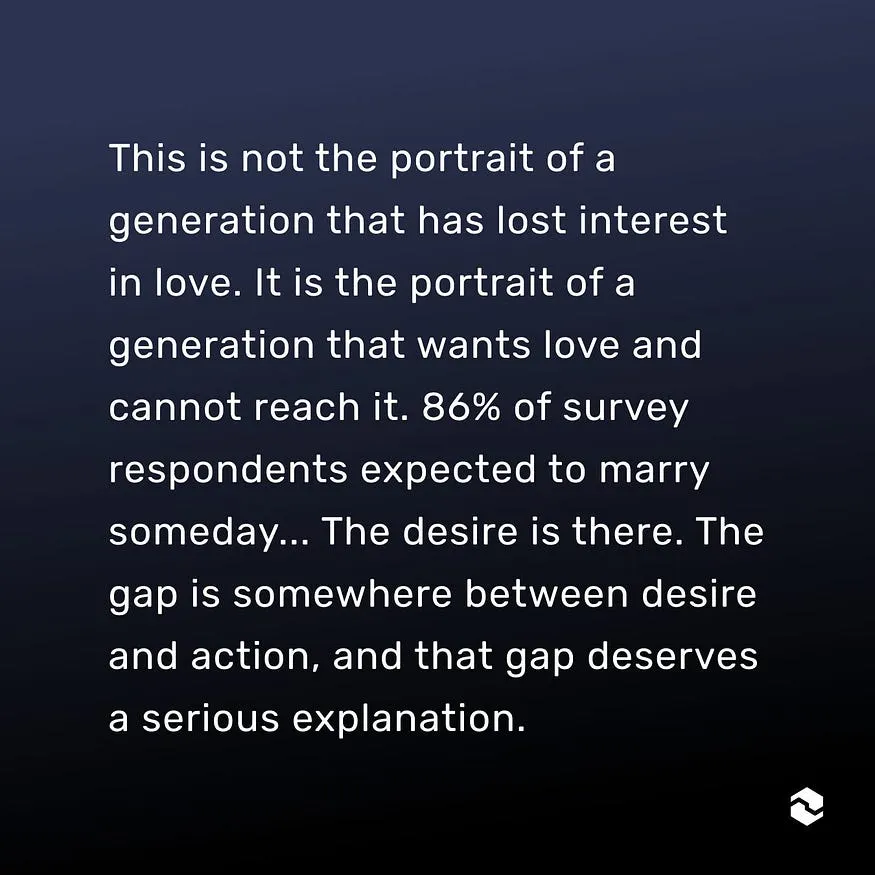
This is not the portrait of a generation that has lost interest in love. It is the portrait of a generation that wants love and cannot reach it. 86% of survey respondents expected to marry someday. 80% said they date to create emotional connection. 78% said their goal was to form serious relationships [1]. The desire is there. The gap is somewhere between desire and action, and that gap deserves a serious explanation.
The confidence gap: Why most young adults do not trust themselves to date
The 2025 National Dating Landscape Survey asked respondents to assess their own dating skills across seven domains. The results were striking in their consistency. Only 25% felt confident approaching someone they were romantically interested in. Only 34% felt comfortable discussing their feelings with a potential partner. Only 37% trusted their own judgment in choosing a dating partner. Only 28% could stay positive after a bad date or relationship setback [1].
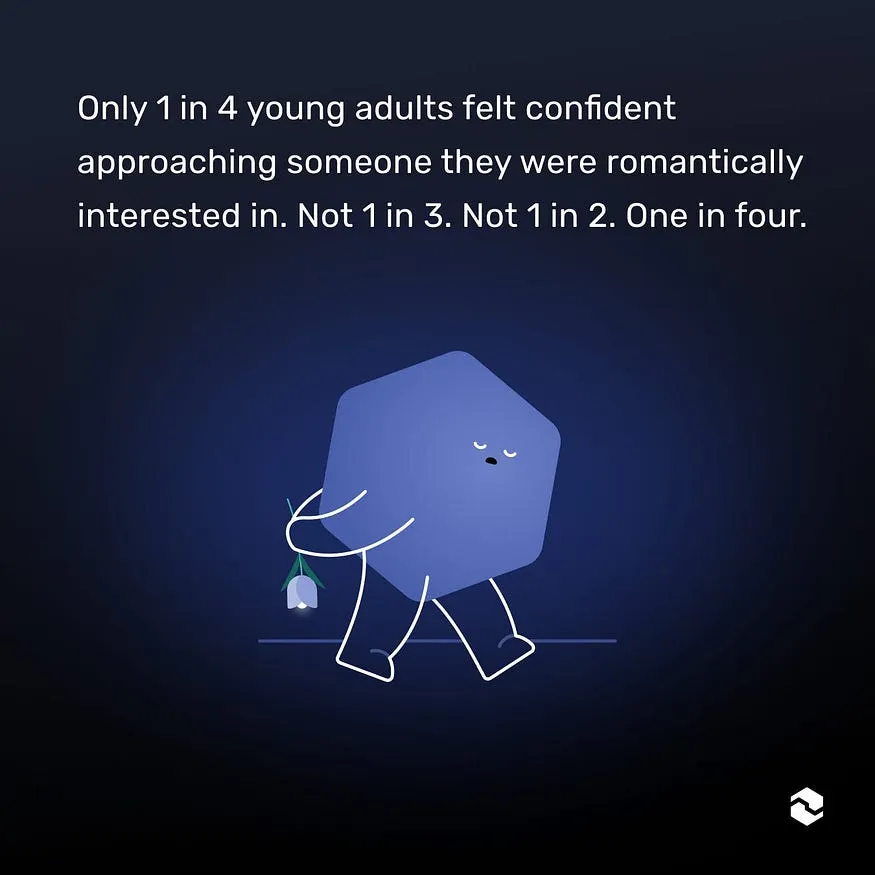
Only 1 in 4 young adults felt confident approaching someone they were romantically interested in. Not 1 in 3. Not 1 in 2. One in four. These numbers describe something the researchers call dating efficacy: a person’s belief in their own capacity to perform the behaviours that dating requires. The concept maps onto Albert Bandura’s broader framework of self-efficacy, which holds that perceived capability is a significant determinant of whether people attempt behaviours at all [5]. When efficacy is low, people avoid situations where failure feels likely, not because they do not want the outcome, but because they do not believe they can produce it.
What generates this low efficacy? The survey points toward accumulated bad experiences. Nearly half of respondents (48%) cited bad dating experiences in the past as a barrier to current dating. More than half (55%) agreed that their breakups had made them more reluctant to begin new romantic relationships. Nearly half (45%) had passed up opportunities for new romantic relationships because of bad experiences from previous ones [1].
The neural basis of this pattern connects to what researchers describe as fear conditioning. The amygdala forms associations between contexts or cues and aversive outcomes, and these associations can generalise to similar future contexts [4]. A painful breakup encodes a prediction: that romantic investment leads to harm. The brain then applies that prediction forward, making the initiation of new relationships feel not just uncertain but dangerous.
Culturally, this dynamic intersects with a broader crisis of social confidence in this generation. The Surgeon General of the United States identified a loneliness epidemic in 2023, noting that Americans had experienced significant declines in social connection across multiple dimensions over the preceding two decades [6]. This is the backdrop against which young adults are trying to date: a society where the basic social muscles required for dating, approaching strangers, tolerating vulnerability, reading ambiguous social cues, have been weakening for years. The survey’s finding that 39% of respondents found the social component of dating challenging should be read in this context [1]. Dating is hard partly because sustained social interaction itself has become harder.
The price of a date: Financial barriers and the commodification of romance
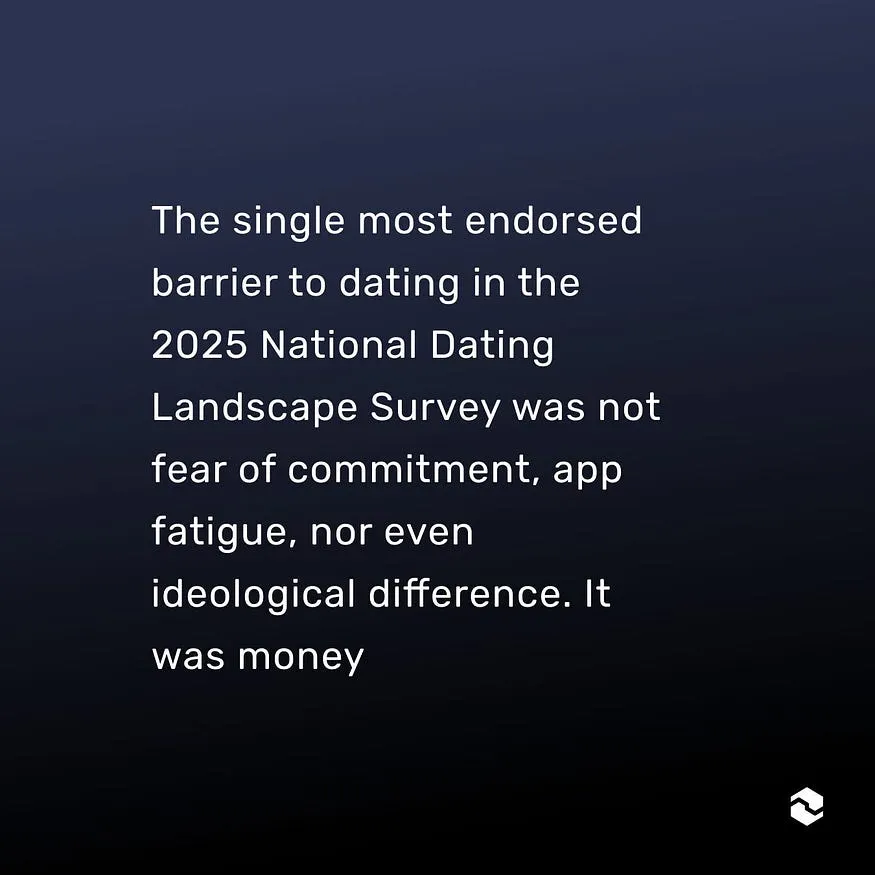
The single most endorsed barrier to dating in the 2025 National Dating Landscape Survey was not fear of commitment, app fatigue, nor even ideological difference. It was money. Fifty-two percent of respondents said they did not have enough money for dating activities. Among men, this rose to 58%. Among women, this number was 47% [1].
The normative understanding of a date in contemporary American culture involves commercial venues: restaurants, bars, concerts, paid experiences. Research in cultural sociology has examined how market logics have increasingly colonised intimate life, transforming courtship from a social practice into a form of consumption [7]. When the cost of initiating a relationship is defined by participation in commercial culture, people without disposable income are structurally excluded from the dating market.
There is a direct observation here: contemporary dating is focused on commercial activities, and young adults feel they cannot afford to date in this way [1]. This is not simply about being unable to afford an expensive dinner. It is about the psychological weight of cost asymmetry in a cultural context where offering a cheap date reads as low effort, low interest, or low value.
Neuroscience offers a complementary angle. The brain’s reward system is sensitive not just to outcomes but to expectations. When the expected standard of a date is expensive and a person cannot meet that standard, anticipatory anxiety activates stress circuitry before the date has even been attempted. Research on social evaluation and status threat has shown that situations in which people expect to be judged negatively activate regions associated with social pain, including the anterior cingulate cortex [3]. Financial inability in a commercial dating culture is not merely a practical constraint. It is a source of anticipated social shame.
There is also a gendered dimension that deserves attention. The survey could not determine whether women reporting financial barriers were reflecting concern about their own costs or whether expectations of cost-bearing had shifted [1]. But research in gender and consumer culture has documented persistent asymmetries in who bears dating costs and how those asymmetries are perceived [8]. The financial barrier to dating is real and measurable.The horizon that keeps moving: Temporal disconnection and the paralysis of indefinite delay
One of the most quietly alarming findings in the 2025 National Dating Landscape Survey is one that is easy to overlook in the headline statistics. Regardless of a respondent’s current age, their expected age of marriage remained approximately five to six years in the future. For a 23-year-old, the expected marriage age was around 28 or 29. For a 32-year-old, it was around 36 or 37.It’s a horizon sliding forward [1].
This temporal structure has consequences for dating motivation that go beyond mere delay. If marriage is perpetually five years away, dating is perpetually preparatory. It is practice, not pursuit. The urgency that might otherwise motivate active partner-seeking is diffused into an indefinite future. The report describes this as a temporal disconnection between dating and marriage expectations, with young adults’ romantic lives only abstractly associated with the idea of marriage [1].
The psychological literature on temporal discounting is relevant here. Research has consistently shown that humans weigh near-term costs more heavily than near-term rewards when the long-term goal is perceived as distant [9]. The immediate costs of dating, emotional exposure, financial outlay and the possibility of rejection are vivid and concrete. The long-term reward, a stable partnership, is five to six years away by the respondents’ own estimation. The brain’s intertemporal calculus is not well-designed for this particular structure of incentives.
The finding that marital salience does not differ significantly by age is also worth examining. A 33-year-old in this survey placed roughly the same importance on marriage as a 24-year-old, yet the 33-year-old’s expected marriage age was nearly four years later [1]. This suggests that the abstract desire for marriage does not reliably intensify into active pursuit with age, at least not within this demographic and survey window. Wanting marriage and actively working toward it through dating are, for many young adults, operating on entirely separate tracks.
Sociologically, this pattern reflects what scholars of emerging adulthood have described as the elongation of the transition to adulthood, a stretching of the period between leaving education and achieving the markers of settled adult life, including partnership, parenthood and financial stability [10]. This elongation is not evenly distributed. It is most pronounced for those navigating economic precarity, rising housing costs and labour market uncertainty, all of which are structural conditions, not individual character failures. When the 2026 State of Our Unions report notes that first-marriage rates have fallen by more than 10% over the past two decades and that a third of young adults born in the early 21st century will never marry, these numbers are not random. They are the arithmetic of a generation caught between strong desires and structural impossibility [1].
Platform logic, gender scripts and the architecture of avoidance
Dating applications have restructured the experience of romantic search in ways that research in media studies and digital culture has been documenting for over a decade. The swipe-based interface commodifies potential partners into evaluable units, creating what sociologist Illouz has described as a market logic of romantic choice that transforms intimacy into consumption [7]. The survey respondents in the 2025 National Dating Landscape Survey reflected this directly: only 21% reported satisfaction with their dating options, and 39% reported active dissatisfaction [1]. The report’s authors note that the repetitive cycle of matching, messaging and meeting that ends in disappointment leads to significant dating fatigue and cynicism about the whole process.
Gender dynamics layer onto this in specific ways. The survey found that men were significantly more likely to report being interested in starting a relationship (60% of men versus 47% of women) and women were more likely to be exclusively dating (29% of women versus 13% of men) [1]. These asymmetries reflect cultural scripts about who initiates, who bears the emotional and financial costs and whose romantic preferences are treated as the standard to be met. Research in gender studies has documented how heterosexual dating norms continue to place disproportionate initiation and financial burden on men while placing disproportionate gatekeeping and evaluative pressure on women, often without either party having consciously chosen those roles [8].
The ideological divide between young men and women also appears to be widening in ways that affect the dating pool. The 2026 report acknowledges the growing political and ideological gap between young men and women as a potential factor in dating landscape difficulties, citing survey research from the American Enterprise Institute [1]. When prospective partners hold substantially different worldviews, the population of perceived compatible partners shrinks, and with it, the motivation to enter a dating market that feels misaligned.
The survey’s finding that young adults strongly endorse the traditional purposes of dating, such as emotional connection, forming serious relationships and personal growth, over casual or socially performative ones [1], is a useful corrective to a common cultural narrative. The problem is not that young adults do not want relationships. It is that they lack the skills, the resilience, and often the financial and structural conditions to pursue them.

The report identifies a specific gap between marital expectations and dating skills, and calls for what they term dating education: structured, skills-focused support for the practical and emotional challenges of initiating and sustaining early romantic relationships [1]. Research in social learning suggests that efficacy beliefs are built through mastery experiences and that structured practice with appropriate support can shift them [5]. This is not a call for a dating class in the way a driving lesson is a driving class. It is a call for support that addresses real skill deficits: how to initiate, how to communicate under emotional vulnerability and how to absorb rejection without generalising it into avoidance.
The report also notes that the gender differences in dating barriers are minimal, which has practical implications for how education and support are designed [1]. There is no need to assume men and women need fundamentally different interventions. The underlying deficits in confidence, resilience and emotional skill are broadly shared. What differs is how those deficits are expressed and which cultural pressures amplify them.
Perhaps, most usefully, understanding that the financial barrier is real and structural, and not a rationalisation, points toward interventions at the level of dating culture itself. The report suggests redefining what constitutes an acceptable date, away from commercial activities and toward simpler, lower-cost encounters focused on conversation and connection and notes that social media influencers may be better positioned than educators to shift that cultural norm [1].
Somewhere in the gap between wanting love and pursuing it, a generation is waiting. The 2025 National Dating Landscape Survey makes it clear that this waiting is not indifference. Nearly half of young adults in the survey said they would like to be married now [1]. Nearly everyone said they wanted emotional connection.
Dating in the shadow of the family: The Indian context
The dating recession is not only an American story. In urban India, a version of the same phenomenon is playing out with a different set of pressures layered on top of the universal ones. The language is different. The parental involvement is more explicit. The stakes of being seen to date, before being formally ready to marry, carry a social weight that has no direct equivalent in the American context. But the underlying structure, of wanting connection yet lacking the skills and conditions to pursue it, is recognisable.
India’s dating app market is one of the fastest-growing in the world, with platforms like Bumble, Hinge and homegrown apps like TrulyMadly and Aisle reporting significant user growth among urban millennials and Gen Z. Yet download numbers and active romantic pursuit are not the same thing. Research published in the journal Culture, Health and Sexuality examining young adults in urban India found that the negotiation between individual romantic desire and family expectation created significant emotional conflict, with many young people managing a double life in which dating existed in private while public behaviour conformed to family and community norms [15].
Feminism in India has documented how this split lands differently on women. Writing on family surveillance and intimate life, the platform has reported how phone monitoring, curfews and constant interrogation make dating a context of fear rather than choice and how, for many women, the question is not whether they want to love, but whether they are permitted to [17]. Young Indian women navigating dating face social reputation management in communities where female sexuality is monitored more closely than male sexuality; they also experience a persistent pressure to treat every relationship as a potential marriage prospect, because casual dating is culturally framed as wasting time that should be spent finding a suitable match. This is the Indian version of the marital horizon problem. Where American young adults experience a sliding timeline that keeps marriage abstract, young Indian women often experience the opposite pressure: a hard deadline imposed from outside, usually by family, that makes dating feel not too far away but dangerously close to a high-stakes evaluation.
The arranged marriage system, even in its modernised form, complicates this further. Semi-arranged marriages, in which families initiate introductions but young people retain some veto power, now exist alongside app-based dating and love marriages in most Indian cities. When analyzing dating vs arranged marriage in urban India, research published in Contributions to Indian Sociology found that this coexistence created profound ambiguity about what dating was actually for: was it personal exploration or was it an informal extension of the marriage market [16]? Young people who could not answer that question clearly often found themselves paralysed in the same way the American survey respondents were, not because they lacked desire, but because the purpose of acting on that desire was unclear.
The confidence deficit documented in the 2025 National Dating Landscape Survey has a specific texture in the Indian context. The survey found that only 25% of American young adults felt confident approaching someone they were romantically interested in [1]. In India, the barrier is not only internal. It is also social architecture. Fatima and Patra, writing in Feminism in India, have argued that the institutions of caste and patriarchy are so pervasive they invade the design of dating apps themselves and that the platforms have produced a new culturally desirable female role characterised by independence and sexual freedom, but one that ultimately avoids challenging male hegemony rather than dismantling it [18]. The result is that patriarchal courtship scripts persist online: male dominance continues to dictate who initiates, and women who attempt to initiate face penalties that men do not [19]. Every interaction carries the weight of potential romantic evaluation before anyone has learned to simply be comfortable in the room.
The financial barrier documented in the American survey also operates in India, but with a different distribution. The aspirational culture of urban dating, coffee shops, restaurants, the kind of dating content that circulates on Instagram and YouTube, is shaped by consumption patterns accessible to a small fraction of young Indians. For the majority navigating urban living on modest incomes, the commodification of romance is a barrier that is both real and rarely named. The cultural expectation that a man should pay, a norm that persists in urban India even among otherwise progressive young people, places particular financial pressure on young men who want to date but cannot afford the version of dating that is culturally legible as effort.
What the Indian context adds to the larger picture is a reminder that the dating recession is not simply a product of app fatigue or millennial psychology. It is produced by the intersection of individual nervous systems with specific social structures, and those structures vary. The neural costs of anticipated rejection, the difficulty of building romantic confidence without safe spaces to practice, the way financial constraints map onto social shame: these are universal mechanisms. But the cultural architecture that supports them is particular to each context. In India, that architecture includes family surveillance, caste and community endogamy expectations, the residue of a socialisation system that kept young men and women apart and a media culture that simultaneously glamorises romantic love and treats female desire as suspect [17,18,19].
Conclusion

What neuroscience tells us is that the brain remembers pain more vividly than it anticipates reward and that after enough painful experiences, avoidance begins to feel like self-preservation. What psychology tells us is that low efficacy is self-reinforcing: you avoid what you do not believe you can do, and avoidance prevents the experiences that would build belief. What sociology tells us is that the structural conditions of digital dating culture, its commercial logic, its asymmetric gender scripts and its platform incentives are not neutral. They are actively difficult and they are hardest on people who are already financially and emotionally stretched.
The dating recession is not a mystery. It is a predictable outcome of a specific set of conditions, neural, psychological and structural, converging on a generation that is largely trying to manage them alone. The question the 2026 State of Our Unions report poses, and does not fully answer, is whether any of those conditions can be changed. The answer probably depends on which ones we are willing to name.
References:
[1] Hawkins AJ, Willoughby BJ, Carroll JS, Wilcox WB. The dating recession: How bad is it and what can we do? A view from the 2025 National Dating Landscape Survey. State of Our Unions: 2026. Wheatley Institute & Institute for Family Studies; 2026.
[2] Aron A, Fisher H, Mashek DJ, Strong G, Li H, Brown LL. Reward, motivation, and emotion systems associated with early-stage intense romantic love. J Neurophysiol. 2005;94(1):327-37.
[3] Eisenberger NI, Lieberman MD, Williams KD. Does rejection hurt? An fMRI study of social exclusion. Science. 2003;302(5643):290-2.
[4] Phelps EA. Human emotion and memory: Interactions of the amygdala and hippocampal complex. Curr Opin Neurobiol. 2004;14(2):198-202.
[5] Bandura A. Self-efficacy: Toward a unifying theory of behavioral change. Psychol Rev. 1977;84(2):191-215.
[6] U.S. Surgeon General’s Advisory. Our epidemic of loneliness and isolation. Office of the Surgeon General; 2023.
[7] Illouz E. Cold intimacies: The making of emotional capitalism. Polity Press; 2007.
[8] England P, McClintock E. The gendered double standard of aging in US marriage markets. Popul Dev Rev. 2009;35(4):797-816.
[9] Loewenstein G, Prelec D. Anomalies in intertemporal choice: Evidence and an interpretation. Q J Econ. 1992;107(2):573-97.
[10] Arnett JJ. Emerging adulthood: The winding road from the late teens through the twenties. Oxford University Press; 2004.
[11] Willoughby BJ, Carroll JS, Dover C, Hakala RH. Counterfeit connections: The rise of romantic AI companions and sexualized media among the rising generation. The Wheatley Institute; 2025.
[12] Stone L. 1-in-3: A record share of young adults will never marry. Institute for Family Studies; 2024.
[13] Cacioppo JT, Hawkley LC. Perceived social isolation and cognition. Trends Cogn Sci. 2009;13(10):447-54.
[14] Kearney MS. The two-parent privilege: How Americans stopped getting married and started falling behind. University of Chicago Press; 2023.
[15] Grover S. Lived experiences and perceptions of the ‘new’ in relationships and its institutions among young people in urban India. Culture Health Sex. 2011;13(5):517-30.
[16] Banerjee A, Duflo E, Ghatak M, Lafortune J. Marry for what? Caste and mate selection in modern India. Am Econ J Microecon. 2013;5(2):33-72.
[17] Dating Under Watch: How Family Support Shapes Queer Women’s Intimate Lives. Feminism in India. 9 January 2026. https://feminisminindia.com/2026/01/09/dating-under-watch-how-family-support-shapes-queer-womens-intimate-lives/
[18] Fatima T, Patra P. Online Dating In India: Radicalisation Or Reinforcement Of Existing Societal Norms. Feminism in India. 12 May 2023. https://feminisminindia.com/2023/05/12/online-dating-in-india-radicalisation-reinforcement-societal-norms/
[19] Aryal S. Gendered Landscape Of Love: Online Dating, Gender Roles And Expectations. Feminism in India. 16 February 2024. https://feminisminindia.com/2024/02/16/gendered-landscape-of-love-online-dating-gender-roles-and-expectations/
The dating recession: Why 70% of young adults have stopped trying
When Zohran Mamdani won the New York City mayoral race in November 2025, one detail from his campaign trail went quietly viral. He met his wife, Syrian–American artist Rama Duwaji, on Hinge in 2021. "There is still hope in those dating apps," Mamdani told a podcast during his campaign. The internet loved it. The story had everything: romance, proof of concept, a happy ending on the subway in the rain. Gen Z took the story and ran with it. Here, finally, was the case for the apps, not a cautionary tale about ghosting or algorithm fatigue, but a genuine love story, a mayor and his wife, found through a screen. If it worked for him, the implicit logic went, the system works.
The data says something else entirely. The 2026 State of Our Unions report, produced by the Wheatley Institute at Brigham Young University and the Institute for Family Studies, offers the most detailed portrait yet of this phenomenon. Drawing on the 2025 National Dating Landscape Survey, a nationally representative sample of 5,275 unmarried Americans aged 22 to 35, the report finds that only 31% of young adults are active daters, meaning they date at least once a month. Nearly three-quarters of women (74%) and nearly two-thirds of men (64%) reported they had not dated at all or only a few times in the last year [1].
This is not the portrait of a generation that has lost interest in love. It is the portrait of a generation that wants love and cannot reach it. 86% of survey respondents expected to marry someday. 80% said they date to create emotional connection. 78% said their goal was to form serious relationships [1]. The desire is there. The gap is somewhere between desire and action, and that gap deserves a serious explanation.
The confidence gap: Why most young adults do not trust themselves to date
The 2025 National Dating Landscape Survey asked respondents to assess their own dating skills across seven domains. The results were striking in their consistency. Only 25% felt confident approaching someone they were romantically interested in. Only 34% felt comfortable discussing their feelings with a potential partner. Only 37% trusted their own judgment in choosing a dating partner. Only 28% could stay positive after a bad date or relationship setback [1].
Only 1 in 4 young adults felt confident approaching someone they were romantically interested in. Not 1 in 3. Not 1 in 2. One in four. These numbers describe something the researchers call dating efficacy: a person’s belief in their own capacity to perform the behaviours that dating requires. The concept maps onto Albert Bandura’s broader framework of self-efficacy, which holds that perceived capability is a significant determinant of whether people attempt behaviours at all [5]. When efficacy is low, people avoid situations where failure feels likely, not because they do not want the outcome, but because they do not believe they can produce it.
What generates this low efficacy? The survey points toward accumulated bad experiences. Nearly half of respondents (48%) cited bad dating experiences in the past as a barrier to current dating. More than half (55%) agreed that their breakups had made them more reluctant to begin new romantic relationships. Nearly half (45%) had passed up opportunities for new romantic relationships because of bad experiences from previous ones [1].
The neural basis of this pattern connects to what researchers describe as fear conditioning. The amygdala forms associations between contexts or cues and aversive outcomes, and these associations can generalise to similar future contexts [4]. A painful breakup encodes a prediction: that romantic investment leads to harm. The brain then applies that prediction forward, making the initiation of new relationships feel not just uncertain but dangerous.
Culturally, this dynamic intersects with a broader crisis of social confidence in this generation. The Surgeon General of the United States identified a loneliness epidemic in 2023, noting that Americans had experienced significant declines in social connection across multiple dimensions over the preceding two decades [6]. This is the backdrop against which young adults are trying to date: a society where the basic social muscles required for dating, approaching strangers, tolerating vulnerability, reading ambiguous social cues, have been weakening for years. The survey’s finding that 39% of respondents found the social component of dating challenging should be read in this context [1]. Dating is hard partly because sustained social interaction itself has become harder.
The price of a date: Financial barriers and the commodification of romance
The single most endorsed barrier to dating in the 2025 National Dating Landscape Survey was not fear of commitment, app fatigue, nor even ideological difference. It was money. Fifty-two percent of respondents said they did not have enough money for dating activities. Among men, this rose to 58%. Among women, this number was 47% [1].
The normative understanding of a date in contemporary American culture involves commercial venues: restaurants, bars, concerts, paid experiences. Research in cultural sociology has examined how market logics have increasingly colonised intimate life, transforming courtship from a social practice into a form of consumption [7]. When the cost of initiating a relationship is defined by participation in commercial culture, people without disposable income are structurally excluded from the dating market.
There is a direct observation here: contemporary dating is focused on commercial activities, and young adults feel they cannot afford to date in this way [1]. This is not simply about being unable to afford an expensive dinner. It is about the psychological weight of cost asymmetry in a cultural context where offering a cheap date reads as low effort, low interest, or low value.
Neuroscience offers a complementary angle. The brain’s reward system is sensitive not just to outcomes but to expectations. When the expected standard of a date is expensive and a person cannot meet that standard, anticipatory anxiety activates stress circuitry before the date has even been attempted. Research on social evaluation and status threat has shown that situations in which people expect to be judged negatively activate regions associated with social pain, including the anterior cingulate cortex [3]. Financial inability in a commercial dating culture is not merely a practical constraint. It is a source of anticipated social shame.
There is also a gendered dimension that deserves attention. The survey could not determine whether women reporting financial barriers were reflecting concern about their own costs or whether expectations of cost-bearing had shifted [1]. But research in gender and consumer culture has documented persistent asymmetries in who bears dating costs and how those asymmetries are perceived [8]. The financial barrier to dating is real and measurable.The horizon that keeps moving: Temporal disconnection and the paralysis of indefinite delay
One of the most quietly alarming findings in the 2025 National Dating Landscape Survey is one that is easy to overlook in the headline statistics. Regardless of a respondent’s current age, their expected age of marriage remained approximately five to six years in the future. For a 23-year-old, the expected marriage age was around 28 or 29. For a 32-year-old, it was around 36 or 37.It’s a horizon sliding forward [1].
This temporal structure has consequences for dating motivation that go beyond mere delay. If marriage is perpetually five years away, dating is perpetually preparatory. It is practice, not pursuit. The urgency that might otherwise motivate active partner-seeking is diffused into an indefinite future. The report describes this as a temporal disconnection between dating and marriage expectations, with young adults’ romantic lives only abstractly associated with the idea of marriage [1].
The psychological literature on temporal discounting is relevant here. Research has consistently shown that humans weigh near-term costs more heavily than near-term rewards when the long-term goal is perceived as distant [9]. The immediate costs of dating, emotional exposure, financial outlay and the possibility of rejection are vivid and concrete. The long-term reward, a stable partnership, is five to six years away by the respondents’ own estimation. The brain’s intertemporal calculus is not well-designed for this particular structure of incentives.
The finding that marital salience does not differ significantly by age is also worth examining. A 33-year-old in this survey placed roughly the same importance on marriage as a 24-year-old, yet the 33-year-old’s expected marriage age was nearly four years later [1]. This suggests that the abstract desire for marriage does not reliably intensify into active pursuit with age, at least not within this demographic and survey window. Wanting marriage and actively working toward it through dating are, for many young adults, operating on entirely separate tracks.
Sociologically, this pattern reflects what scholars of emerging adulthood have described as the elongation of the transition to adulthood, a stretching of the period between leaving education and achieving the markers of settled adult life, including partnership, parenthood and financial stability [10]. This elongation is not evenly distributed. It is most pronounced for those navigating economic precarity, rising housing costs and labour market uncertainty, all of which are structural conditions, not individual character failures. When the 2026 State of Our Unions report notes that first-marriage rates have fallen by more than 10% over the past two decades and that a third of young adults born in the early 21st century will never marry, these numbers are not random. They are the arithmetic of a generation caught between strong desires and structural impossibility [1].
Platform logic, gender scripts and the architecture of avoidance
Dating applications have restructured the experience of romantic search in ways that research in media studies and digital culture has been documenting for over a decade. The swipe-based interface commodifies potential partners into evaluable units, creating what sociologist Illouz has described as a market logic of romantic choice that transforms intimacy into consumption [7]. The survey respondents in the 2025 National Dating Landscape Survey reflected this directly: only 21% reported satisfaction with their dating options, and 39% reported active dissatisfaction [1]. The report’s authors note that the repetitive cycle of matching, messaging and meeting that ends in disappointment leads to significant dating fatigue and cynicism about the whole process.
Gender dynamics layer onto this in specific ways. The survey found that men were significantly more likely to report being interested in starting a relationship (60% of men versus 47% of women) and women were more likely to be exclusively dating (29% of women versus 13% of men) [1]. These asymmetries reflect cultural scripts about who initiates, who bears the emotional and financial costs and whose romantic preferences are treated as the standard to be met. Research in gender studies has documented how heterosexual dating norms continue to place disproportionate initiation and financial burden on men while placing disproportionate gatekeeping and evaluative pressure on women, often without either party having consciously chosen those roles [8].
The ideological divide between young men and women also appears to be widening in ways that affect the dating pool. The 2026 report acknowledges the growing political and ideological gap between young men and women as a potential factor in dating landscape difficulties, citing survey research from the American Enterprise Institute [1]. When prospective partners hold substantially different worldviews, the population of perceived compatible partners shrinks, and with it, the motivation to enter a dating market that feels misaligned.
The survey’s finding that young adults strongly endorse the traditional purposes of dating, such as emotional connection, forming serious relationships and personal growth, over casual or socially performative ones [1], is a useful corrective to a common cultural narrative. The problem is not that young adults do not want relationships. It is that they lack the skills, the resilience, and often the financial and structural conditions to pursue them.
The report identifies a specific gap between marital expectations and dating skills, and calls for what they term dating education: structured, skills-focused support for the practical and emotional challenges of initiating and sustaining early romantic relationships [1]. Research in social learning suggests that efficacy beliefs are built through mastery experiences and that structured practice with appropriate support can shift them [5]. This is not a call for a dating class in the way a driving lesson is a driving class. It is a call for support that addresses real skill deficits: how to initiate, how to communicate under emotional vulnerability and how to absorb rejection without generalising it into avoidance.
The report also notes that the gender differences in dating barriers are minimal, which has practical implications for how education and support are designed [1]. There is no need to assume men and women need fundamentally different interventions. The underlying deficits in confidence, resilience and emotional skill are broadly shared. What differs is how those deficits are expressed and which cultural pressures amplify them.
Perhaps, most usefully, understanding that the financial barrier is real and structural, and not a rationalisation, points toward interventions at the level of dating culture itself. The report suggests redefining what constitutes an acceptable date, away from commercial activities and toward simpler, lower-cost encounters focused on conversation and connection and notes that social media influencers may be better positioned than educators to shift that cultural norm [1].
Somewhere in the gap between wanting love and pursuing it, a generation is waiting. The 2025 National Dating Landscape Survey makes it clear that this waiting is not indifference. Nearly half of young adults in the survey said they would like to be married now [1]. Nearly everyone said they wanted emotional connection.
Dating in the shadow of the family: The Indian context
The dating recession is not only an American story. In urban India, a version of the same phenomenon is playing out with a different set of pressures layered on top of the universal ones. The language is different. The parental involvement is more explicit. The stakes of being seen to date, before being formally ready to marry, carry a social weight that has no direct equivalent in the American context. But the underlying structure, of wanting connection yet lacking the skills and conditions to pursue it, is recognisable.
India’s dating app market is one of the fastest-growing in the world, with platforms like Bumble, Hinge and homegrown apps like TrulyMadly and Aisle reporting significant user growth among urban millennials and Gen Z. Yet download numbers and active romantic pursuit are not the same thing. Research published in the journal Culture, Health and Sexuality examining young adults in urban India found that the negotiation between individual romantic desire and family expectation created significant emotional conflict, with many young people managing a double life in which dating existed in private while public behaviour conformed to family and community norms [15].
Feminism in India has documented how this split lands differently on women. Writing on family surveillance and intimate life, the platform has reported how phone monitoring, curfews and constant interrogation make dating a context of fear rather than choice and how, for many women, the question is not whether they want to love, but whether they are permitted to [17]. Young Indian women navigating dating face social reputation management in communities where female sexuality is monitored more closely than male sexuality; they also experience a persistent pressure to treat every relationship as a potential marriage prospect, because casual dating is culturally framed as wasting time that should be spent finding a suitable match. This is the Indian version of the marital horizon problem. Where American young adults experience a sliding timeline that keeps marriage abstract, young Indian women often experience the opposite pressure: a hard deadline imposed from outside, usually by family, that makes dating feel not too far away but dangerously close to a high-stakes evaluation.
The arranged marriage system, even in its modernised form, complicates this further. Semi-arranged marriages, in which families initiate introductions but young people retain some veto power, now exist alongside app-based dating and love marriages in most Indian cities. When analyzing dating vs arranged marriage in urban India, research published in Contributions to Indian Sociology found that this coexistence created profound ambiguity about what dating was actually for: was it personal exploration or was it an informal extension of the marriage market [16]? Young people who could not answer that question clearly often found themselves paralysed in the same way the American survey respondents were, not because they lacked desire, but because the purpose of acting on that desire was unclear.
The confidence deficit documented in the 2025 National Dating Landscape Survey has a specific texture in the Indian context. The survey found that only 25% of American young adults felt confident approaching someone they were romantically interested in [1]. In India, the barrier is not only internal. It is also social architecture. Fatima and Patra, writing in Feminism in India, have argued that the institutions of caste and patriarchy are so pervasive they invade the design of dating apps themselves and that the platforms have produced a new culturally desirable female role characterised by independence and sexual freedom, but one that ultimately avoids challenging male hegemony rather than dismantling it [18]. The result is that patriarchal courtship scripts persist online: male dominance continues to dictate who initiates, and women who attempt to initiate face penalties that men do not [19]. Every interaction carries the weight of potential romantic evaluation before anyone has learned to simply be comfortable in the room.
The financial barrier documented in the American survey also operates in India, but with a different distribution. The aspirational culture of urban dating, coffee shops, restaurants, the kind of dating content that circulates on Instagram and YouTube, is shaped by consumption patterns accessible to a small fraction of young Indians. For the majority navigating urban living on modest incomes, the commodification of romance is a barrier that is both real and rarely named. The cultural expectation that a man should pay, a norm that persists in urban India even among otherwise progressive young people, places particular financial pressure on young men who want to date but cannot afford the version of dating that is culturally legible as effort.
What the Indian context adds to the larger picture is a reminder that the dating recession is not simply a product of app fatigue or millennial psychology. It is produced by the intersection of individual nervous systems with specific social structures, and those structures vary. The neural costs of anticipated rejection, the difficulty of building romantic confidence without safe spaces to practice, the way financial constraints map onto social shame: these are universal mechanisms. But the cultural architecture that supports them is particular to each context. In India, that architecture includes family surveillance, caste and community endogamy expectations, the residue of a socialisation system that kept young men and women apart and a media culture that simultaneously glamorises romantic love and treats female desire as suspect [17,18,19].
Conclusion
What neuroscience tells us is that the brain remembers pain more vividly than it anticipates reward and that after enough painful experiences, avoidance begins to feel like self-preservation. What psychology tells us is that low efficacy is self-reinforcing: you avoid what you do not believe you can do, and avoidance prevents the experiences that would build belief. What sociology tells us is that the structural conditions of digital dating culture, its commercial logic, its asymmetric gender scripts and its platform incentives are not neutral. They are actively difficult and they are hardest on people who are already financially and emotionally stretched.
The dating recession is not a mystery. It is a predictable outcome of a specific set of conditions, neural, psychological and structural, converging on a generation that is largely trying to manage them alone. The question the 2026 State of Our Unions report poses, and does not fully answer, is whether any of those conditions can be changed. The answer probably depends on which ones we are willing to name.
References:
[1] Hawkins AJ, Willoughby BJ, Carroll JS, Wilcox WB. The dating recession: How bad is it and what can we do? A view from the 2025 National Dating Landscape Survey. State of Our Unions: 2026. Wheatley Institute & Institute for Family Studies; 2026.
[2] Aron A, Fisher H, Mashek DJ, Strong G, Li H, Brown LL. Reward, motivation, and emotion systems associated with early-stage intense romantic love. J Neurophysiol. 2005;94(1):327-37.
[3] Eisenberger NI, Lieberman MD, Williams KD. Does rejection hurt? An fMRI study of social exclusion. Science. 2003;302(5643):290-2.
[4] Phelps EA. Human emotion and memory: Interactions of the amygdala and hippocampal complex. Curr Opin Neurobiol. 2004;14(2):198-202.
[5] Bandura A. Self-efficacy: Toward a unifying theory of behavioral change. Psychol Rev. 1977;84(2):191-215.
[6] U.S. Surgeon General’s Advisory. Our epidemic of loneliness and isolation. Office of the Surgeon General; 2023.
[7] Illouz E. Cold intimacies: The making of emotional capitalism. Polity Press; 2007.
[8] England P, McClintock E. The gendered double standard of aging in US marriage markets. Popul Dev Rev. 2009;35(4):797-816.
[9] Loewenstein G, Prelec D. Anomalies in intertemporal choice: Evidence and an interpretation. Q J Econ. 1992;107(2):573-97.
[10] Arnett JJ. Emerging adulthood: The winding road from the late teens through the twenties. Oxford University Press; 2004.
[11] Willoughby BJ, Carroll JS, Dover C, Hakala RH. Counterfeit connections: The rise of romantic AI companions and sexualized media among the rising generation. The Wheatley Institute; 2025.
[12] Stone L. 1-in-3: A record share of young adults will never marry. Institute for Family Studies; 2024.
[13] Cacioppo JT, Hawkley LC. Perceived social isolation and cognition. Trends Cogn Sci. 2009;13(10):447-54.
[14] Kearney MS. The two-parent privilege: How Americans stopped getting married and started falling behind. University of Chicago Press; 2023.
[15] Grover S. Lived experiences and perceptions of the ‘new’ in relationships and its institutions among young people in urban India. Culture Health Sex. 2011;13(5):517-30.
[16] Banerjee A, Duflo E, Ghatak M, Lafortune J. Marry for what? Caste and mate selection in modern India. Am Econ J Microecon. 2013;5(2):33-72.
[17] Dating Under Watch: How Family Support Shapes Queer Women’s Intimate Lives. Feminism in India. 9 January 2026. https://feminisminindia.com/2026/01/09/dating-under-watch-how-family-support-shapes-queer-womens-intimate-lives/
[18] Fatima T, Patra P. Online Dating In India: Radicalisation Or Reinforcement Of Existing Societal Norms. Feminism in India. 12 May 2023. https://feminisminindia.com/2023/05/12/online-dating-in-india-radicalisation-reinforcement-societal-norms/
[19] Aryal S. Gendered Landscape Of Love: Online Dating, Gender Roles And Expectations. Feminism in India. 16 February 2024. https://feminisminindia.com/2024/02/16/gendered-landscape-of-love-online-dating-gender-roles-and-expectations/

Your privacy matters most.
- We will never share your data with any third parties. Vlncy will always be an ad-free platform.
- We will use your anonymised data only to improve the platform, in our efforts to serve you better.
- We do not store/ own any of your content on our servers.
- Upon account deletion, we will purge all your personal data.
- We will never reveal your identity on the platform. Only you decide when, how and with whom your information is shared.


